
TLR3、RIG-I 和 MDA5 在呼吸道合胞病毒感染支气管上皮细胞中的协调作用。
Co-ordinated role of TLR3, RIG-I and MDA5 in the innate response to rhinovirus in bronchial epithelium.
机构信息
Department of Respiratory Medicine, National Heart & Lung Institute, Imperial College London, London, United Kingdom.
出版信息
PLoS Pathog. 2010 Nov 4;6(11):e1001178. doi: 10.1371/journal.ppat.1001178.
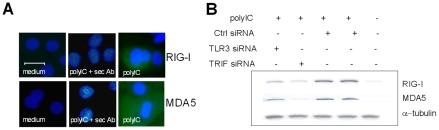
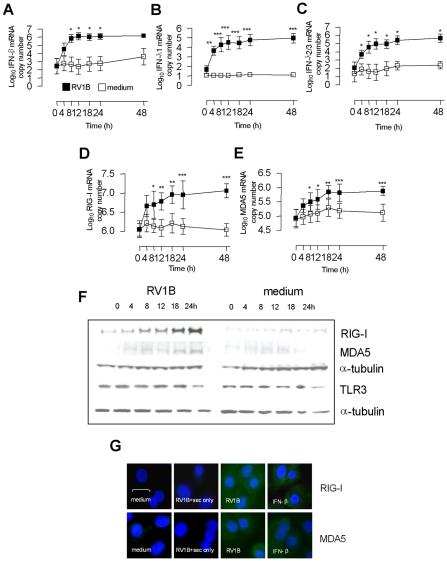
The relative roles of the endosomal TLR3/7/8 versus the intracellular RNA helicases RIG-I and MDA5 in viral infection is much debated. We investigated the roles of each pattern recognition receptor in rhinovirus infection using primary bronchial epithelial cells. TLR3 was constitutively expressed; however, RIG-I and MDA5 were inducible by 8-12 h following rhinovirus infection. Bronchial epithelial tissue from normal volunteers challenged with rhinovirus in vivo exhibited low levels of RIG-I and MDA5 that were increased at day 4 post infection. Inhibition of TLR3, RIG-I and MDA5 by siRNA reduced innate cytokine mRNA, and increased rhinovirus replication. Inhibition of TLR3 and TRIF using siRNA reduced rhinovirus induced RNA helicases. Furthermore, IFNAR1 deficient mice exhibited RIG-I and MDA5 induction early during RV1B infection in an interferon independent manner. Hence anti-viral defense within bronchial epithelium requires co-ordinated recognition of rhinovirus infection, initially via TLR3/TRIF and later via inducible RNA helicases.
内体 TLR3/7/8 与细胞内 RNA 解旋酶 RIG-I 和 MDA5 在病毒感染中的相对作用存在很大争议。我们使用原代支气管上皮细胞研究了每种模式识别受体在鼻病毒感染中的作用。TLR3 持续表达;然而,RIG-I 和 MDA5 在鼻病毒感染后 12 小时内可诱导。体内用鼻病毒攻击的正常志愿者的支气管上皮组织中,RIG-I 和 MDA5 的水平较低,在感染后第 4 天增加。siRNA 抑制 TLR3、RIG-I 和 MDA5 减少了先天细胞因子 mRNA,并增加了鼻病毒复制。siRNA 抑制 TLR3 和 TRIF 减少了鼻病毒诱导的 RNA 解旋酶。此外,IFNAR1 缺陷小鼠在 RV1B 感染早期以干扰素非依赖性方式诱导 RIG-I 和 MDA5。因此,支气管上皮细胞中的抗病毒防御需要协调识别鼻病毒感染,最初通过 TLR3/TRIF,然后通过诱导型 RNA 解旋酶。


 Zotero 插件