
全基因组关联研究血压极值发现与高血压相关的 UMOD 附近变体。
Genome-wide association study of blood pressure extremes identifies variant near UMOD associated with hypertension.
机构信息
Institute of Cardiovascular and Medical Sciences, College of Medical Veterinary and Life Sciences, University of Glasgow, Glasgow, United Kingdom.
出版信息
PLoS Genet. 2010 Oct 28;6(10):e1001177. doi: 10.1371/journal.pgen.1001177.
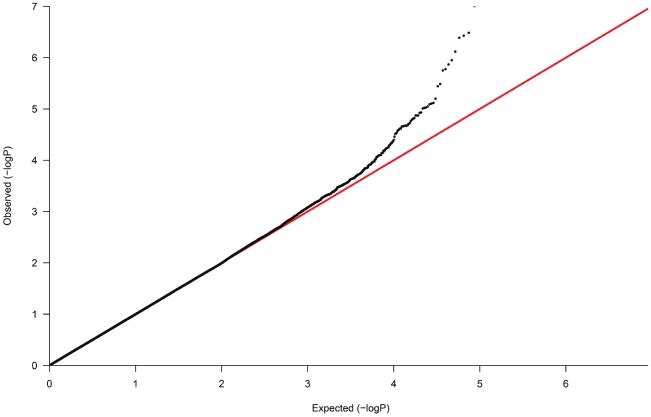
Hypertension is a heritable and major contributor to the global burden of disease. The sum of rare and common genetic variants robustly identified so far explain only 1%-2% of the population variation in BP and hypertension. This suggests the existence of more undiscovered common variants. We conducted a genome-wide association study in 1,621 hypertensive cases and 1,699 controls and follow-up validation analyses in 19,845 cases and 16,541 controls using an extreme case-control design. We identified a locus on chromosome 16 in the 5' region of Uromodulin (UMOD; rs13333226, combined P value of 3.6 × 10⁻¹¹). The minor G allele is associated with a lower risk of hypertension (OR [95%CI]: 0.87 [0.84-0.91]), reduced urinary uromodulin excretion, better renal function; and each copy of the G allele is associated with a 7.7% reduction in risk of CVD events after adjusting for age, sex, BMI, and smoking status (H.R. = 0.923, 95% CI 0.860-0.991; p = 0.027). In a subset of 13,446 individuals with estimated glomerular filtration rate (eGFR) measurements, we show that rs13333226 is independently associated with hypertension (unadjusted for eGFR: 0.89 [0.83-0.96], p = 0.004; after eGFR adjustment: 0.89 [0.83-0.96], p = 0.003). In clinical functional studies, we also consistently show the minor G allele is associated with lower urinary uromodulin excretion. The exclusive expression of uromodulin in the thick portion of the ascending limb of Henle suggests a putative role of this variant in hypertension through an effect on sodium homeostasis. The newly discovered UMOD locus for hypertension has the potential to give new insights into the role of uromodulin in BP regulation and to identify novel drugable targets for reducing cardiovascular risk.
高血压是一种遗传性疾病,也是全球疾病负担的主要原因之一。迄今为止,已鉴定出的罕见和常见遗传变异的总和只能解释血压和高血压人群变异的 1%-2%。这表明存在更多未被发现的常见变异。我们采用极端病例对照设计,在 1621 例高血压患者和 1699 例对照中进行了全基因组关联研究,并在 19845 例病例和 16541 例对照中进行了后续验证分析。我们在 Uromodulin(UMOD)的 5'区域发现了一个位于染色体 16 上的基因座(rs13333226,联合 P 值为 3.6×10⁻¹¹)。次要的 G 等位基因与较低的高血压风险相关(OR [95%CI]:0.87 [0.84-0.91]),尿 UMOD 排泄减少,肾功能更好;每一个 G 等位基因的存在与 CVD 事件风险降低 7.7%相关,校正年龄、性别、BMI 和吸烟状态后(HR=0.923,95%CI 0.860-0.991;p=0.027)。在有估计肾小球滤过率(eGFR)测量值的 13446 名个体的亚组中,我们表明 rs13333226 与高血压独立相关(未校正 eGFR:0.89 [0.83-0.96],p=0.004;校正 eGFR 后:0.89 [0.83-0.96],p=0.003)。在临床功能研究中,我们也一致表明,次要的 G 等位基因与较低的尿 UMOD 排泄有关。UMOD 仅在 Henle 升支粗段表达,这表明该变异可能通过影响钠稳态在高血压中发挥作用。新发现的高血压 UMOD 基因座有可能为 UMOD 在血压调节中的作用提供新的见解,并为降低心血管风险确定新的可药物治疗靶点。



 Zotero 插件