
线粒体抑制素在衰老过程中的相反作用。
Opposing function of mitochondrial prohibitin in aging.
作者信息
Artal-Sanz Marta, Tavernarakis Nektarios
机构信息
Laboratory for Bioinformatics and Molecular Genetics, Bio III, Albert-Ludwigs-University of Freiburg, D-79104 Freiburg, Germany.
出版信息
Aging (Albany NY). 2010 Dec;2(12):1004-11. doi: 10.18632/aging.100246.
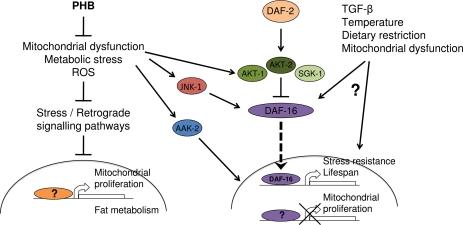
While specific signalling cascades involved in aging, such as the insulin/IGF-1 pathway, are well-described, the actual metabolic changes they elicit to prolong lifespan remain obscure. Nevertheless, the tuning of cellular metabolism towards maximal survival is the molecular basis of longevity. The eukaryotic mitochondrial prohibitin complex is a macromolecular structure at the inner mitochondrial membrane, implicated in several important cellular processes such as mitochondrial biogenesis and function, molecular signalling, replicative senescence, and cell death. Recent studies inC. elegans have revealed that prohibitin differentially influences aging by moderating fat metabolism and energy production, in response to both intrinsic signalling events and extrinsic cues. These findings indicate that prohibitin is a context-dependent modulator of longevity. The tight evolutionary conservation and ubiquitous expression of prohibitin proteins suggest a similar role for the mitochondrial prohibitin complex during aging in other organisms.
虽然参与衰老过程的特定信号级联反应,如胰岛素/胰岛素样生长因子-1(IGF-1)通路,已得到充分描述,但它们为延长寿命而引发的实际代谢变化仍不清楚。然而,将细胞代谢调节至最大生存能力是长寿的分子基础。真核生物线粒体抑制素复合体是线粒体内膜上的一种大分子结构,参与线粒体生物发生与功能、分子信号传导、复制性衰老和细胞死亡等多个重要细胞过程。秀丽隐杆线虫的最新研究表明,抑制素通过调节脂肪代谢和能量产生,对内在信号事件和外在线索作出反应,从而对衰老产生不同影响。这些发现表明,抑制素是一种依赖于环境的长寿调节因子。抑制素蛋白在进化上的高度保守性和广泛表达表明,线粒体抑制素复合体在其他生物体衰老过程中可能发挥类似作用。
 Zotero 插件