
去甲肾上腺素剂量和校准频率对脉搏轮廓心输出量测量准确性的影响。
Effect of norepinephrine dosage and calibration frequency on accuracy of pulse contour-derived cardiac output.
机构信息
Department of Anaesthesiology and Intensive Care Medicine, University Hospital Schleswig-Holstein, Campus Kiel, Schwanenweg 21, D-24105 Kiel, Germany.
出版信息
Crit Care. 2011;15(1):R22. doi: 10.1186/cc9967. Epub 2011 Jan 17.
INTRODUCTION
Continuous cardiac output monitoring is used for early detection of hemodynamic instability and guidance of therapy in critically ill patients. Recently, the accuracy of pulse contour-derived cardiac output (PCCO) has been questioned in different clinical situations. In this study, we examined agreement between PCCO and transcardiopulmonary thermodilution cardiac output (COTCP) in critically ill patients, with special emphasis on norepinephrine (NE) administration and the time interval between calibrations.
METHODS
This prospective, observational study was performed with a sample of 73 patients (mean age, 63 ± 13 years) requiring invasive hemodynamic monitoring on a non-cardiac surgery intensive care unit. PCCO was recorded immediately before calibration by COTCP. Bland-Altman analysis was performed on data subsets comparing agreement between PCCO and COTCP according to NE dosage and the time interval between calibrations up to 24 hours. Further, central artery stiffness was calculated on the basis of the pulse pressure to stroke volume relationship.
RESULTS
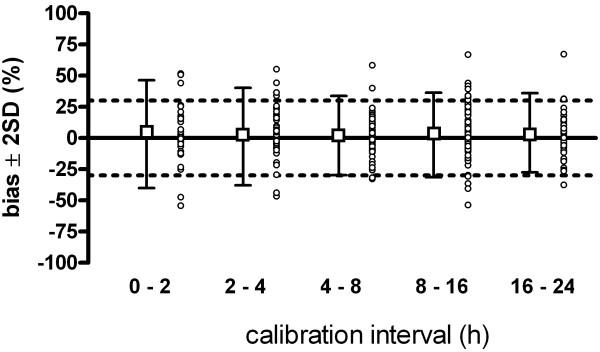
A total of 330 data pairs were analyzed. For all data pairs, the mean COTCP (±SD) was 8.2 ± 2.0 L/min. PCCO had a mean bias of 0.16 L/min with limits of agreement of -2.81 to 3.15 L/min (percentage error, 38%) when compared to COTCP. Whereas the bias between PCCO and COTCP was not significantly different between NE dosage categories or categories of time elapsed between calibrations, interchangeability (percentage error <30%) between methods was present only in the high NE dosage subgroup (≥0.1 μg/kg/min), as the percentage errors were 40%, 47% and 28% in the no NE, NE < 0.1 and NE ≥ 0.1 μg/kg/min subgroups, respectively. PCCO was not interchangeable with COTCP in subgroups of different calibration intervals. The high NE dosage group showed significantly increased central artery stiffness.
CONCLUSIONS
This study shows that NE dosage, but not the time interval between calibrations, has an impact on the agreement between PCCO and COTCP. Only in the measurements with high NE dosage (representing the minority of measurements) was PCCO interchangeable with COTCP.
介绍
连续心输出量监测用于早期发现危重病患者的血流动力学不稳定,并指导治疗。最近,脉冲轮廓衍生心输出量(PCCO)的准确性在不同的临床情况下受到了质疑。在这项研究中,我们检查了危重病患者中 PCCO 与经心肺热稀释心输出量(COTCP)之间的一致性,特别强调去甲肾上腺素(NE)的给药和校准之间的时间间隔。
方法
这是一项前瞻性、观察性研究,共纳入 73 名(平均年龄 63±13 岁)需要在非心脏手术重症监护病房进行有创血流动力学监测的患者。PCCO 在通过 COTCP 立即进行校准之前进行记录。根据 NE 剂量和校准之间的时间间隔(最长可达 24 小时),对 PCCO 和 COTCP 之间的一致性数据子集进行 Bland-Altman 分析。此外,基于脉搏压力与stroke volume 关系计算中心动脉僵硬度。
结果
共分析了 330 对数据。对于所有数据对,COTCP 的平均值(±SD)为 8.2±2.0 L/min。PCCO 的平均偏差为 0.16 L/min,一致性界限为-2.81 至 3.15 L/min(百分比误差为 38%),与 COTCP 相比。虽然 NE 剂量类别或校准之间时间间隔类别之间 PCCO 和 COTCP 之间的偏差没有显著差异,但只有在高 NE 剂量亚组(≥0.1μg/kg/min)中,方法之间具有可互换性(百分比误差 <30%),因为在无 NE、NE<0.1 和 NE≥0.1μg/kg/min 亚组中,百分比误差分别为 40%、47%和 28%。在不同校准间隔的亚组中,PCCO 与 COTCP 不可互换。高 NE 剂量组的中心动脉僵硬度显著增加。
结论
本研究表明,NE 剂量,而不是校准之间的时间间隔,对 PCCO 和 COTCP 之间的一致性有影响。只有在高 NE 剂量(代表少数测量)的测量中,PCCO 才与 COTCP 可互换。


 Zotero 插件