
在脓毒性休克患者的 T 细胞上上调程序性死亡受体 1,在单核细胞上上调程序性死亡配体 1。
Upregulation of programmed death-1 on T cells and programmed death ligand-1 on monocytes in septic shock patients.
机构信息
Clinical Research Center, Changhai Hospital, Second Military Medical University, 168 Changhai Road, Shanghai 200433, PR China.
出版信息
Crit Care. 2011;15(1):R70. doi: 10.1186/cc10059. Epub 2011 Feb 24.
INTRODUCTION
Studies on the role of programmed death-1(PD-1) and its main ligand (PD-L1) during experimental models of sepsis have shown that the PD-1/PD-L1 pathway plays a pathologic role in altering microbial clearance, the innate inflammatory response and accelerated apoptosis in sepsis. However, the expression of PD-1 and PD-L1 and their role during the development of immune suppression in septic patients have not been elucidated. The present study was designed to determine whether the expression of PD-1 and PD-L1 is upregulated in septic shock patients and to explore the role of this pathway in sepsis-induced immunosuppression.
METHODS
Nineteen septic shock patients and 22 sex-matched and age-matched healthy controls were prospectively enrolled. Apoptosis in lymphocyte subpopulations and PD-1/PD-L1 expression on peripheral T cells, B cells and monocytes were measured using flow cytometry. Apoptosis of T cells induced by TNFα or T-cell receptor ligation in vitro and effects of anti-PD-L1 antibody administration were measured by flow cytometry. CD14+ monocytes of septic shock patients were purified and incubated with either lipopolysaccharide, anti-PD-L1 antibody, isotype antibody, or a combination of lipopolysaccharide and anti-PD-L1 antibody or isotype antibody. Supernatants were harvested to examine production of cytokines by ELISA.
RESULTS
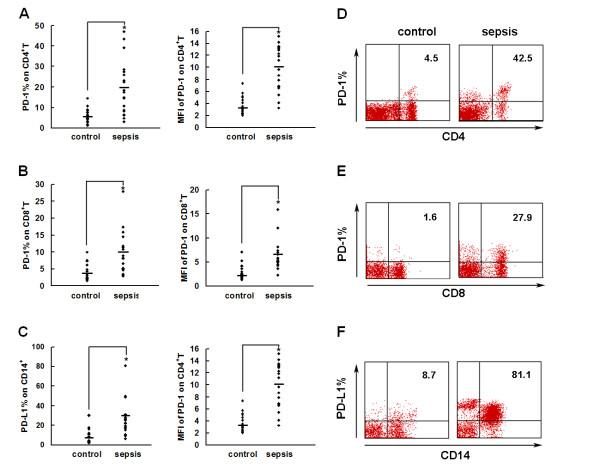
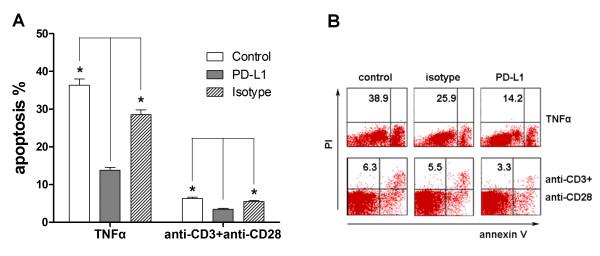
Compared with healthy controls, septic shock induced a marked increase in apoptosis as detected by the annexin-V binding and active caspase-3 on CD4+ T cells, CD8+ T cells and CD19+ B cells. Expression of PD-1 on T cells and of PD-L1 on monocytes was dramatically upregulated in septic shock patients. PD-1/PD-L1 pathway blockade in vitro with anti-PD-L1 antibody decreased apoptosis of T cells induced by TNFα or T-cell receptor ligation. Meanwhile, this blockade potentiated the lipopolysaccharide-induced TNFα and IL-6 production and decreased IL-10 production by monocytes in vitro.
CONCLUSIONS
The expression of PD-1 on T cells and PD-L1 on monocytes was upregulated in septic shock patients. The PD-1/PD-L1 pathway might play an essential role in sepsis-induced immunosuppression.
简介
在脓毒症的实验模型中,研究程序性死亡受体-1(PD-1)及其主要配体(PD-L1)的作用表明,PD-1/PD-L1 通路在改变微生物清除率、固有炎症反应和加速脓毒症中的细胞凋亡方面起着病理性作用。然而,PD-1 和 PD-L1 的表达及其在脓毒症患者免疫抑制发展中的作用尚未阐明。本研究旨在确定 PD-1 和 PD-L1 的表达是否在脓毒性休克患者中上调,并探讨该通路在脓毒症引起的免疫抑制中的作用。
方法
前瞻性纳入 19 例脓毒性休克患者和 22 例性别和年龄匹配的健康对照者。使用流式细胞术检测淋巴细胞亚群的凋亡以及外周 T 细胞、B 细胞和单核细胞上 PD-1/PD-L1 的表达。通过流式细胞术测量 TNFα 或 T 细胞受体交联诱导的 T 细胞凋亡以及抗 PD-L1 抗体给药的效果。从脓毒性休克患者中纯化 CD14+单核细胞,并与脂多糖、抗 PD-L1 抗体、同型抗体或脂多糖和抗 PD-L1 抗体或同型抗体的组合孵育。收获上清液,通过 ELISA 检测细胞因子的产生。
结果
与健康对照组相比,脓毒性休克诱导 CD4+T 细胞、CD8+T 细胞和 CD19+B 细胞上的膜联蛋白 V 结合和活性 caspase-3 的凋亡明显增加。T 细胞上 PD-1 的表达和单核细胞上 PD-L1 的表达在脓毒性休克患者中显著上调。体外用抗 PD-L1 抗体阻断 PD-1/PD-L1 通路可减少 TNFα 或 T 细胞受体交联诱导的 T 细胞凋亡。同时,这种阻断增强了单核细胞体外脂多糖诱导的 TNFα 和 IL-6 的产生,并降低了 IL-10 的产生。
结论
在脓毒性休克患者中,T 细胞上的 PD-1 和单核细胞上的 PD-L1 的表达上调。PD-1/PD-L1 通路可能在脓毒症引起的免疫抑制中起重要作用。


 Zotero 插件