
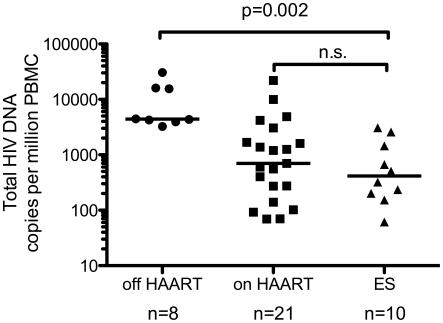
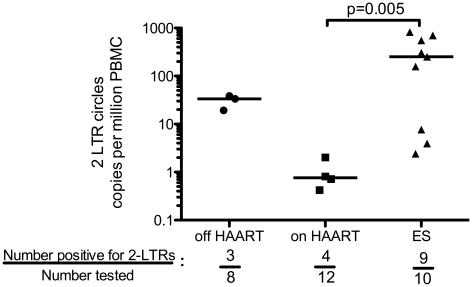
与接受和未接受高效抗逆转录病毒治疗(HAART)的 HIV 阳性患者相比,精英抑制剂中整合的 HIV DNA 水平较低,而 2-LTR 环状 HIV DNA 水平较高。
Elite suppressors harbor low levels of integrated HIV DNA and high levels of 2-LTR circular HIV DNA compared to HIV+ patients on and off HAART.
机构信息
Department of Pathology and Laboratory Medicine, University of Pennsylvania School of Medicine, Philadelphia, Pennsylvania, United States of America.
出版信息
PLoS Pathog. 2011 Feb;7(2):e1001300. doi: 10.1371/journal.ppat.1001300. Epub 2011 Feb 24.
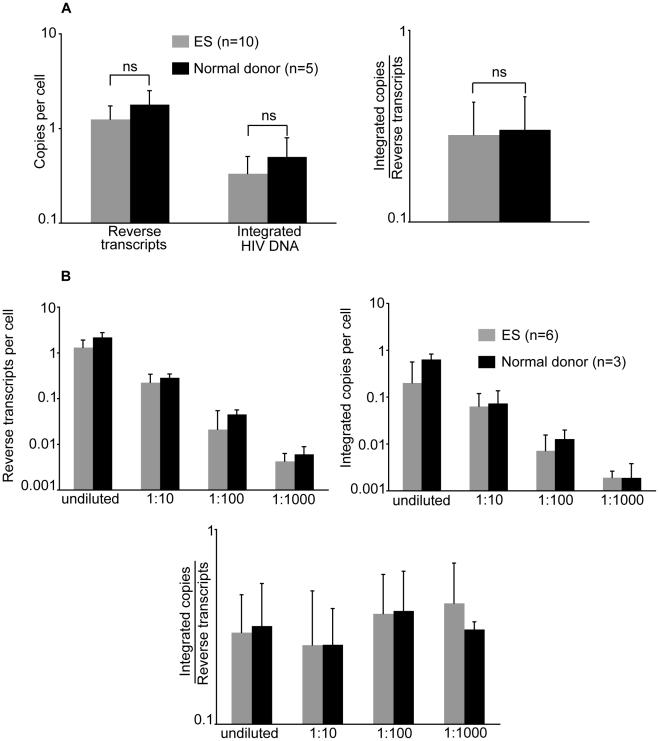
Elite suppressors (ES) are a rare population of HIV-infected individuals that are capable of naturally controlling the infection without the use of highly active anti-retroviral therapy (HAART). Patients on HAART often achieve viral control to similar (undetectable) levels. Accurate and sensitive methods to measure viral burden are needed to elucidate important differences between these two patient populations in order to better understand their mechanisms of control. Viral burden quantification in ES patients has been limited to measurements of total DNA in PBMC, and estimates of Infectious Units per Million cells (IUPM). There appears to be no significant difference in the level of total HIV DNA between cells from ES patients and patients on HAART. However, recovering infectious virus from ES patient samples is much more difficult, suggesting their reservoir size should be much smaller than that in patients on HAART. Here we find that there is a significant difference in the level of integrated HIV DNA in ES patients compared to patients on HAART, providing an explanation for the previous results. When comparing the level of total to integrated HIV DNA in these samples we find ES patients have large excesses of unintegrated HIV DNA. To determine the composition of unintegrated HIV DNA in these samples, we measured circular 2-LTR HIV DNA forms and found ES patients frequently have high levels of 2-LTR circles in PBMC. We further show that these high levels of 2-LTR circles are not the result of inefficient integration in ES cells, since HIV integrates with similar efficiency in ES and normal donor cells. Our findings suggest that measuring integration provides a better surrogate of viral burden than total HIV DNA in ES patients. Moreover, they add significantly to our understanding of the mechanisms that allow viral control and reservoir maintenance in this unique patient population.
精英抑制剂 (ES) 是一群罕见的 HIV 感染者,他们能够在不使用高效抗逆转录病毒疗法 (HAART) 的情况下自然控制感染。接受 HAART 的患者通常能够达到类似的(无法检测到的)病毒控制水平。为了更好地了解这两种患者群体的控制机制,需要准确和敏感的方法来测量病毒载量,以阐明它们之间的重要差异。ES 患者的病毒载量定量一直局限于 PBMC 总 DNA 的测量和每百万细胞的感染性单位 (IUPM) 的估计。ES 患者细胞中的总 HIV DNA 水平与接受 HAART 的患者之间似乎没有显著差异。然而,从 ES 患者样本中回收感染性病毒要困难得多,这表明他们的储库大小应该比接受 HAART 的患者小得多。在这里,我们发现 ES 患者与接受 HAART 的患者相比,整合 HIV DNA 的水平存在显著差异,这为之前的结果提供了一个解释。当比较这些样本中总 HIV DNA 与整合 HIV DNA 的水平时,我们发现 ES 患者有大量未整合的 HIV DNA 过剩。为了确定这些样本中未整合 HIV DNA 的组成,我们测量了环状 2-LTR HIV DNA 形式,发现 ES 患者的 PBMC 中经常有高水平的 2-LTR 环。我们进一步表明,这些高水平的 2-LTR 环不是 ES 细胞中整合效率低下的结果,因为 HIV 在 ES 和正常供体细胞中的整合效率相似。我们的研究结果表明,与总 HIV DNA 相比,测量整合提供了一个更好的 ES 患者病毒载量替代物。此外,它们大大增加了我们对允许这种独特患者群体控制病毒和维持储库的机制的理解。



 Zotero 插件