
芬维 A 胺在人体和小鼠中的代谢:利用其代谢途径的药理学调节来增加系统暴露。
Fenretinide metabolism in humans and mice: utilizing pharmacological modulation of its metabolic pathway to increase systemic exposure.
机构信息
Cancer Center and Departments of Cell Biology & Biochemistry Pharmacology & Neuroscience Internal Medicine Pediatrics, School of Medicine, Texas Tech University Health Sciences Center, Lubbock, TX, USA.
出版信息
Br J Pharmacol. 2011 Jul;163(6):1263-75. doi: 10.1111/j.1476-5381.2011.01310.x.
BACKGROUND AND PURPOSE
High plasma levels of fenretinide [N-(4-hydroxyphenyl)retinamide (4-HPR)] were associated with improved outcome in a phase II clinical trial. Low bioavailability of 4-HPR has been limiting its therapeutic applications. This study characterized metabolism of 4-HPR in humans and mice, and to explore the effects of ketoconazole, an inhibitor of CYP3A4, as a modulator to increase 4-HPR plasma levels in mice and to increase the low bioavailability of 4-HPR.
EXPERIMENTAL APPROACH
4-HPR metabolites were identified by mass spectrometric analysis and levels of 4-HPR and its metabolites [N-(4-methoxyphenyl)retinamide (4-MPR) and 4-oxo-N-(4-hydroxyphenyl)retinamide (4-oxo-4-HPR)] were quantified by high-performance liquid chromatography (HPLC). Kinetic analysis of enzyme activities and the effects of enzyme inhibitors were performed in pooled human and pooled mouse liver microsomes, and in human cytochrome P450 (CYP) 3A4 isoenzyme microsomes. In vivo metabolism of 4-HPR was inhibited in mice.
KEY RESULTS
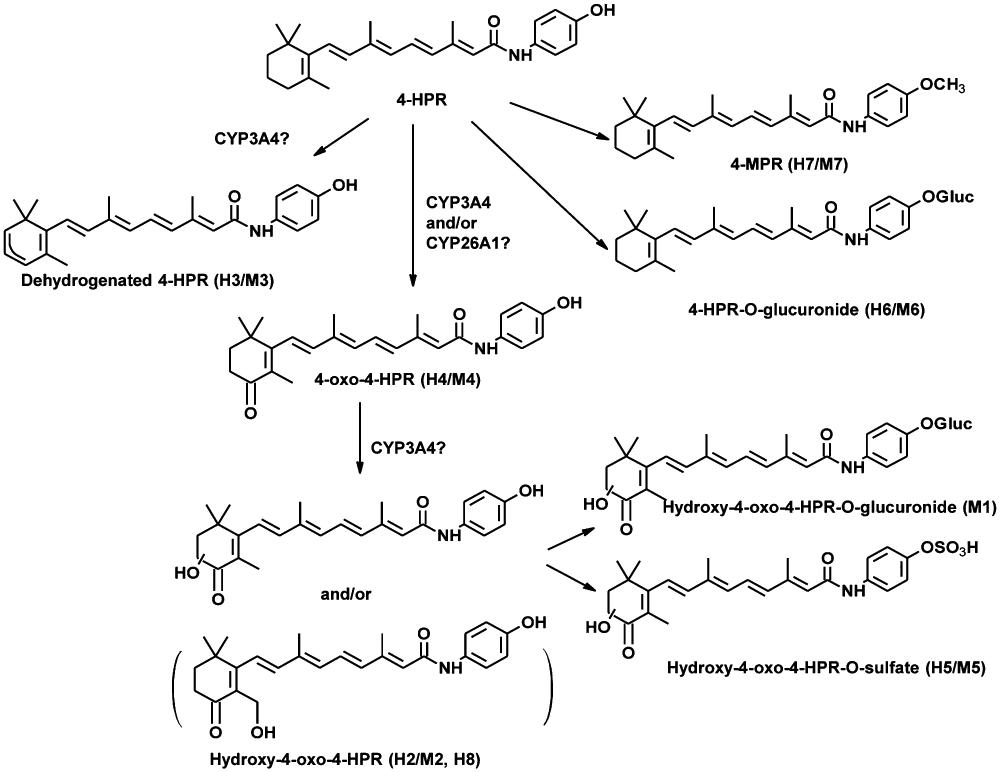
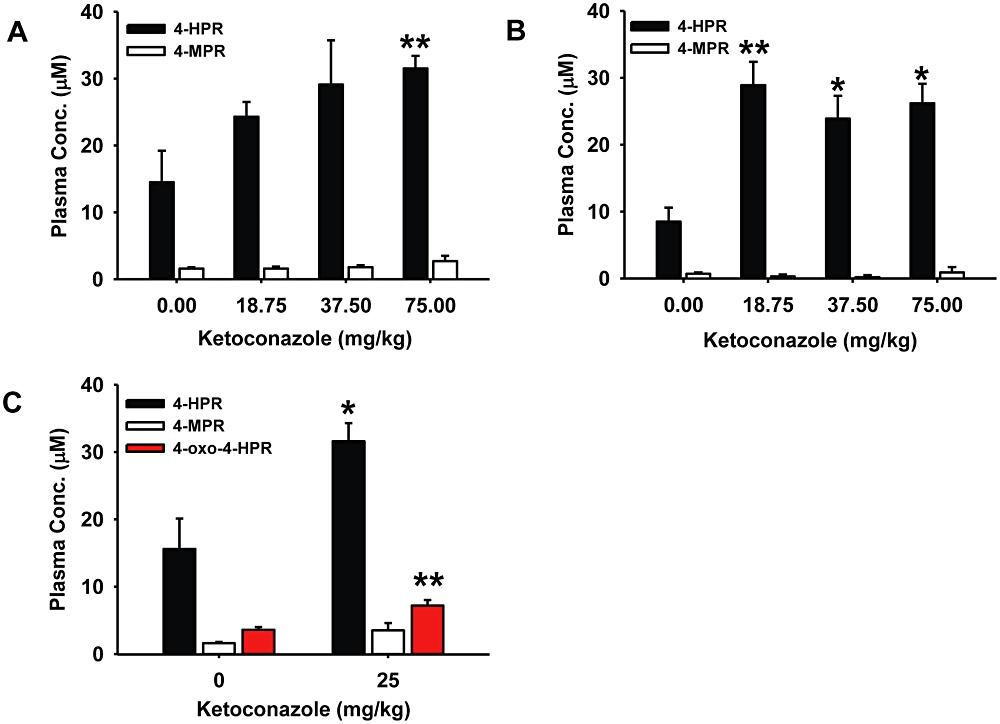
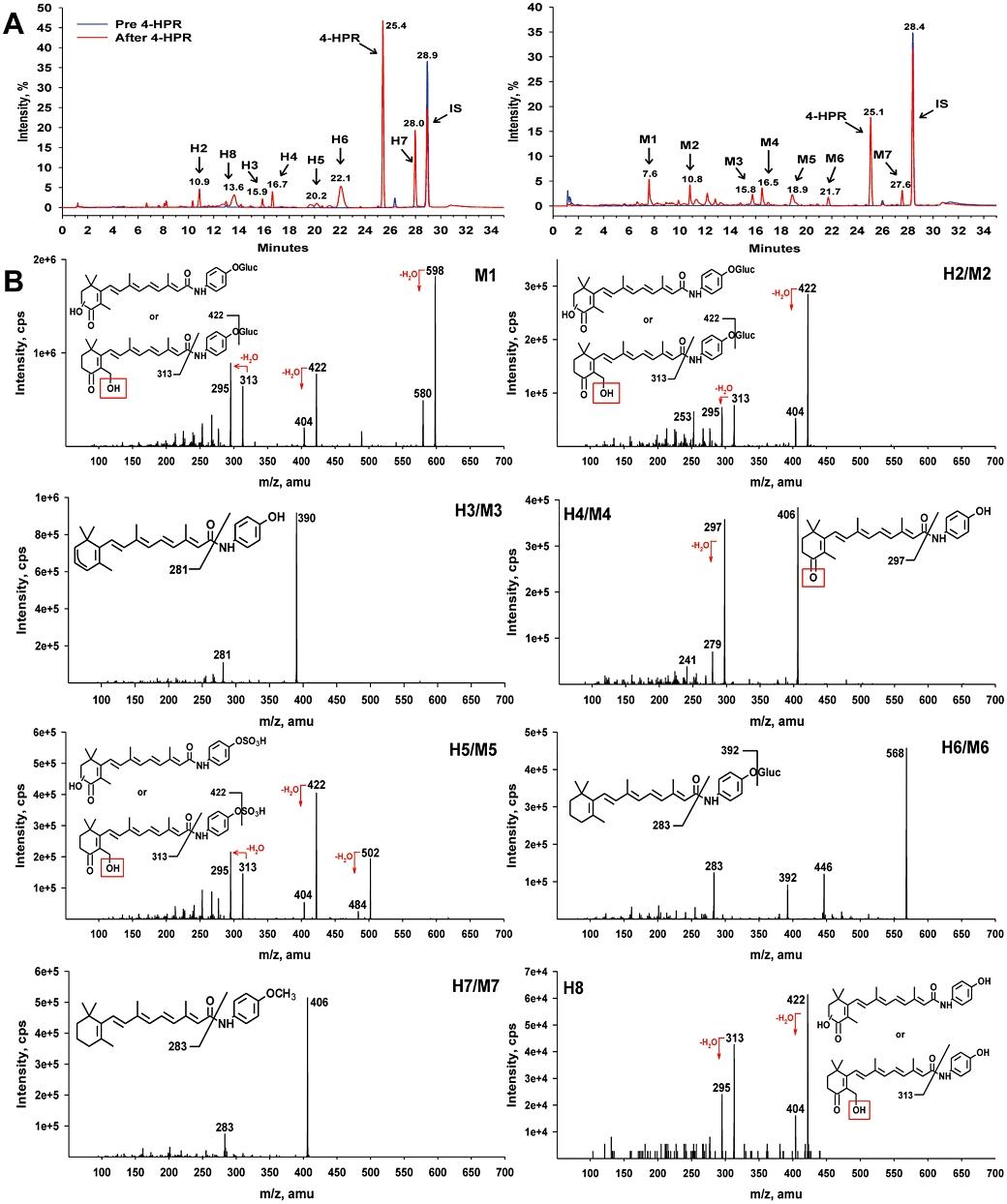
Six 4-HPR metabolites were identified in the plasma of patients and mice. 4-HPR was oxidized to 4-oxo-4-HPR, at least in part via human CYP3A4. The CYP3A4 inhibitor ketoconazole significantly reduced 4-oxo-4-HPR formation in both human and mouse liver microsomes. In two strains of mice, co-administration of ketoconazole with 4-HPR in vivo significantly increased 4-HPR plasma concentrations by > twofold over 4-HPR alone and also increased 4-oxo-4-HPR levels.
CONCLUSIONS AND IMPLICATIONS
Mice may serve as an in vivo model of human 4-HPR pharmacokinetics. In vivo data suggest that the co-administration of ketoconazole at normal clinical doses with 4-HPR may increase systemic exposure to 4-HPR in humans.
背景与目的
芬维 A 胺(N-(4- 羟基苯基)维 A 酰胺,4-HPR)的血浆水平升高与 II 期临床试验的改善结果相关。4-HPR 的生物利用度低一直限制了其治疗应用。本研究对 4-HPR 在人和小鼠中的代谢进行了特征描述,并探讨了酮康唑(CYP3A4 的抑制剂)作为调节剂的作用,以增加小鼠中 4-HPR 的血浆水平并提高 4-HPR 的低生物利用度。
实验方法
通过质谱分析鉴定 4-HPR 的代谢物,并通过高效液相色谱法(HPLC)定量测定 4-HPR 及其代谢物[N-(4- 甲氧基苯基)维 A 酰胺(4-MPR)和 4- 氧代 -N-(4- 羟基苯基)维 A 酰胺(4- 氧代 -4-HPR)]的水平。在人肝微粒体和鼠肝微粒体的混合液中以及人细胞色素 P450(CYP)3A4 同工酶微粒体中进行酶活性的动力学分析和酶抑制剂的作用。在小鼠体内抑制 4-HPR 的代谢。
主要结果
在患者和小鼠的血浆中鉴定出 6 种 4-HPR 代谢物。4-HPR 被氧化为 4- 氧代 -4-HPR,至少部分通过人 CYP3A4。CYP3A4 抑制剂酮康唑可显著降低人肝微粒体和鼠肝微粒体中 4- 氧代 -4-HPR 的形成。在两种小鼠品系中,酮康唑与 4-HPR 体内联合给药使 4-HPR 血浆浓度比单独使用 4-HPR 增加了两倍以上,同时也增加了 4- 氧代 -4-HPR 水平。
结论和意义
小鼠可能成为 4-HPR 药代动力学的体内模型。体内数据表明,酮康唑与 4-HPR 联合使用时,以正常临床剂量给药可能会增加 4-HPR 在人体内的全身暴露。


 Zotero 插件