
树突棘结构可塑性的信号通路。
Signalling pathways underlying structural plasticity of dendritic spines.
机构信息
Department of Neurobiology, Howard Hughes Medical Institute, Duke University Medical Center, Durham, NC 27710, USA.
出版信息
Br J Pharmacol. 2011 Aug;163(8):1626-38. doi: 10.1111/j.1476-5381.2011.01328.x.
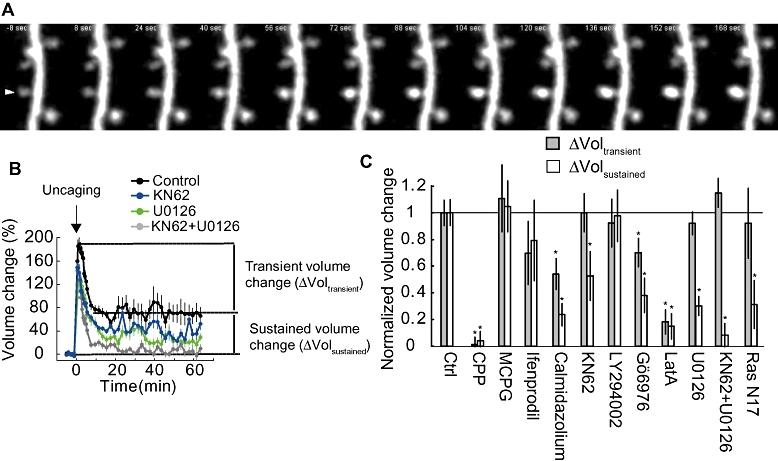
Synaptic plasticity, or changes in synaptic strength, is thought to underlie learning and memory. Imaging studies, mainly in brain slices, have revealed that long-term synaptic plasticity of excitatory synapses in hippocampal neurons is coupled with structural plasticity of dendritic spines, which is thought to be essential for inducing and regulating functional plasticity. Using pharmacological and genetic manipulation, the signalling network underlying structural plasticity has been extensively studied. Furthermore, the recent advent of fluorescence resonance energy transfer (FRET) imaging techniques has provided a readout of the dynamics of signal transduction in dendritic spines undergoing structural plasticity. These studies reveal the signalling pathways relaying Ca(2+) to the functional and structural plasticity of dendritic spines.
突触可塑性,即突触强度的变化,被认为是学习和记忆的基础。成像研究主要在脑片中揭示了海马神经元兴奋性突触的长时程突触可塑性与树突棘的结构可塑性相关联,而后者被认为对于诱导和调节功能可塑性至关重要。通过药理学和遗传学操作,已经广泛研究了结构可塑性的信号转导网络。此外,最近荧光共振能量转移(FRET)成像技术的出现为树突棘经历结构可塑性时信号转导的动力学提供了一种读出方法。这些研究揭示了将 Ca(2+) 传递到树突棘的功能和结构可塑性的信号通路。


 Zotero 插件