
磷脂酰肌醇3激酶调控酵母中自噬体的形成。
PtdIns 3-Kinase Orchestrates Autophagosome Formation in Yeast.
作者信息
Obara Keisuke, Ohsumi Yoshinori
机构信息
Faculty of Pharmaceutical Sciences, Hokkaido University, Kita-12 jo Nishi-6 chome, Kitaku, Sapporo 060-0812, Japan.
出版信息
J Lipids. 2011;2011:498768. doi: 10.1155/2011/498768. Epub 2011 Jan 4.
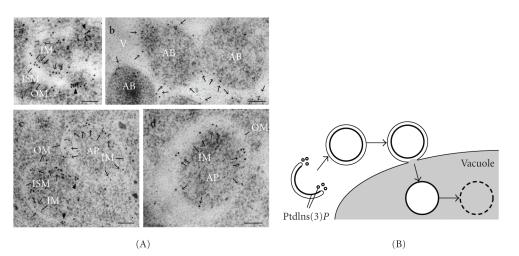
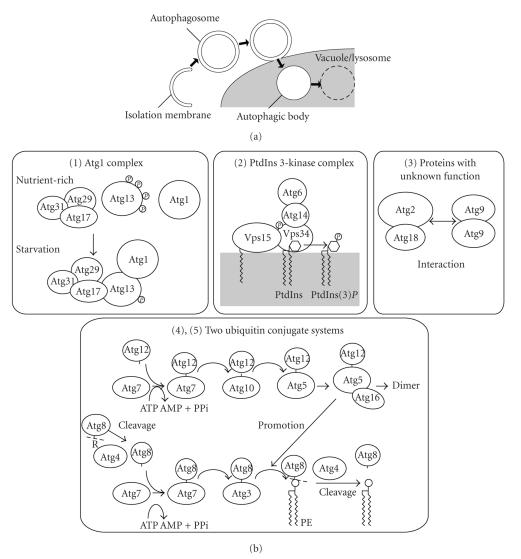
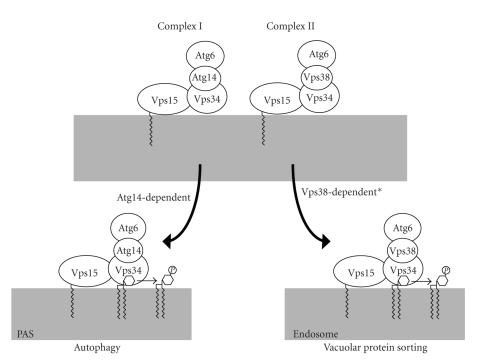
Eukaryotic cells can massively transport their own cytoplasmic contents into a lytic compartment, the vacuole/lysosome, for recycling through a conserved system called autophagy. The key process in autophagy is the sequestration of cytoplasmic contents within a double-membrane structure, the autophagosome. Autophagosome formation requires the elaborate cooperation of Atg (autophagy-related) proteins and lipid molecules. Phosphorylation of phosphatidylinositol (PtdIns) by a PtdIns 3-kinase, Vps34, is a key step in coordinating Atg proteins and lipid molecules. Vps34 forms two distinct protein complexes, only one of which is involved in generating autophagic membranes. Upon induction of autophagy, PtdIns(3)P, the enzymatic product of PtdIns 3-kinase, is massively transported into the lumen of the vacuole via autophagy. PtdIns(3)P is enriched on the inner membrane of the autophagosome. PtdIns(3)P recruits the Atg18-Atg2 complex and presumably other Atg proteins to autophagic membranes, thereby coordinating lipid molecules and Atg proteins.
真核细胞能够通过一种称为自噬的保守系统,将自身大量的细胞质内容物运输到一个溶酶体区室(液泡/溶酶体)中进行循环利用。自噬的关键过程是将细胞质内容物隔离在一个双膜结构——自噬体中。自噬体的形成需要自噬相关(Atg)蛋白和脂质分子的精心协作。磷脂酰肌醇3激酶(Vps34)对磷脂酰肌醇(PtdIns)进行磷酸化是协调Atg蛋白和脂质分子的关键步骤。Vps34形成两种不同的蛋白质复合物,其中只有一种参与自噬膜的生成。在自噬诱导后,PtdIns 3激酶的酶促产物磷脂酰肌醇-3-磷酸(PtdIns(3)P)通过自噬大量运输到液泡腔中。PtdIns(3)P在自噬体的内膜上富集。PtdIns(3)P将Atg18-Atg2复合物以及可能的其他Atg蛋白招募到自噬膜上,从而协调脂质分子和Atg蛋白。
 Zotero 插件