
在慢性感染期间,传播阶段主导锥虫的体内动态。
Transmission stages dominate trypanosome within-host dynamics during chronic infections.
机构信息
Centre for Immunity, Infection, and Evolution, Institute for Immunology and Infection Research, School of Biological Sciences, University of Edinburgh, Edinburgh, UK.
出版信息
Cell Host Microbe. 2011 Apr 21;9(4):310-8. doi: 10.1016/j.chom.2011.03.013.
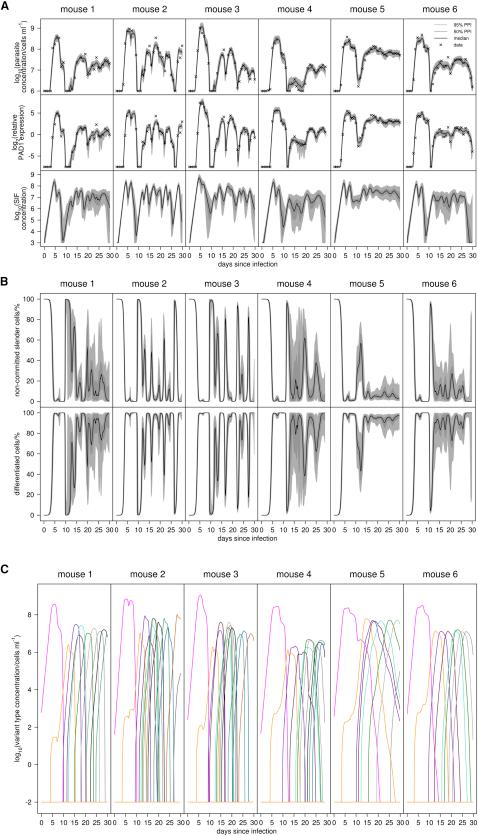
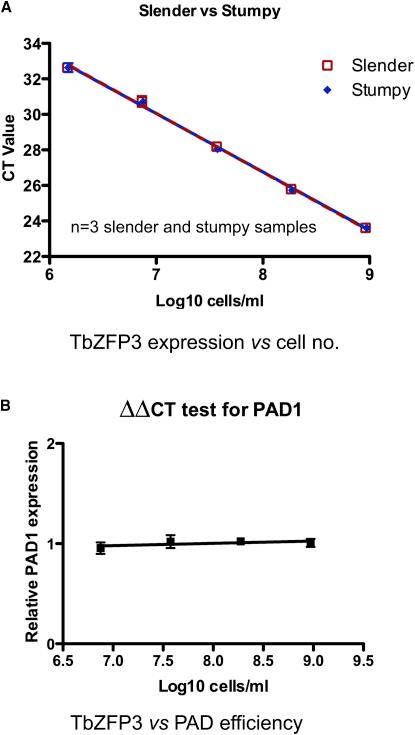
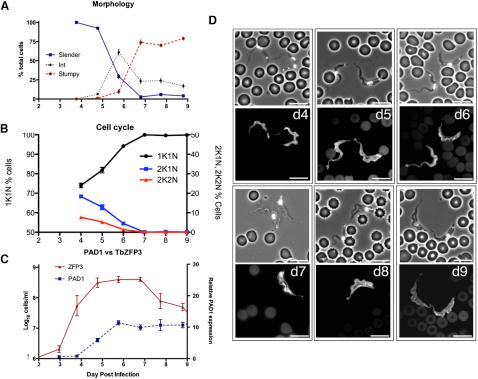
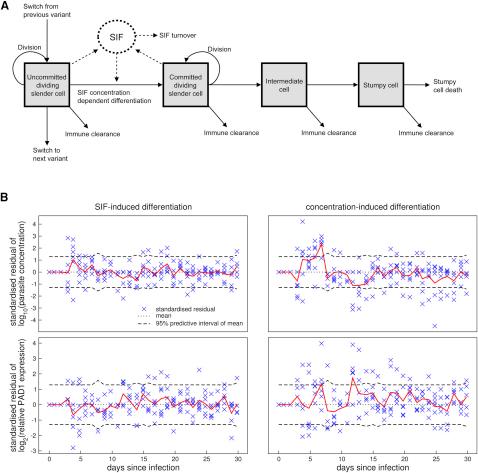
Sleeping sickness is characterized by waves of the extracellular parasite Trypanosoma brucei in host blood, with infections continuing for months or years until inevitable host death. These waves reflect the dynamic conflict between the outgrowth of a succession of parasite antigenic variants and their control by the host immune system. Although a contributor to these dynamics is the density-dependent differentiation from proliferative "slender forms" to transmissible "stumpy forms," an absence of markers discriminating stumpy forms has prevented accurate parameterization of this component. Here, we exploit the stumpy-specific PAD1 marker, which functionally defines transmission competence, to quantitatively monitor stumpy formation during chronic infections. This allows reconstruction of the temporal events early in infection. Mathematical modeling of these data describes the parameters controlling trypanosome within-host dynamics and provides strong support for a quorum-sensing-like mechanism. Our data reveal the dominance of transmission stages throughout infection, a consequence being austere use of the parasite's antigen repertoire.
昏睡病的特征是宿主血液中的寄生虫布氏锥虫(Trypanosoma brucei)出现一波又一波的波动,感染会持续数月甚至数年,直到宿主不可避免地死亡。这些波动反映了寄生虫抗原变体连续出现和宿主免疫系统对其进行控制之间的动态冲突。尽管密度依赖性分化是导致这一动态变化的因素之一,从增殖的“细长型”分化为可传播的“粗短型”,但缺乏区分粗短型的标志物,使得无法准确参数化这一成分。在这里,我们利用特异性标记 PAD1 来监测慢性感染期间的粗短型形成,该标记功能上定义了传播能力。这可以重建感染早期的时间事件。对这些数据的数学建模描述了控制寄生虫在宿主内动态的参数,并为群体感应样机制提供了强有力的支持。我们的数据揭示了传播阶段在整个感染过程中的主导地位,这导致寄生虫抗原库的使用变得非常严格。


 Zotero 插件