
扫描电子显微镜研究菝葜叶提取物对变异链球菌 ATCC 25175 的抑制作用。
Scanning electron microscopic study of Piper betle L. leaves extract effect against Streptococcus mutans ATCC 25175.
机构信息
Department of Oral Biology, Dental School, University of Malaya, Kuala Lumpur, Malaysia.
出版信息
J Appl Oral Sci. 2011 Apr;19(2):137-46. doi: 10.1590/s1678-77572011000200010.
INTRODUCTION
Previous studies have shown that Piper betle L. leaves extract inhibits the adherence of Streptococcus mutans to glass surface, suggesting its potential role in controlling dental plaque development.
OBJECTIVES
In this study, the effect of the Piper betle L. extract towards S. mutans (with/without sucrose) using scanning electron microscopy (SEM) and on partially purified cell-associated glucosyltransferase activity were determined.
MATERIAL AND METHODS
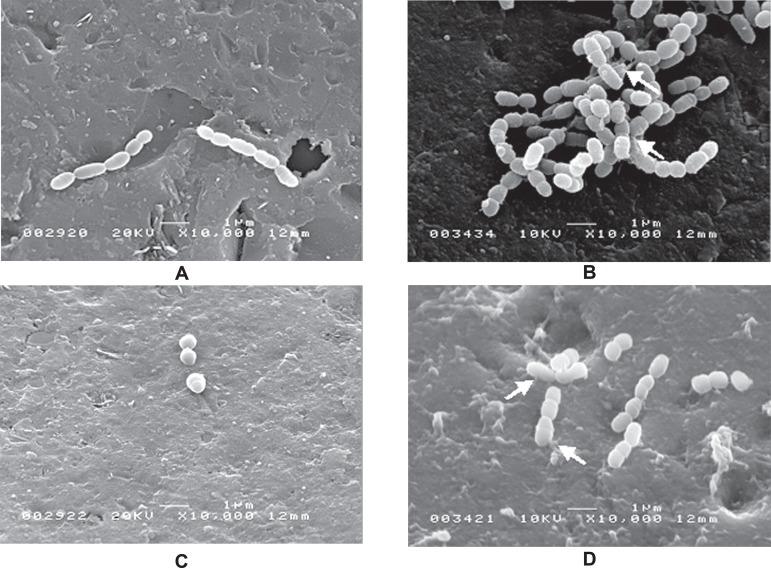
S. mutans were allowed to adhere to glass beads suspended in 6 different Brain Heart Infusion broths [without sucrose; with sucrose; without sucrose containing the extract (2 mg mL(-1) and 4 mg mL(-1)); with sucrose containing the extract (2 mg mL(-1) and 4 mg mL(-1))]. Positive control was 0.12% chlorhexidine. The glass beads were later processed for SEM viewing. Cell surface area and appearance and, cell population of S. mutans adhering to the glass beads were determined upon viewing using the SEM. The glucosyltransferase activity (with/without extract) was also determined. One- and two-way ANOVA were used accordingly.
RESULTS
It was found that sucrose increased adherence and cell surface area of S. mutans (p<0.001). S. mutans adhering to 100 µm² glass surfaces (with/without sucrose) exhibited reduced cell surface area, fluffy extracellular appearance and cell population in the presence of the Piper betle L. leaves extract. It was also found that the extract inhibited glucosyltransferase activity and its inhibition at 2.5 mg mL(-1) corresponded to that of 0.12% chlorhexidine. At 4 mg mL(-1) of the extract, the glucosyltransferase activity was undetectable and despite that, bacterial cells still demonstrated adherence capacity.
CONCLUSION
The SEM analysis confirmed the inhibitory effects of the Piper betle L. leaves extract towards cell adherence, cell growth and extracellular polysaccharide formation of S. mutans visually. In bacterial cell adherence, other factors besides glucosyltransferase are involved.
简介
先前的研究表明,胡椒(Piper betle L.)叶提取物可抑制变形链球菌(Streptococcus mutans)黏附于玻璃表面,这表明其在控制牙菌斑形成方面可能具有一定作用。
目的
本研究通过扫描电子显微镜(SEM)观察胡椒提取物对变形链球菌(含/不含蔗糖)的作用,并测定部分纯化的细胞相关葡糖基转移酶活性。
材料和方法
将变形链球菌接种于含或不含蔗糖的 6 种脑心浸液肉汤[不含蔗糖;含蔗糖;含 2mg/ml 和 4mg/ml 提取物的无蔗糖溶液;含 2mg/ml 和 4mg/ml 提取物的含蔗糖溶液]中的玻璃珠悬液中,使细菌黏附于玻璃珠上。阳性对照为 0.12%洗必泰。随后对玻璃珠进行 SEM 观察,以确定黏附于玻璃珠上的变形链球菌的细胞表面面积和形态、细胞密度。测定有无提取物存在时的葡糖基转移酶活性。相应地使用单因素和双因素方差分析。
结果
结果发现,蔗糖可增加变形链球菌的黏附力和细胞表面面积(p<0.001)。在存在胡椒叶提取物的情况下,黏附于 100μm²玻璃表面(含/不含蔗糖)的变形链球菌的细胞表面面积减小,细胞外形态呈絮状,细胞密度降低。此外,还发现提取物可抑制葡糖基转移酶活性,其在 2.5mg/ml 时的抑制作用与 0.12%洗必泰相当。在 4mg/ml 提取物时,葡糖基转移酶活性无法检测到,但细菌细胞仍具有黏附能力。
结论
SEM 分析证实,胡椒叶提取物可通过视觉观察抑制变形链球菌的细胞黏附、生长和细胞外多糖形成。在细菌细胞黏附中,除葡糖基转移酶外,还涉及其他因素。


 Zotero 插件