
叶酸偶联氧化石墨烯负载光敏剂用于靶向光动力治疗。
Folic Acid-conjugated Graphene Oxide loaded with Photosensitizers for Targeting Photodynamic Therapy.
机构信息
National Key Laboratory of Nano/Micro Fabrication Technology, Key Laboratory for Thin Film and Microfabrication of Ministry of Education, Institute of Micro-Nano Science and Technology, Shanghai Jiao Tong University, 800 Dongchuan Road, Shanghai 200240, PR China.
出版信息
Theranostics. 2011 Apr 13;1:240-50. doi: 10.7150/thno/v01p0240.
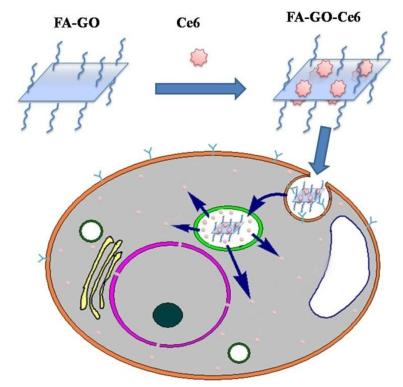
Photodynamic therapy (PDT) has emerged as an alternative and promising noninvasive treatment for cancer as well as non-cancer diseases, which involves the uptake of photosensitizers (PSs) by cancer cells followed by irradiation. The use of nanomaterials as carriers of PSs is a very promising approach to improve the development of PDT in clinical medicine. In this study, a novel folic acid-conjugated graphene oxide (GO) was strategically designed and prepared as targeting drug delivery system to achieve higher specificity. The second generation photosensitizer (PS) Chlorin e6 (Ce6) was effectively loaded into the system via hydrophobic interactions and π-π stacking. The nanocarriers can significantly increase the accumulation of Ce6 in tumor cells and lead to a remarkable photodynamic efficacy on MGC803 cells upon irradiation. These suggested that folic acid-conjugated GO loaded Ce6 had great potential as effective drug delivery system in targeting PDT.
光动力疗法 (PDT) 已成为癌症和非癌症疾病的一种替代且有前途的非侵入性治疗方法,其涉及光敏剂 (PS) 被癌细胞摄取,然后进行辐照。将纳米材料用作 PS 的载体是改善 PDT 在临床医学中发展的一种很有前途的方法。在这项研究中,设计并制备了一种新型的叶酸偶联氧化石墨烯 (GO) 作为靶向药物传递系统,以实现更高的特异性。第二代光敏剂 (PS) 氯乙酮 (Ce6) 通过疏水相互作用和 π-π 堆积有效地装载到该系统中。纳米载体可以显著增加 Ce6 在肿瘤细胞中的积累,并在辐照下导致 MGC803 细胞显著的光动力疗效。这些表明,叶酸偶联 GO 负载 Ce6 具有作为靶向 PDT 的有效药物传递系统的巨大潜力。




 Zotero 插件