
异常的 DNA 甲基化与疾病进展、对伊马替尼的耐药性以及慢性髓性白血病患者的生存时间缩短有关。
Aberrant DNA methylation is associated with disease progression, resistance to imatinib and shortened survival in chronic myelogenous leukemia.
机构信息
Department of Leukemia, The University of Texas MD Anderson Cancer Center, Houston, Texas, United States of America.
出版信息
PLoS One. 2011;6(7):e22110. doi: 10.1371/journal.pone.0022110. Epub 2011 Jul 8.
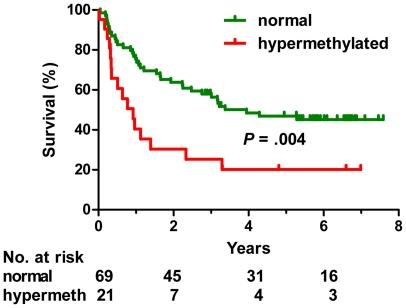
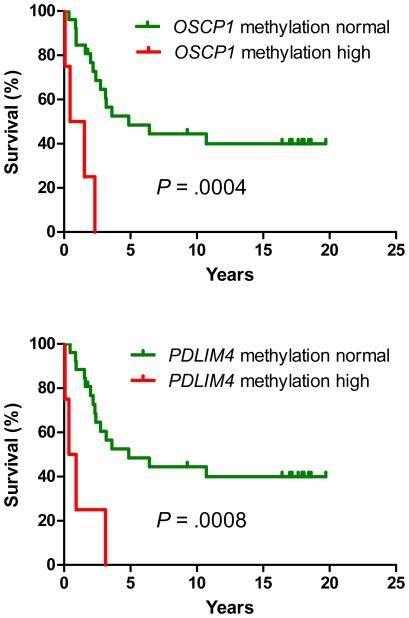
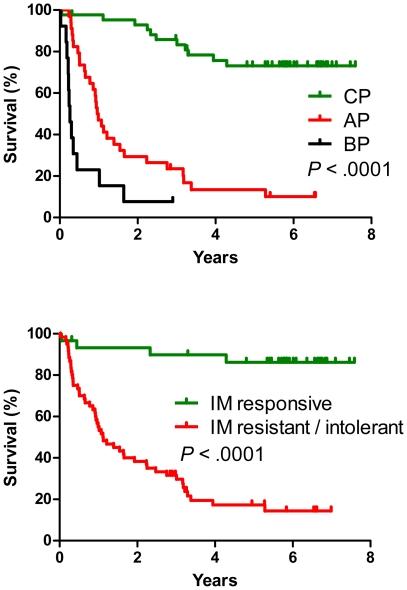
The epigenetic impact of DNA methylation in chronic myelogenous leukemia (CML) is not completely understood. To elucidate its role we analyzed 120 patients with CML for methylation of promoter-associated CpG islands of 10 genes. Five genes were identified by DNA methylation screening in the K562 cell line and 3 genes in patients with myeloproliferative neoplasms. The CDKN2B gene was selected for its frequent methylation in myeloid malignancies and ABL1 as the target of BCR-ABL translocation. Thirty patients were imatinib-naïve (mostly treated by interferon-alpha before the imatinib era), 30 were imatinib-responsive, 50 were imatinib-resistant, and 10 were imatinib-intolerant. We quantified DNA methylation by bisulfite pyrosequencing. The average number of methylated genes was 4.5 per patient in the chronic phase, increasing significantly to 6.2 in the accelerated and 6.4 in the blastic phase. Higher numbers of methylated genes were also observed in patients resistant or intolerant to imatinib. These patients also showed almost exclusive methylation of a putative transporter OSCP1. Abnormal methylation of a Src suppressor gene PDLIM4 was associated with shortened survival independently of CML stage and imatinib responsiveness. We conclude that aberrant DNA methylation is associated with CML progression and that DNA methylation could be a marker associated with imatinib resistance. Finally, DNA methylation of PDLIM4 may help identify a subset of CML patients that would benefit from treatment with Src/Abl inhibitors.
DNA 甲基化在慢性髓性白血病(CML)中的表观遗传学影响尚不完全清楚。为了阐明其作用,我们分析了 120 例 CML 患者的 10 个基因启动子相关 CpG 岛的甲基化情况。在 K562 细胞系中通过 DNA 甲基化筛选鉴定了 5 个基因,在骨髓增生性肿瘤患者中鉴定了 3 个基因。选择 CDKN2B 基因是因为它在髓系恶性肿瘤中经常发生甲基化,选择 ABL1 是因为它是 BCR-ABL 易位的靶点。30 例患者为伊马替尼初治(大多在伊马替尼时代前接受干扰素-α治疗),30 例为伊马替尼反应性,50 例为伊马替尼耐药,10 例为伊马替尼不耐受。我们通过亚硫酸氢盐焦磷酸测序定量 DNA 甲基化。在慢性期,每位患者的平均甲基化基因数为 4.5 个,在加速期和急变期显著增加到 6.2 和 6.4 个。对伊马替尼耐药或不耐受的患者也观察到更多的甲基化基因。这些患者还表现出对假定转运体 OSCP1 的几乎完全甲基化。Src 抑制剂基因 PDLIM4 的异常甲基化与 CML 分期和伊马替尼反应性无关,与生存时间缩短独立相关。我们得出结论,异常的 DNA 甲基化与 CML 进展相关,并且 DNA 甲基化可能是与伊马替尼耐药相关的标志物。最后,PDLIM4 的 DNA 甲基化可能有助于识别一组可能受益于Src/Abl 抑制剂治疗的 CML 患者。
 Zotero 插件