
一种从临床血液样本中直接纯化恶性疟原虫 DNA 用于全基因组高通量测序的有效方法。
An effective method to purify Plasmodium falciparum DNA directly from clinical blood samples for whole genome high-throughput sequencing.
机构信息
Wellcome Trust Sanger Institute, Wellcome Trust Genome Campus, Hinxton, United Kingdom.
出版信息
PLoS One. 2011;6(7):e22213. doi: 10.1371/journal.pone.0022213. Epub 2011 Jul 18.
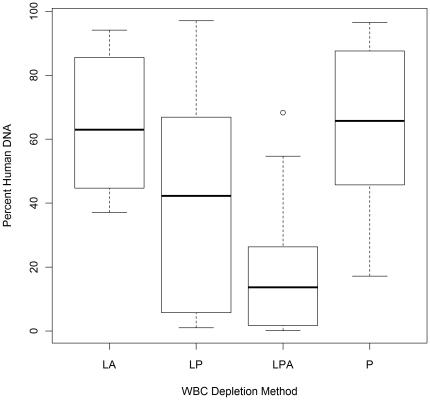
Highly parallel sequencing technologies permit cost-effective whole genome sequencing of hundreds of Plasmodium parasites. The ability to sequence clinical Plasmodium samples, extracted directly from patient blood without a culture step, presents a unique opportunity to sample the diversity of "natural" parasite populations in high resolution clinical and epidemiological studies. A major challenge to sequencing clinical Plasmodium samples is the abundance of human DNA, which may substantially reduce the yield of Plasmodium sequence. We tested a range of human white blood cell (WBC) depletion methods on P. falciparum-infected patient samples in search of a method displaying an optimal balance of WBC-removal efficacy, cost, simplicity, and applicability to low resource settings. In the first of a two-part study, combinations of three different WBC depletion methods were tested on 43 patient blood samples in Mali. A two-step combination of Lymphoprep plus Plasmodipur best fitted our requirements, although moderate variability was observed in human DNA quantity. This approach was further assessed in a larger sample of 76 patients from Burkina Faso. WBC-removal efficacy remained high (<30% human DNA in >70% samples) and lower variation was observed in human DNA quantities. In order to assess the Plasmodium sequence yield at different human DNA proportions, 59 samples with up to 60% human DNA contamination were sequenced on the Illumina Genome Analyzer platform. An average ~40-fold coverage of the genome was observed per lane for samples with ≤ 30% human DNA. Even in low resource settings, using a simple two-step combination of Lymphoprep plus Plasmodipur, over 70% of clinical sample preparations should exhibit sufficiently low human DNA quantities to enable ~40-fold sequence coverage of the P. falciparum genome using a single lane on the Illumina Genome Analyzer platform. This approach should greatly facilitate large-scale clinical and epidemiologic studies of P. falciparum.
高通量测序技术使得对数百种疟原虫进行经济有效的全基因组测序成为可能。能够对直接从患者血液中提取的临床疟原虫样本进行测序,而无需培养步骤,这为在高分辨率临床和流行病学研究中对“自然”寄生虫群体的多样性进行采样提供了独特的机会。测序临床疟原虫样本的一个主要挑战是人类 DNA 的丰度,这可能会大大降低疟原虫序列的产量。我们在感染疟原虫的患者样本中测试了一系列白细胞(WBC)去除方法,以寻找一种在 WBC 去除效果、成本、简单性和适用于低资源环境方面表现出最佳平衡的方法。在两部分研究的第一部分中,我们在马里的 43 份患者血液样本中测试了三种不同白细胞去除方法的组合。Lymphoprep 加 Plasmodipur 的两步组合最符合我们的要求,尽管人类 DNA 数量存在中等程度的变化。在来自布基纳法索的 76 名患者的更大样本中进一步评估了这种方法。WBC 去除效果仍然很高(>70%的样本中人类 DNA<30%),并且人类 DNA 数量的变化较小。为了评估不同人类 DNA 比例下的疟原虫序列产量,我们对 59 份人类 DNA 污染高达 60%的样本进行了 Illumina 基因组分析仪平台测序。对于人类 DNA 含量≤30%的样本,每个泳道平均观察到约 40 倍的基因组覆盖率。即使在资源匮乏的环境中,使用简单的两步 Lymphoprep 加 Plasmodipur 组合,超过 70%的临床样本制备应该表现出足够低的人类 DNA 数量,从而可以在 Illumina 基因组分析仪平台上使用单个泳道实现约 40 倍的恶性疟原虫基因组序列覆盖。这种方法将极大地促进恶性疟原虫的大规模临床和流行病学研究。



 Zotero 插件