
人群叶酸对 MTHFR 基因型、同型半胱氨酸与卒中风险之间关联的修饰作用:基于遗传研究和随机试验的荟萃分析。
Effect modification by population dietary folate on the association between MTHFR genotype, homocysteine, and stroke risk: a meta-analysis of genetic studies and randomised trials.
机构信息
Research Department of Epidemiology and Public Health, University College London, London, UK.
出版信息
Lancet. 2011 Aug 13;378(9791):584-94. doi: 10.1016/S0140-6736(11)60872-6. Epub 2011 Jul 29.
BACKGROUND
The MTHFR 677C→T polymorphism has been associated with raised homocysteine concentration and increased risk of stroke. A previous overview showed that the effects were greatest in regions with low dietary folate consumption, but differentiation between the effect of folate and small-study bias was difficult. A meta-analysis of randomised trials of homocysteine-lowering interventions showed no reduction in coronary heart disease events or stroke, but the trials were generally set in populations with high folate consumption. We aimed to reduce the effect of small-study bias and investigate whether folate status modifies the association between MTHFR 677C→T and stroke in a genetic analysis and meta-analysis of randomised controlled trials.
METHODS
We established a collaboration of genetic studies consisting of 237 datasets including 59,995 individuals with data for homocysteine and 20,885 stroke events. We compared the genetic findings with a meta-analysis of 13 randomised trials of homocysteine-lowering treatments and stroke risk (45,549 individuals, 2314 stroke events, 269 transient ischaemic attacks).
FINDINGS
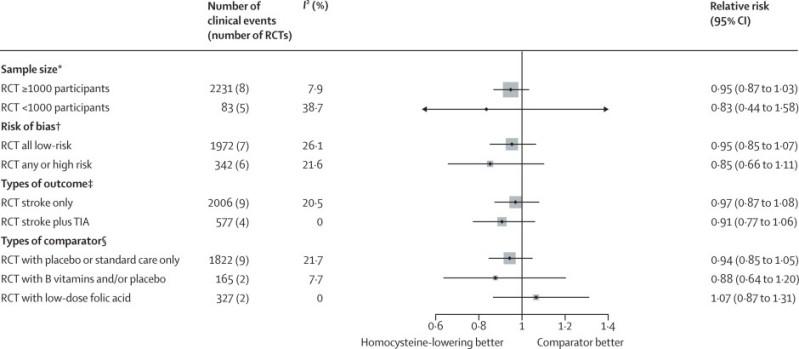
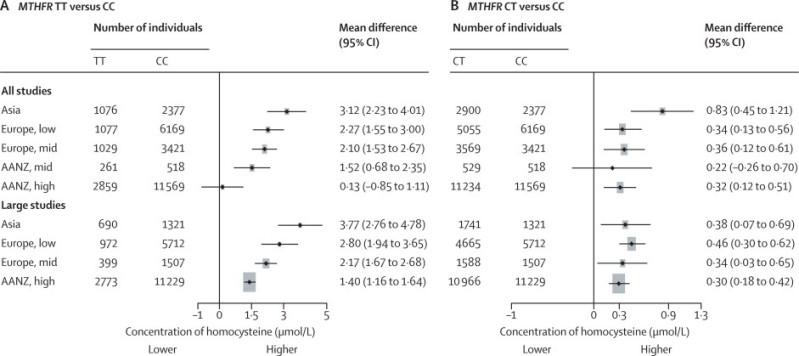
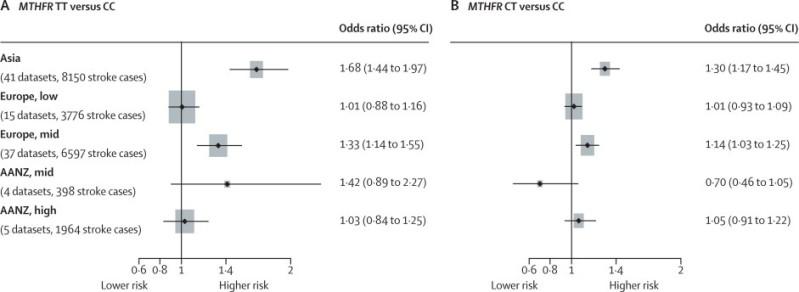
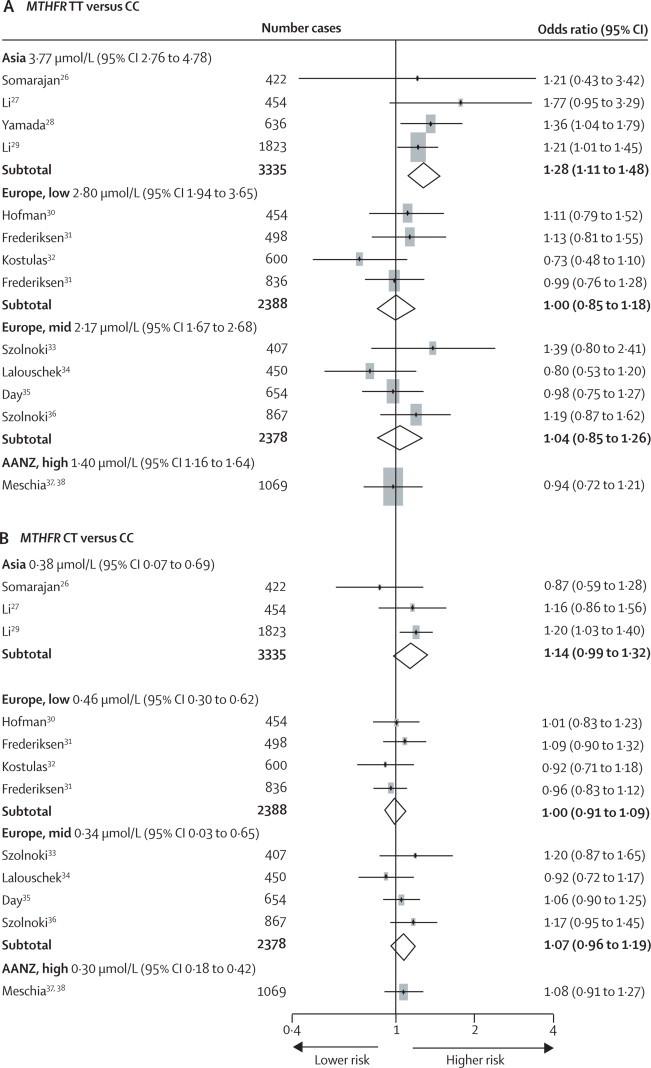
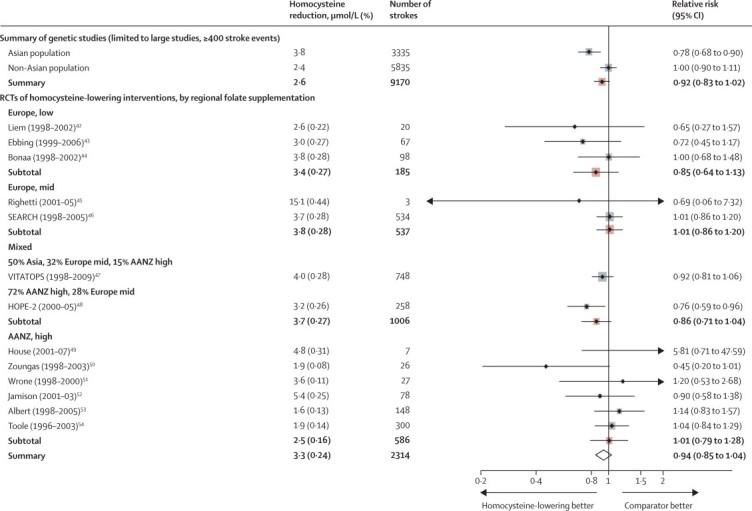
The effect of the MTHFR 677C→T variant on homocysteine concentration was larger in low folate regions (Asia; difference between individuals with TT versus CC genotype, 3·12 μmol/L, 95% CI 2·23 to 4·01) than in areas with folate fortification (America, Australia, and New Zealand, high; 0·13 μmol/L, -0·85 to 1·11). The odds ratio (OR) for stroke was also higher in Asia (1·68, 95% CI 1·44 to 1·97) than in America, Australia, and New Zealand, high (1·03, 0·84 to 1·25). Most randomised trials took place in regions with high or increasing population folate concentrations. The summary relative risk (RR) of stroke in trials of homocysteine-lowering interventions (0·94, 95% CI 0·85 to 1·04) was similar to that predicted for the same extent of homocysteine reduction in large genetic studies in populations with similar folate status (predicted RR 1·00, 95% CI 0·90 to 1·11). Although the predicted effect of homocysteine reduction from large genetic studies in low folate regions (Asia) was larger (RR 0·78, 95% CI 0·68 to 0·90), no trial has evaluated the effect of lowering of homocysteine on stroke risk exclusively in a low folate region.
INTERPRETATION
In regions with increasing levels or established policies of population folate supplementation, evidence from genetic studies and randomised trials is concordant in suggesting an absence of benefit from lowering of homocysteine for prevention of stroke. Further large-scale genetic studies of the association between MTHFR 677C→T and stroke in low folate settings are needed to distinguish effect modification by folate from small-study bias. If future randomised trials of homocysteine-lowering interventions for stroke prevention are undertaken, they should take place in regions with low folate consumption.
FUNDING
Full funding sources listed at end of paper (see Acknowledgments).
背景
MTHFR677C→T 多态性与同型半胱氨酸浓度升高和中风风险增加有关。先前的综述表明,这种影响在叶酸摄入量低的地区最大,但很难区分叶酸和小研究偏倚的作用。一项降低同型半胱氨酸干预措施的随机试验荟萃分析显示,冠心病事件或中风没有减少,但试验通常是在叶酸摄入量高的人群中进行的。我们旨在减少小研究偏倚的影响,并通过随机对照试验的遗传分析和荟萃分析,研究叶酸状态是否改变 MTHFR677C→T 与中风之间的关联。
方法
我们建立了一个由 237 个数据集组成的遗传研究合作,其中包括 59995 名个体的同型半胱氨酸数据和 20885 例中风事件。我们将遗传发现与 13 项降低同型半胱氨酸治疗和中风风险的随机试验的荟萃分析进行了比较(45549 名个体,2314 例中风,269 例短暂性脑缺血发作)。
结果
MTHFR677C→T 变体对同型半胱氨酸浓度的影响在叶酸水平低的地区(亚洲;TT 基因型与 CC 基因型个体之间的差异,3.12μmol/L,95%CI2.23 至 4.01)大于叶酸强化地区(美洲、澳大利亚和新西兰,高;0.13μmol/L,-0.85 至 1.11)。亚洲中风的比值比(OR)也高于美洲、澳大利亚和新西兰高(1.68,95%CI1.44 至 1.97)(1.03,0.84 至 1.25)。大多数随机试验都在叶酸浓度高或不断增加的地区进行。同型半胱氨酸降低干预试验的汇总相对风险(RR)(0.94,95%CI0.85 至 1.04)与在具有类似叶酸状态的人群中进行的大型遗传研究中预测的同型半胱氨酸降低相同程度的中风风险相似(预测 RR1.00,95%CI0.90 至 1.11)。尽管低叶酸地区(亚洲)大型遗传研究中预测的同型半胱氨酸降低效果更大(RR0.78,95%CI0.68 至 0.90),但尚无试验专门评估降低同型半胱氨酸对中风风险的影响。
解释
在叶酸水平不断提高或实施人口叶酸补充政策的地区,遗传研究和随机试验的证据一致表明,降低同型半胱氨酸对预防中风没有益处。需要在低叶酸环境中进行更大规模的遗传研究,以区分叶酸对 MTHFR677C→T 和中风之间关联的修饰作用和小研究偏倚。如果未来进行降低同型半胱氨酸治疗中风的随机试验,它们应该在叶酸摄入量低的地区进行。
资助
文末列出了全部资助来源(详见致谢)。
 Zotero 插件