
HIV-1 Tat 通过依赖于 p38 丝裂原活化蛋白激酶的方式激活鼠脑立体培养海马切片中的吲哚胺 2,3 双加氧酶。
HIV-1 Tat activates indoleamine 2,3 dioxygenase in murine organotypic hippocampal slice cultures in a p38 mitogen-activated protein kinase-dependent manner.
机构信息
Integrative Immunology and Behavior Program, Department of Animal Sciences, College of ACES, University of Illinois at Urbana-Champaign, Urbana, Illinois 61801, USA.
出版信息
J Neuroinflammation. 2011 Aug 2;8:88. doi: 10.1186/1742-2094-8-88.
BACKGROUND
We have established that activation of the tryptophan degrading enzyme indoleamine 2,3 dioxygenase (IDO) mediates the switch from cytokine-induced sickness behavior to depressive-like behavior. Because human immunodeficiency virus type 1 (HIV-1) Tat protein causes depressive-like behavior in mice, we investigated its ability to activate IDO in organotypic hippocampal slice cultures (OHSCs) derived from neonatal C57BL/6 mice.
METHODS
Depressive-like behavior in C57BL/6J mice was assessed by the forced swim test. Expression of cytokines and IDO mRNA in OHSCs was measured by real-time RT-PCR and cytokine protein was measured by enzyme-linked immunosorbent assays (ELISAs). p38 MAPK phosphorylation was analyzed by western blot.
RESULTS
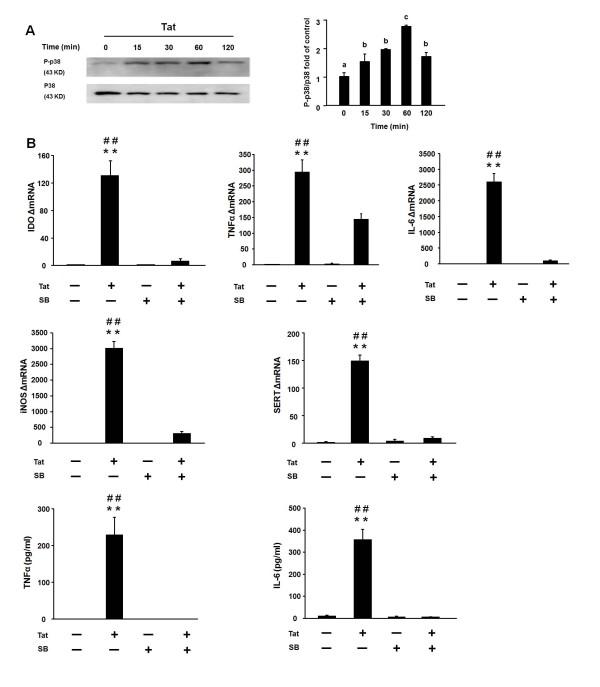
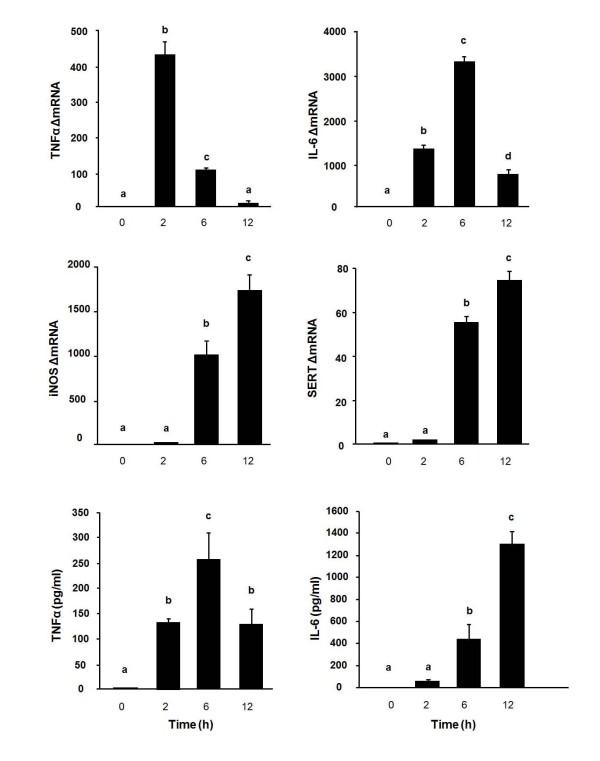
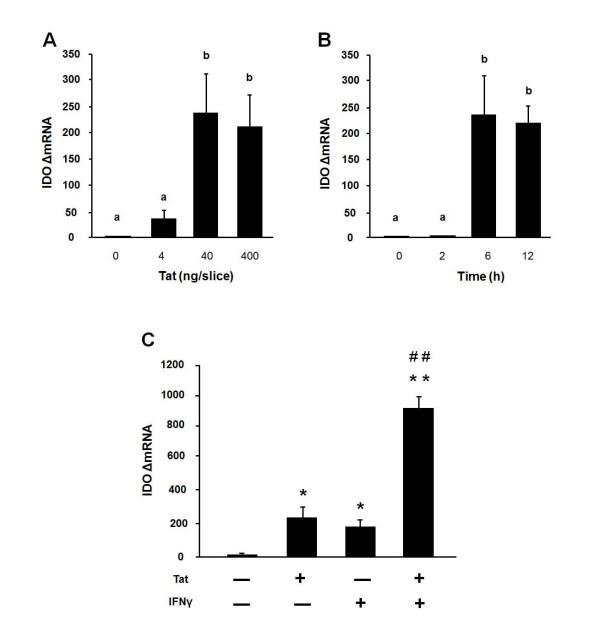
Intracerebroventricular (i.c.v.) administration of Tat (40 ng) induced depressive-like behavior in the absence of sickness. Addition of Tat (40 ng/slice) to the medium of OHSCs induced IDO steady-state mRNA that peaked at 6 h. This effect was potentiated by pretreatment with IFNγ. Tat also induced the synthesis and release of TNFα and IL-6 protein in the supernatant of the slices and increased expression of the inducible isoform of nitric oxide synthase (iNOS) and the serotonin transporter (SERT). Tat had no effect on endogenous synthesis of IFNγ. To explore the mechanisms of Tat-induced IDO expression, slices were pretreated with the p38 mitogen-activated protein kinase (MAPK) inhibitor SB 202190 for 30 min before Tat treatment. SB 202190 significantly decreased IDO expression induced by Tat, and this effect was accompanied by a reduction of Tat-induced expression of TNFα, IL-6, iNOS and SERT.
CONCLUSION
These data establish that Tat induces IDO expression via an IFNγ-independent mechanism that depends upon activation of p38 MAPK. Targeting IDO itself or the p38 MAPK signaling pathway could provide a novel therapy for comorbid depressive disorders in HIV-1-infected patients.
背景
我们已经证实,色氨酸降解酶吲哚胺 2,3 双加氧酶(IDO)的激活介导了细胞因子诱导的疾病行为向抑郁样行为的转变。由于人类免疫缺陷病毒 1(HIV-1)Tat 蛋白会导致小鼠出现抑郁样行为,我们研究了它在源自新生 C57BL/6 小鼠的器官型海马切片培养物(OHSCs)中激活 IDO 的能力。
方法
通过强迫游泳试验评估 C57BL/6J 小鼠的抑郁样行为。通过实时 RT-PCR 测量 OHSCs 中的细胞因子和 IDO mRNA 的表达,并通过酶联免疫吸附测定(ELISA)测量细胞因子蛋白。通过 Western blot 分析 p38 MAPK 磷酸化。
结果
侧脑室(i.c.v.)给予 Tat(40 ng)在没有疾病的情况下诱导抑郁样行为。将 Tat(40 ng/切片)添加到 OHSCs 的培养基中诱导 IDO 稳态 mRNA,其在 6 小时达到峰值。这种作用通过 IFNγ 的预处理得到增强。Tat 还诱导了上清液中 TNFα 和 IL-6 蛋白的合成和释放,并增加了诱导型一氧化氮合酶(iNOS)和 5-羟色胺转运体(SERT)的表达。Tat 对 IFNγ 的内源性合成没有影响。为了探索 Tat 诱导 IDO 表达的机制,在 Tat 处理前用 p38 丝裂原激活蛋白激酶(MAPK)抑制剂 SB 202190 预处理切片 30 分钟。SB 202190 显著降低了 Tat 诱导的 IDO 表达,并且这种作用伴随着 Tat 诱导的 TNFα、IL-6、iNOS 和 SERT 表达的减少。
结论
这些数据表明,Tat 通过一种不依赖 IFNγ 的机制诱导 IDO 表达,该机制依赖于 p38 MAPK 的激活。针对 IDO 本身或 p38 MAPK 信号通路可能为 HIV-1 感染患者的共病性抑郁障碍提供一种新的治疗方法。


 Zotero 插件