
用 PHD 手指手选表观遗传标记。
Handpicking epigenetic marks with PHD fingers.
机构信息
Department of Pharmacology, University of Colorado School of Medicine, Aurora, CO 80045, USA.
出版信息
Nucleic Acids Res. 2011 Nov;39(21):9061-71. doi: 10.1093/nar/gkr613. Epub 2011 Aug 3.
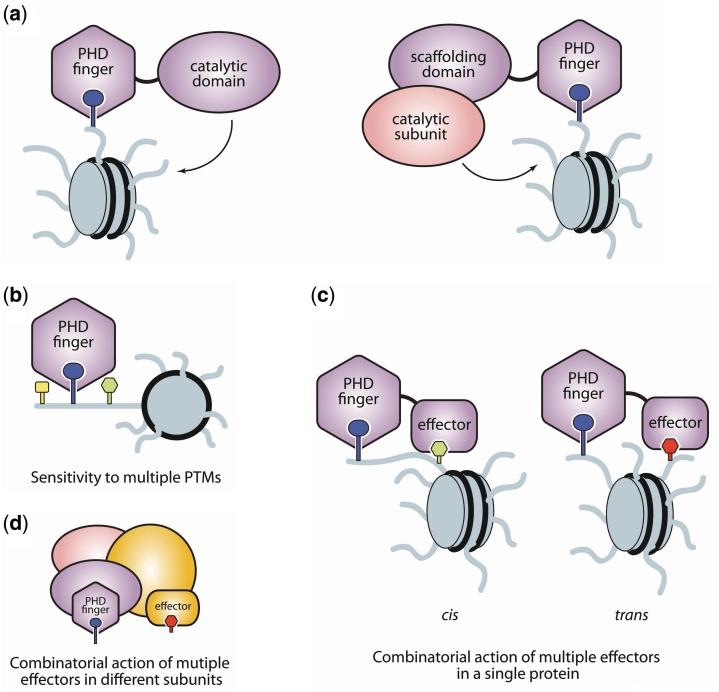
Plant homeodomain (PHD) fingers have emerged as one of the largest families of epigenetic effectors capable of recognizing or 'reading' post-translational histone modifications and unmodified histone tails. These interactions are highly specific and can be modulated by the neighboring epigenetic marks and adjacent effectors. A few PHD fingers have recently been found to also associate with non-histone proteins. In this review, we detail the molecular mechanisms and biological outcomes of the histone and non-histone targeting by PHD fingers. We discuss the significance of crosstalk between the histone modifications and consequences of combinatorial readout for selective recruitment of the PHD finger-containing components of chromatin remodeling and transcriptional complexes.
植物同源结构域 (PHD) 指是最大的一组表观遗传效应因子家族之一,能够识别或“读取”翻译后组蛋白修饰和未修饰的组蛋白尾巴。这些相互作用具有高度特异性,并可被相邻的表观遗传标记和相邻的效应物调节。最近发现少数 PHD 指也与非组蛋白蛋白结合。在这篇综述中,我们详细描述了 PHD 指对组蛋白和非组蛋白的靶向的分子机制和生物学结果。我们讨论了组蛋白修饰之间的串扰以及组合读出对选择性招募染色质重塑和转录复合物中含有 PHD 指的成分的后果的意义。



 Zotero 插件