
掠食者猫气味激活感染弓形虫大鼠大脑中的性唤起途径。
Predator cat odors activate sexual arousal pathways in brains of Toxoplasma gondii infected rats.
机构信息
Program in Neuroscience, Stanford University, Stanford, California, United States of America.
出版信息
PLoS One. 2011;6(8):e23277. doi: 10.1371/journal.pone.0023277. Epub 2011 Aug 17.
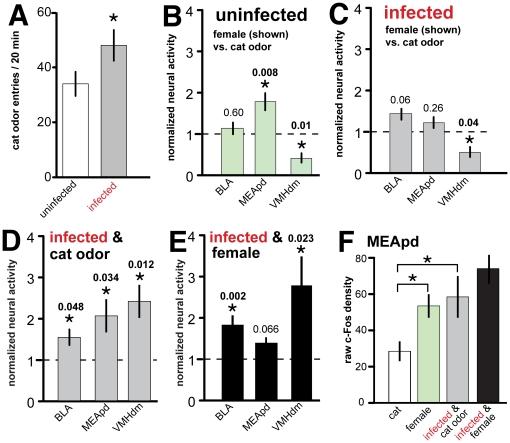
Cat odors induce rapid, innate and stereotyped defensive behaviors in rats at first exposure, a presumed response to the evolutionary pressures of predation. Bizarrely, rats infected with the brain parasite Toxoplasma gondii approach the cat odors they typically avoid. Since the protozoan Toxoplasma requires the cat to sexually reproduce, this change in host behavior is thought to be a remarkable example of a parasite manipulating a mammalian host for its own benefit. Toxoplasma does not influence host response to non-feline predator odor nor does it alter behavior on olfactory, social, fear or anxiety tests, arguing for specific manipulation in the processing of cat odor. We report that Toxoplasma infection alters neural activity in limbic brain areas necessary for innate defensive behavior in response to cat odor. Moreover, Toxoplasma increases activity in nearby limbic regions of sexual attraction when the rat is exposed to cat urine, compelling evidence that Toxoplasma overwhelms the innate fear response by causing, in its stead, a type of sexual attraction to the normally aversive cat odor.
猫的气味在老鼠初次接触时会引发快速、先天和刻板的防御行为,这被认为是对捕食压力的进化反应。奇怪的是,感染了脑部寄生虫刚地弓形虫的老鼠会接近它们通常会避开的猫的气味。由于原生动物刚地弓形虫需要猫进行有性繁殖,这种宿主行为的改变被认为是寄生虫为了自身利益操纵哺乳动物宿主的一个显著例子。刚地弓形虫不会影响宿主对非猫科捕食者气味的反应,也不会改变嗅觉、社交、恐惧或焦虑测试中的行为,这表明它在猫气味的处理过程中进行了特定的操纵。我们报告称,刚地弓形虫感染会改变边缘脑区的神经活动,而这些脑区对于对猫的气味做出先天防御反应是必需的。此外,当老鼠接触到猫尿时,刚地弓形虫会增加附近与性吸引力相关的边缘区域的活动,这有力地证明了刚地弓形虫通过引起对通常令人厌恶的猫的气味的一种性吸引力,从而压倒了先天的恐惧反应。

 Zotero 插件