
Pumilio-2 在小鼠神经系统中的功能。
Pumilio-2 function in the mouse nervous system.
机构信息
Institute for Stem Cell Biology and Regenerative Medicine, Department of Obstetrics and Gynecology, Stanford University School of Medicine, Stanford, California, United States of America.
出版信息
PLoS One. 2011;6(10):e25932. doi: 10.1371/journal.pone.0025932. Epub 2011 Oct 7.
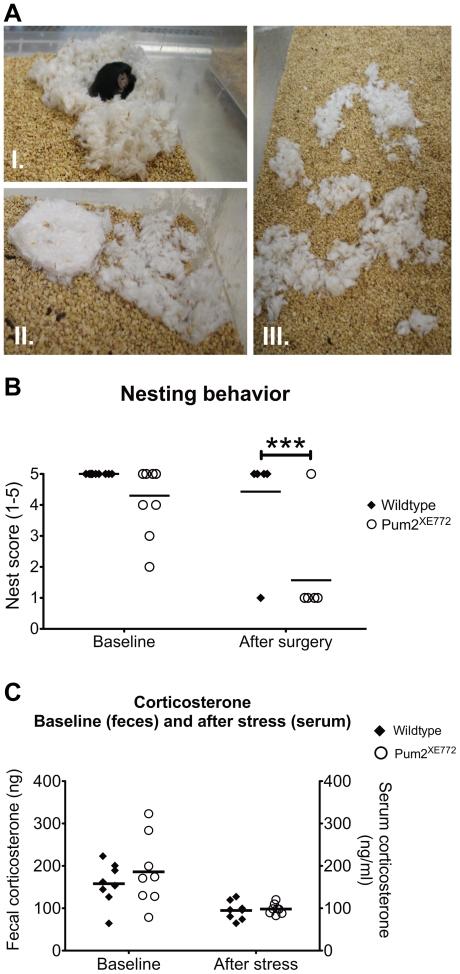
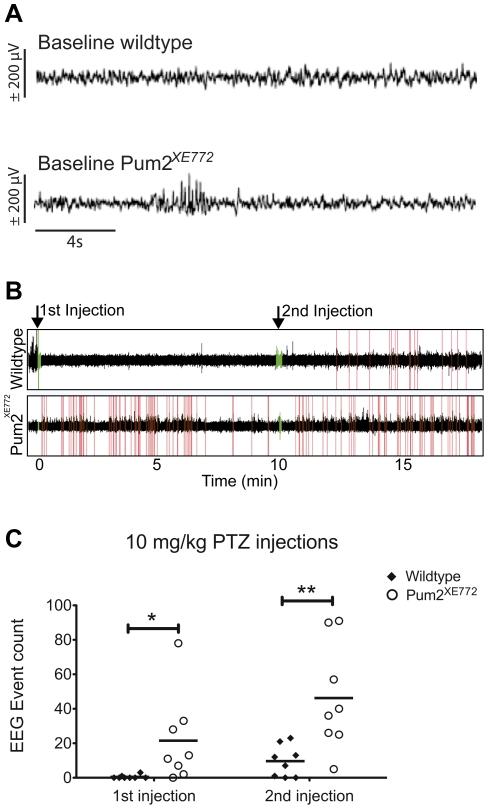
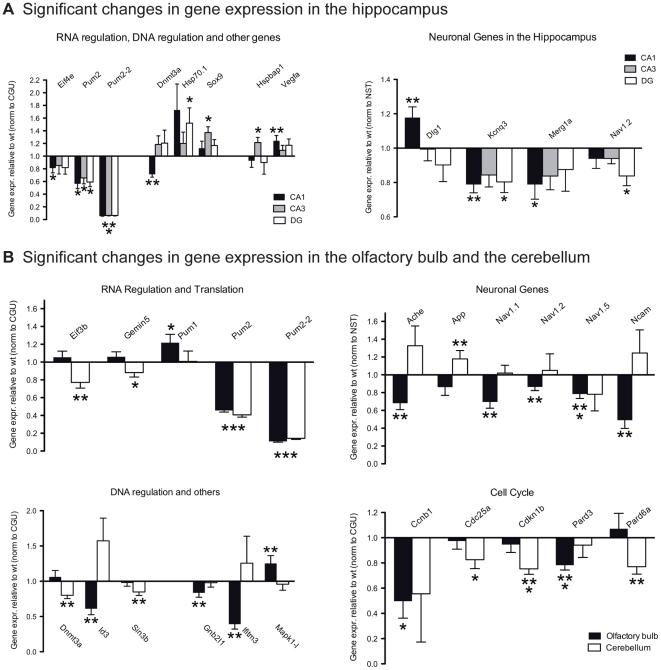
Coordinated mRNA translation at the synapse is increasingly recognized as a critical mechanism for neuronal regulation. Pumilio, a translational regulator, is known to be involved in neuronal homeostasis and memory formation in Drosophila. Most recently, the mammalian Pumilio homolog Pumilio-2 (Pum2) has been found to play a role in the mammalian nervous system, in particular in regulating morphology, arborization and excitability of neuronal dendrites, in vitro. However, the role of Pum2 in vivo remains unclear. Here, we report our investigation of the functional and molecular consequences of Pum2 disruption in vivo using an array of neurophysiology, behavioral and gene expression profiling techniques. We used Pum2-deficient mice to monitor in vivo brain activity using EEG and to study behavior traits, including memory, locomotor activity and nesting capacities. Because of the suspected role of Pum2 in neuronal excitability, we also examined the susceptibility to seizure induction. Finally, we used a quantitative gene expression profiling assay to identify key molecular partners of Pum2. We found that Pum2-deficient mice have abnormal behavioral strategies in spatial and object memory test. Additionally, Pum2 deficiency is associated with increased locomotor activity and decreased body weight. We also observed environmentally-induced impairment in nesting behavior. Most importantly, Pum2-deficient mice showed spontaneous EEG abnormalities and had lower seizure thresholds using a convulsing dosage of pentylenetetrazole. Finally, some genes, including neuronal ion channels, were differentially expressed in the hippocampus of Pum2-deficient mice. These findings demonstrate that Pum2 serves key functions in the adult mammalian central nervous system encompassing neuronal excitability and behavioral response to environmental challenges.
突触处协调的 mRNA 翻译逐渐被认为是神经元调节的关键机制。翻译调节因子 pumilio 已知参与果蝇的神经元稳态和记忆形成。最近,发现哺乳动物 pumilio 同源物 pumilio-2 (pum2) 在哺乳动物神经系统中发挥作用,特别是在调节神经元树突的形态、分支和兴奋性,在体外。然而,pum2 在体内的作用尚不清楚。在这里,我们使用一系列神经生理学、行为和基因表达谱分析技术,报告了我们对体内 pum2 缺失的功能和分子后果的研究。我们使用 pum2 缺陷小鼠使用 EEG 监测体内大脑活动,并研究行为特征,包括记忆、运动活动和筑巢能力。由于 pum2 疑似在神经元兴奋性中发挥作用,我们还检查了对癫痫诱导的易感性。最后,我们使用定量基因表达谱分析检测鉴定 pum2 的关键分子伴侣。我们发现 pum2 缺陷小鼠在空间和物体记忆测试中表现出异常的行为策略。此外,pum2 缺失与运动活动增加和体重减轻有关。我们还观察到筑巢行为的环境诱导损伤。最重要的是,pum2 缺陷小鼠表现出自发的 EEG 异常,并且使用戊四氮致惊厥剂量时癫痫发作阈值降低。最后,一些基因,包括神经元离子通道,在 pum2 缺陷小鼠的海马体中表达不同。这些发现表明 pum2 在成年哺乳动物中枢神经系统中发挥关键功能,包括神经元兴奋性和对环境挑战的行为反应。



 Zotero 插件