
犬尿氨酸途径代谢产物对人原代星形胶质细胞和神经元细胞内烟酰胺腺嘌呤二核苷酸合成及细胞死亡的影响。
Effects of Kynurenine Pathway Metabolites on Intracellular NAD Synthesis and Cell Death in Human Primary Astrocytes and Neurons.
作者信息
Braidy Nady, Grant Ross, Brew Bruce J, Adams Seray, Jayasena Tharusha, Guillemin Gilles J
机构信息
University of New South Wales, Faculty of Medicine, Sydney, Australia.
出版信息
Int J Tryptophan Res. 2009;2:61-9. doi: 10.4137/ijtr.s2318. Epub 2009 Apr 3.
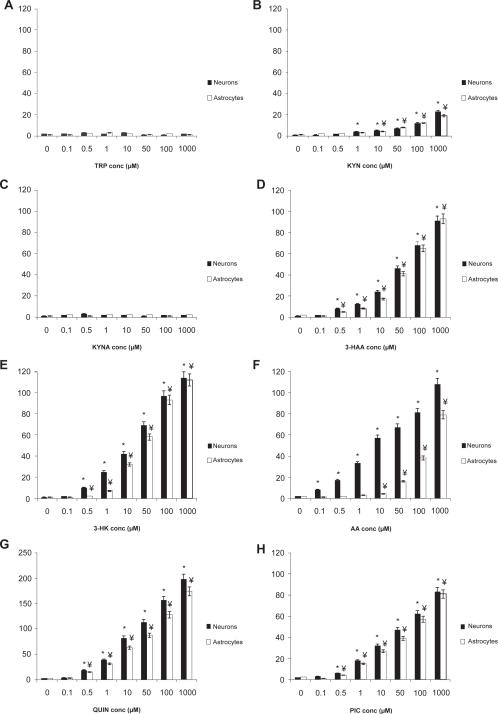
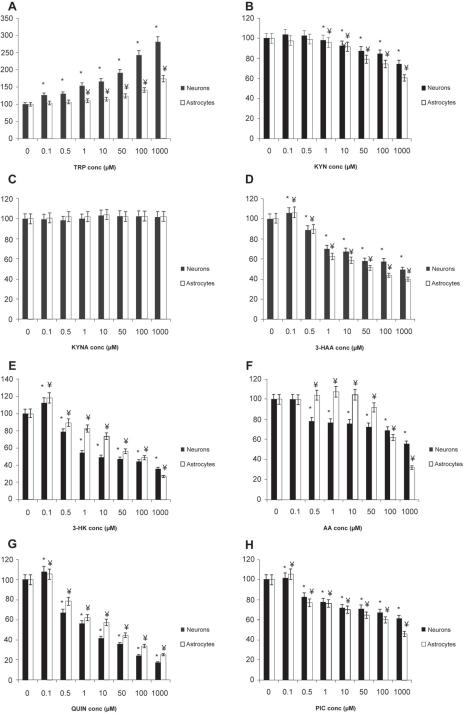
The kynurenine pathway (KP) is a major route of L-tryptophan catabolism resulting in the production of the essential pyridine nucleotide nicotinamide adenine dinucleotide, (NAD(+)). Up-regulation of the KP during inflammation leads to the release of a number of biologically active metabolites into the brain. We hypothesised that while some of the extracellular KP metabolites may be beneficial for intracellular NAD(+) synthesis and cell survival at physiological concentrations, they may contribute to neuronal and astroglial dysfunction and cell death at pathophysiological concentrations. In this study, we found that treatment of human primary neurons and astrocytes with 3-hydroxyanthranilic acid (3-HAA), 3-hydroxykynurenine (3-HK), quinolinic acid (QUIN), and picolinic acid (PIC) at concentrations below 100 nM significantly increased intracellular NAD(+) levels compared to non-treated cells. However, a dose dependent decrease in intracellular NAD(+) levels and increased extracellular LDH activity was observed in human astrocytes and neurons treated with 3-HAA, 3-HK, QUIN and PIC at concentrations >100 nM and kynurenine (KYN), at concentrations above 1 μM. Intracellular NAD(+) levels were unchanged in the presence of the neuroprotectant, kynurenic acid (KYNA), and a dose dependent increase in intracellular NAD(+) levels was observed for TRP up to 1 mM. While anthranilic acid (AA) increased intracellular NAD(+) levels at concentration below 10 μM in astrocytes. NAD(+) depletion and cell death was observed in AA treated neurons at concentrations above 500 nM. Therefore, the differing responses of astrocytes and neurons to an increase in KP metabolites should be considered when assessing KP toxicity during neuroinflammation.
犬尿氨酸途径(KP)是L-色氨酸分解代谢的主要途径,可产生必需的吡啶核苷酸烟酰胺腺嘌呤二核苷酸(NAD(+))。炎症期间KP的上调会导致多种生物活性代谢产物释放到大脑中。我们推测,虽然一些细胞外KP代谢产物在生理浓度下可能有利于细胞内NAD(+)合成和细胞存活,但在病理生理浓度下它们可能导致神经元和星形胶质细胞功能障碍及细胞死亡。在本研究中,我们发现,与未处理的细胞相比,用浓度低于100 nM的3-羟基邻氨基苯甲酸(3-HAA)、3-羟基犬尿氨酸(3-HK)、喹啉酸(QUIN)和吡啶甲酸(PIC)处理人原代神经元和星形胶质细胞,可显著提高细胞内NAD(+)水平。然而,在用浓度>100 nM的3-HAA、3-HK、QUIN和PIC以及浓度高于1 μM的犬尿氨酸(KYN)处理的人星形胶质细胞和神经元中,观察到细胞内NAD(+)水平呈剂量依赖性下降,细胞外乳酸脱氢酶(LDH)活性增加。在存在神经保护剂犬尿喹啉酸(KYNA)的情况下,细胞内NAD(+)水平未发生变化,而对于色氨酸(TRP),直至1 mM时观察到细胞内NAD(+)水平呈剂量依赖性增加。虽然邻氨基苯甲酸(AA)在浓度低于10 μM时可提高星形胶质细胞内NAD(+)水平。在浓度高于500 nM时,经AA处理 的神经元中观察到NAD(+)耗竭和细胞死亡。因此,在评估神经炎症期间KP的毒性时,应考虑星形胶质细胞和神经元对KP代谢产物增加的不同反应。

 Zotero 插件