
老年恶性黑色素瘤:区域性疾病不同,预后更差。
Malignant melanoma in the elderly: different regional disease and poorer prognosis.
机构信息
1. Department of Dermatology, Mayo Clinic Arizona, 5777 E Mayo Boulevard, Phoenix, AZ 85054, USA.
出版信息
J Cancer. 2011;2:538-43. doi: 10.7150/jca.2.538. Epub 2011 Nov 1.
PURPOSE
Age is a poor prognostic factor in melanoma patients. Elderly melanoma patients have a different presentation and clinical course than younger patients. We evaluated the impact of age ≥70 years (yrs) on the diagnosis and natural history of melanoma.
METHODS
Retrospective review of 610 patients with malignant melanoma entered into a prospective sentinel lymph node (SLN) database, treated from June 1997 to June 2010. Disease characteristics and clinical outcomes were compared between patients ≥70 yrs vs. <70 yrs of age.
RESULTS
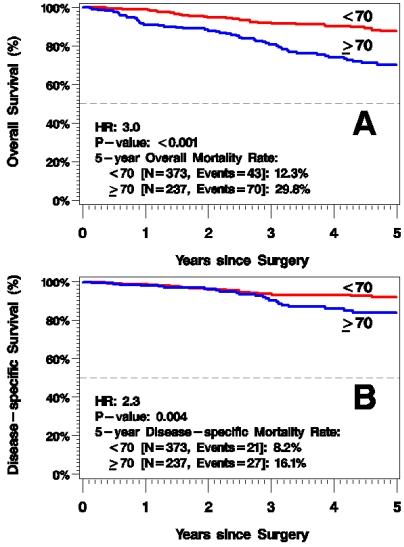
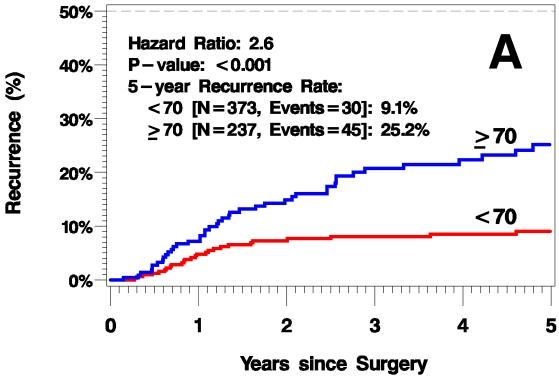
237 patients (39%) were ≥70 yrs. Elderly patients had a higher proportion of head and neck melanomas (34% vs. 20%, p<0.001), and greater mean tumor thickness (2.4mm vs. 1.8mm, p<0.001). A greater proportion of T3 or T4 melanoma was seen in the elderly (p<0.001) as well as a greater mean number of mitotic figures: 3.6/mm(2) vs. 2.7/mm(2) (p=0.005). Despite greater mean thickness, the incidence of SLN metastases was less in the ≥70 yrs group with T3/T4 melanomas (18% vs. 33%, p=0.02). The elderly had a higher rate of local and in-transit recurrences, 14.5% vs. 3.4% at 5 yrs (p<0.001). 5 yr disease-specific mortality and overall mortality were worse for those ≥70 yrs: 16% vs. 8% (p=0.004), and 30% vs. 12% (p<0.001), respectively.
CONCLUSIONS
Elderly (≥70 yrs) melanoma patients present with thicker melanomas and a higher mitotic rate but have fewer SLN metastases. Melanoma in the elderly is more common on the head and neck. Higher incidence of local/in-transit metastases is seen among the elderly. Five-year disease-specific mortality and overall mortality are both worse for these patients.
目的
年龄是黑色素瘤患者的一个不良预后因素。老年黑色素瘤患者的表现和临床过程与年轻患者不同。我们评估了年龄≥70 岁(yrs)对黑色素瘤的诊断和自然史的影响。
方法
回顾性分析了 1997 年 6 月至 2010 年 6 月期间进入前瞻性前哨淋巴结(SLN)数据库的 610 例恶性黑色素瘤患者。比较了≥70 岁和<70 岁患者的疾病特征和临床结局。
结果
237 例(39%)患者≥70 岁。老年患者头颈部黑色素瘤的比例较高(34% vs. 20%,p<0.001),肿瘤平均厚度较大(2.4mm vs. 1.8mm,p<0.001)。T3 或 T4 黑色素瘤在老年患者中更为常见(p<0.001),且平均有丝分裂数也较多:3.6/mm2 vs. 2.7/mm2(p=0.005)。尽管平均厚度较大,但 T3/T4 黑色素瘤的≥70 岁患者的 SLN 转移发生率较低(18% vs. 33%,p=0.02)。老年患者局部和转移复发的发生率较高,分别为 14.5%和 3.4%(p<0.001)。5 年疾病特异性死亡率和总死亡率在≥70 岁的患者中均较差:分别为 16%和 8%(p=0.004),30%和 12%(p<0.001)。
结论
老年(≥70 岁)黑色素瘤患者表现为较厚的黑色素瘤和较高的有丝分裂率,但 SLN 转移较少。老年人的黑色素瘤更常见于头颈部。老年患者局部/转移复发的发生率较高。这些患者的 5 年疾病特异性死亡率和总死亡率均较差。
 Zotero 插件