
人肌肉源性干细胞与脂肪源性干细胞在神经源性转分化中的比较。
Comparison of human muscle-derived stem cells and human adipose-derived stem cells in neurogenic trans-differentiation.
作者信息
Kwon Eun Bi, Lee Ji Young, Piao Shuyu, Kim In Gul, Ra Jeong Chan, Lee Ji Youl
机构信息
Department of Urology, College of Medicine, The Catholic University of Korea, Ltd. Seoul, Korea.
出版信息
Korean J Urol. 2011 Dec;52(12):852-7. doi: 10.4111/kju.2011.52.12.852. Epub 2011 Dec 20.
PURPOSE
Erectile dysfunction (ED) remains a major complication from cavernous nerve injury during radical prostatectomy. Recently, stem cell treatment for ED has been widely reported. This study was conducted to investigate the availability, differentiation into functional cells, and potential of human muscle-derived stem cells (hMDSCs) and human adipose-derived stem cells (hADSCs) for ED treatment.
MATERIALS AND METHODS
We compared the neural differentiation of hMDSCs and hADSCs. Human muscle and adipose tissues were digested with collagenase, followed by filtering and centrifugation. For neural induction, isolated hMDSCs and hADSCs were incubated in neurobasal media containing forskolin, laminin, basic-fibroblast growth factor, and epidermal growth factor for 5 days. Following neural induction, hMDSCs and hADSCs were differentiated into neural cells, including neurons and glia, in vitro.
RESULTS
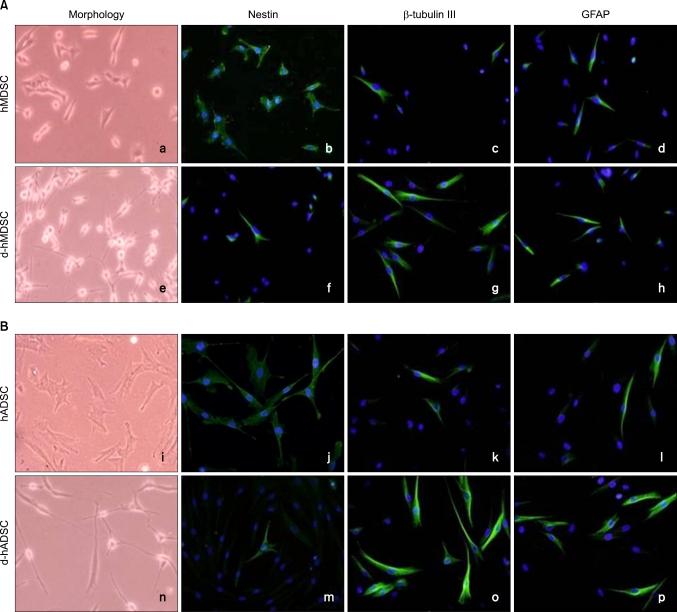
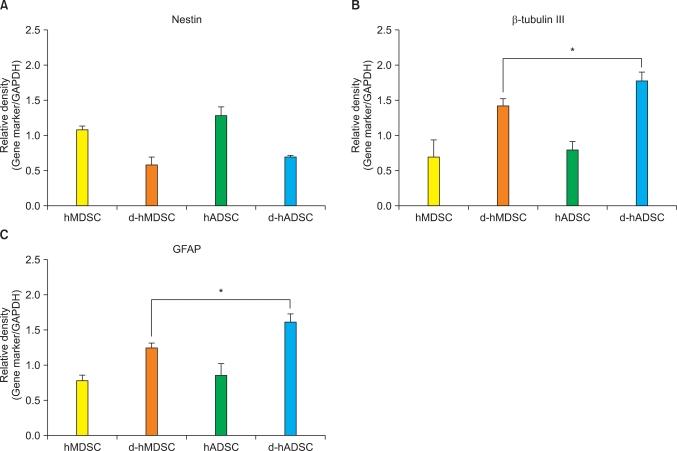
In neural differentiated hMDSCs (d-hMDSCs) and differentiated hADSCs (d-hADSCs), neural stem cell marker (nestin) showed a significant decrease by immunocytochemistry, and neuronal marker (β-tubulin III) and glial marker (GFAP) showed a significant increase, compared with primary hMDSCs and hADSCs. Real-time chain reaction analysis and Western blotting demonstrated significantly elevated levels of mRNA and protein of β-tubulin III and GFAP in d-hADSCs compared with d-hMDSCs.
CONCLUSIONS
We demonstrated that hMDSCs and hADSCs can be induced to undergo phenotypic and molecular changes consistent with neurons. The neural differentiation capacity of hADSCs was better than that of hMDSCs.
目的
勃起功能障碍(ED)仍是根治性前列腺切除术中海绵体神经损伤的主要并发症。近来,干细胞治疗ED的报道颇多。本研究旨在探讨人肌肉源性干细胞(hMDSCs)和人脂肪源性干细胞(hADSCs)用于治疗ED的可行性、向功能细胞的分化能力及潜能。
材料与方法
我们比较了hMDSCs和hADSCs的神经分化情况。用人肌肉和脂肪组织用胶原酶消化,随后过滤和离心。对于神经诱导,将分离的hMDSCs和hADSCs在含有福司可林、层粘连蛋白、碱性成纤维细胞生长因子和表皮生长因子的神经基础培养基中孵育5天。神经诱导后,hMDSCs和hADSCs在体外分化为神经细胞,包括神经元和神经胶质细胞。
结果
与原代hMDSCs和hADSCs相比,免疫细胞化学显示神经分化的hMDSCs(d-hMDSCs)和分化的hADSCs(d-hADSCs)中神经干细胞标志物(巢蛋白)显著减少,神经元标志物(β-微管蛋白III)和神经胶质标志物(胶质纤维酸性蛋白,GFAP)显著增加。实时链反应分析和蛋白质印迹法显示,与d-hMDSCs相比,d-hADSCs中β-微管蛋白III和GFAP的mRNA和蛋白质水平显著升高。
结论
我们证明hMDSCs和hADSCs可被诱导发生与神经元一致的表型和分子变化。hADSCs的神经分化能力优于hMDSCs。

 Zotero 插件