
腹侧被盖区中与奖赏和惩罚相关的神经元类型特异性信号。
Neuron-type-specific signals for reward and punishment in the ventral tegmental area.
机构信息
Department of Molecular and Cellular Biology, Center for Brain Science, Harvard University, Cambridge, Massachusetts 02138, USA.
出版信息
Nature. 2012 Jan 18;482(7383):85-8. doi: 10.1038/nature10754.
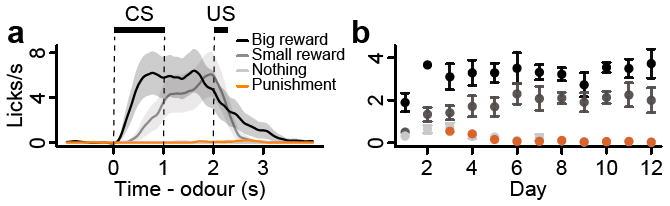
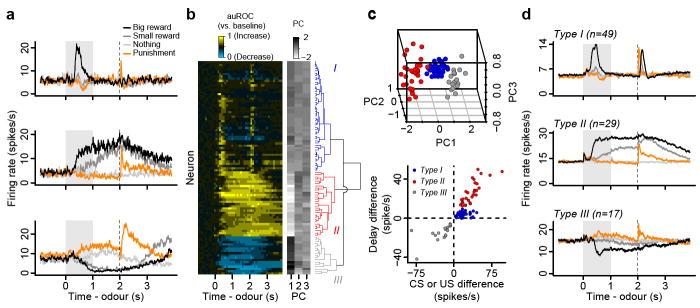
Dopamine has a central role in motivation and reward. Dopaminergic neurons in the ventral tegmental area (VTA) signal the discrepancy between expected and actual rewards (that is, reward prediction error), but how they compute such signals is unknown. We recorded the activity of VTA neurons while mice associated different odour cues with appetitive and aversive outcomes. We found three types of neuron based on responses to odours and outcomes: approximately half of the neurons (type I, 52%) showed phasic excitation after reward-predicting odours and rewards in a manner consistent with reward prediction error coding; the other half of neurons showed persistent activity during the delay between odour and outcome that was modulated positively (type II, 31%) or negatively (type III, 18%) by the value of outcomes. Whereas the activity of type I neurons was sensitive to actual outcomes (that is, when the reward was delivered as expected compared to when it was unexpectedly omitted), the activity of type II and type III neurons was determined predominantly by reward-predicting odours. We 'tagged' dopaminergic and GABAergic neurons with the light-sensitive protein channelrhodopsin-2 and identified them based on their responses to optical stimulation while recording. All identified dopaminergic neurons were of type I and all GABAergic neurons were of type II. These results show that VTA GABAergic neurons signal expected reward, a key variable for dopaminergic neurons to calculate reward prediction error.
多巴胺在动机和奖励中起着核心作用。腹侧被盖区(VTA)中的多巴胺能神经元信号传递了预期和实际奖励之间的差异(即奖励预测误差),但它们如何计算这些信号尚不清楚。我们在小鼠将不同的气味线索与奖赏和厌恶的结果联系起来的同时,记录了 VTA 神经元的活动。我们根据对气味和结果的反应,发现了三种类型的神经元:大约一半的神经元(I 型,52%)以与奖励预测错误编码一致的方式,在奖励预测气味和奖励出现后表现出相位兴奋;另一半神经元在气味和结果之间的延迟期间表现出持续活动,其活动受到结果价值的正向(II 型,31%)或负向(III 型,18%)调节。虽然 I 型神经元的活动对实际结果敏感(即当奖励如预期那样被给予时,与当奖励意外地被省略时相比),但 II 型和 III 型神经元的活动主要取决于奖励预测气味。我们使用光敏感蛋白通道蛋白视紫红质-2 对多巴胺能和 GABA 能神经元进行了“标记”,并在记录的同时根据它们对光刺激的反应来识别它们。所有鉴定出的多巴胺能神经元都是 I 型,所有 GABA 能神经元都是 II 型。这些结果表明,VTA GABA 能神经元信号传递了预期的奖励,这是多巴胺能神经元计算奖励预测误差的关键变量。


 Zotero 插件