
大剂量邻苯二甲酸二(2-乙基己基)酯(DEHP)对食蟹猴(猕猴)肝脏过氧化物酶体的影响。
Effect of a Large Dose of Di (2-ethylhexyl) phthalate (DEHP) on Hepatic Peroxisome in Cynomolgus Monkeys (Macaca Fascicularis).
作者信息
Satake Shigeru, Nakamura Chika, Minamide Yoshiyuki, Kudo Shinobu, Maeda Hiroshi, Chihaya Yutaka, Kamimura Yasuhiro, Miyajima Hiroaki, Sasaki Jun, Goryo Masanobu, Okada Kosuke
出版信息
J Toxicol Pathol. 2010 Jun;23(2):75-83. doi: 10.1293/tox.23.75. Epub 2010 Jun 30.
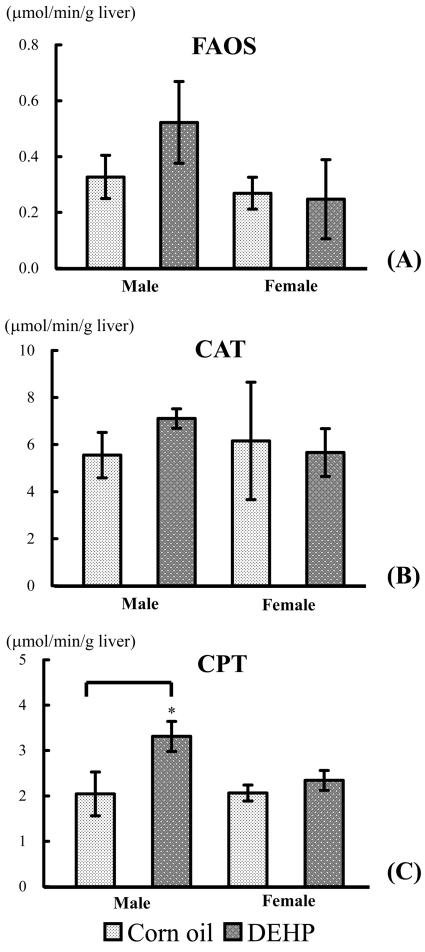
To elucidate the effect of a large dose of di (2-ethylhexyl) phthalate (DEHP), a plasticizer and peroxisome proliferator-activated receptor-α (PPARα) agonist, on hepatic peroxisomes, we orally administered 1,000 mg/kg/day, once daily, to 3 male and 4 female cynomolgus monkeys for 28 days consecutively. Light-microscopic and electron microscopic examinations of the liver were carried out in conjunction with measurement of the hepatic fatty acid β-oxidation system (FAOS), carnitine acetyltransferase (CAT) and carnitine palmitoyltransferase (CPT) activities, which are peroxisomal and/or mitochondrial enzyme activities. Electron microscopically, enlargement of the mitochondria was observed with lamellar orientation of the cristae along the major axis. Although the number of peroxisomes showed a tendency to increase when compared with those in a biopsied specimen before treatment, no abnormality in morphology was observed. A slight increase in CPT activity was noted at termination. No changes were noted in hepatic FAOS or CAT activity. In conclusion, although repeated oral treatment of cynomolgus monkeys with a large dose of DEHP induced a subtle increase in the numbers of peroxisomes with slight enlargements of the mitochondria, this low-sensitivity response to peroxisome proliferators in cynomolgus monkeys was considered to be closer to the response in humans than that in rodents.
为阐明大剂量邻苯二甲酸二(2-乙基己基)酯(DEHP,一种增塑剂和过氧化物酶体增殖物激活受体-α(PPARα)激动剂)对肝脏过氧化物酶体的影响,我们连续28天每天给3只雄性和4只雌性食蟹猴口服1000 mg/kg/天的剂量。结合对肝脏脂肪酸β-氧化系统(FAOS)、肉碱乙酰转移酶(CAT)和肉碱棕榈酰转移酶(CPT)活性的测定进行肝脏的光镜和电镜检查,这些酶活性为过氧化物酶体和/或线粒体酶活性。电镜观察显示线粒体增大,嵴沿主轴呈层状排列。虽然与治疗前活检标本相比,过氧化物酶体数量有增加趋势,但未观察到形态异常。在实验结束时发现CPT活性略有增加。肝脏FAOS或CAT活性未见变化。总之,尽管用大剂量DEHP反复口服治疗食蟹猴会导致过氧化物酶体数量略有增加,线粒体略有增大,但食蟹猴对过氧化物酶体增殖剂的这种低敏感性反应被认为比啮齿动物更接近人类的反应。


 Zotero 插件