
雌激素受体-α 36 介导 ER 阴性乳腺癌细胞中的有丝分裂型抗雌激素信号转导。
Estrogen receptor-alpha 36 mediates mitogenic antiestrogen signaling in ER-negative breast cancer cells.
机构信息
Department of Medical Microbiology and Immunology, Creighton University Medical School, Omaha, Nebraska, United States of America.
出版信息
PLoS One. 2012;7(1):e30174. doi: 10.1371/journal.pone.0030174. Epub 2012 Jan 19.
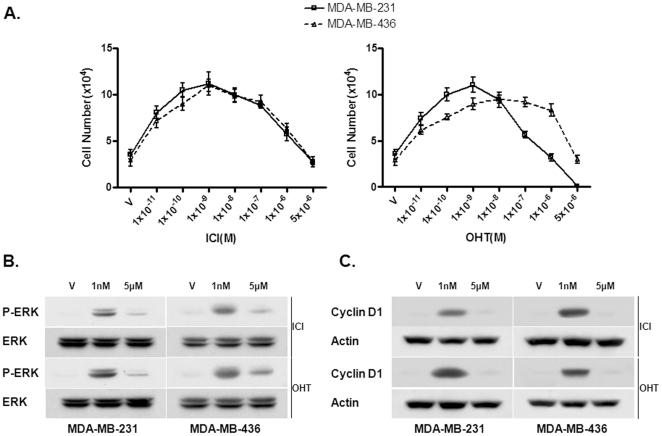
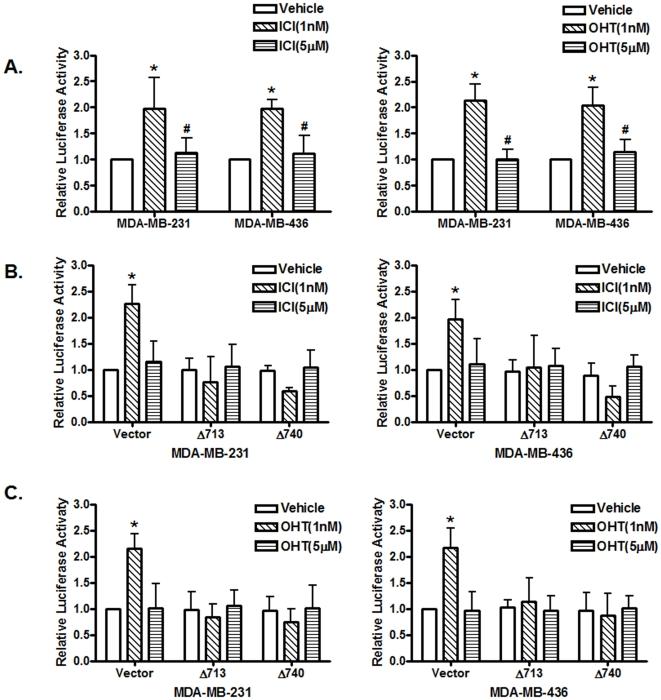
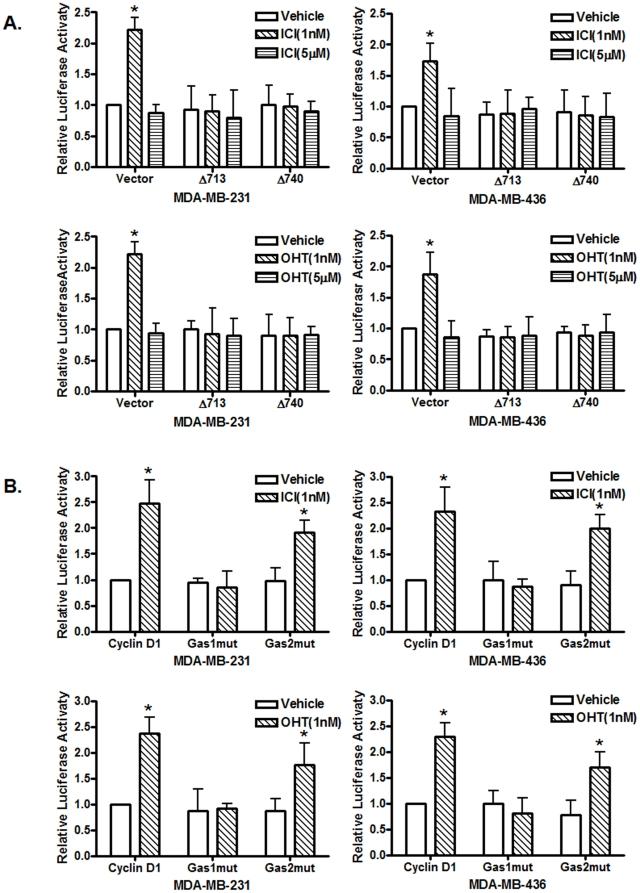
It is prevailingly thought that the antiestrogens tamoxifen and ICI 182, 780 are competitive antagonists of the estrogen-binding site of the estrogen receptor-alpha (ER-α). However, a plethora of evidence demonstrated both antiestrogens exhibit agonist activities in different systems such as activation of the membrane-initiated signaling pathways. The mechanisms by which antiestrogens mediate estrogen-like activities have not been fully established. Previously, a variant of ER-α, EP-α36, has been cloned and showed to mediate membrane-initiated estrogen and antiestrogen signaling in cells only expressing ER-α36. Here, we investigated the molecular mechanisms underlying the antiestrogen signaling in ER-negative breast cancer MDA-MB-231 and MDA-MB-436 cells that express high levels of endogenous ER-α36. We found that the effects of both 4-hydoxytamoxifen (4-OHT) and ICI 182, 780 (ICI) exhibited a non-monotonic, or biphasic dose response curve; antiestrogens at low concentrations, elicited a mitogenic signaling pathway to stimulate cell proliferation while at high concentrations, antiestrogens inhibited cell growth. Antiestrogens at l nM induced the phosphorylation of the Src-Y416 residue, an event to activate Src, while at 5 µM induced Src-Y527 phosphorylation that inactivates Src. Antiestrogens at 1 nM also induced phosphorylation of the MAPK/ERK and activated the Cyclin D1 promoter activity through the Src/EGFR/STAT5 pathways but not at 5 µM. Knock-down of ER-α36 abrogated the biphasic antiestrogen signaling in these cells. Our results thus indicated that ER-α36 mediates biphasic antiestrogen signaling in the ER-negative breast cancer cells and Src functions as a switch of antiestrogen signaling dependent on concentrations of antiestrogens through the EGFR/STAT5 pathway.
普遍认为,抗雌激素他莫昔芬和 ICI 182,780 是雌激素受体-α(ER-α)结合部位的竞争性拮抗剂。然而,大量证据表明,这两种抗雌激素在不同的系统中均表现出激动剂活性,如激活膜起始信号通路。抗雌激素介导类雌激素活性的机制尚未完全确定。先前,已经克隆出一种 ER-α 的变体 EP-α36,并且表明仅在表达 ER-α36 的细胞中,它介导膜起始的雌激素和抗雌激素信号。在这里,我们研究了在表达高水平内源性 ER-α36 的 ER-阴性乳腺癌 MDA-MB-231 和 MDA-MB-436 细胞中,抗雌激素信号转导的分子机制。我们发现,4-羟基他莫昔芬(4-OHT)和 ICI 182,780(ICI)的作用均表现出非单调的双相剂量反应曲线;低浓度的抗雌激素会引发有丝分裂信号通路刺激细胞增殖,而高浓度的抗雌激素则抑制细胞生长。抗雌激素在 1 nM 时诱导 Src-Y416 残基磷酸化,这一事件激活了 Src,而在 5 µM 时诱导 Src-Y527 磷酸化,从而使 Src 失活。抗雌激素在 1 nM 时还诱导 MAPK/ERK 的磷酸化,并通过 Src/EGFR/STAT5 通路激活 Cyclin D1 启动子活性,但在 5 µM 时则没有。ER-α36 的敲低消除了这些细胞中双相抗雌激素信号。因此,我们的结果表明,ER-α36 在 ER-阴性乳腺癌细胞中介导双相抗雌激素信号,Src 作为抗雌激素信号的开关,其功能取决于抗雌激素的浓度,通过 EGFR/STAT5 通路。




 Zotero 插件