
L 型钙通道阻滞剂可预防奥沙利铂诱导的大鼠冷超敏和瞬时受体电位阳离子通道 M8 过表达。
L type Ca²+ channel blockers prevent oxaliplatin-induced cold hyperalgesia and TRPM8 overexpression in rats.
机构信息
Department of Pharmacy, Kyushu University Hospital, 3-1-1 Maidashi, Higashi-ku, Fukuoka 812-8582, Japan.
出版信息
Mol Pain. 2012 Jan 31;8:7. doi: 10.1186/1744-8069-8-7.
BACKGROUND
Oxaliplatin is an important drug used in the treatment of colorectal cancer. However, it frequently causes severe acute and chronic peripheral neuropathies. We recently reported that repeated administration of oxaliplatin induced cold hyperalgesia in the early phase and mechanical allodynia in the late phase in rats, and that oxalate derived from oxaliplatin is involved in the cold hyperalgesia. In the present study, we examined the effects of Ca²⁺ channel blockers on oxaliplatin-induced cold hyperalgesia in rats.
METHODS
Cold hyperalgesia was assessed by the acetone test. Oxaliplatin (4 mg/kg), sodium oxalate (1.3 mg/kg) or vehicle was injected i.p. on days 1 and 2. Ca²⁺ (diltiazem, nifedipine and ethosuximide) and Na⁺ (mexiletine) channel blockers were administered p.o. simultaneously with oxaliplatin or oxalate on days 1 and 2.
RESULTS
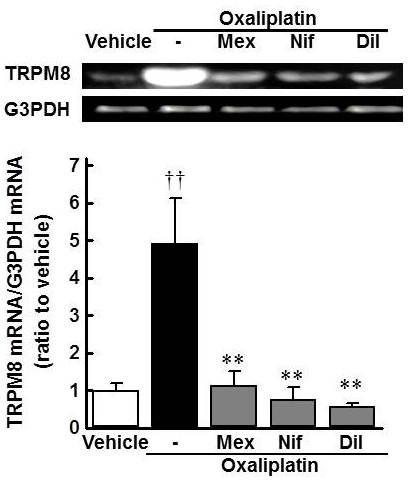
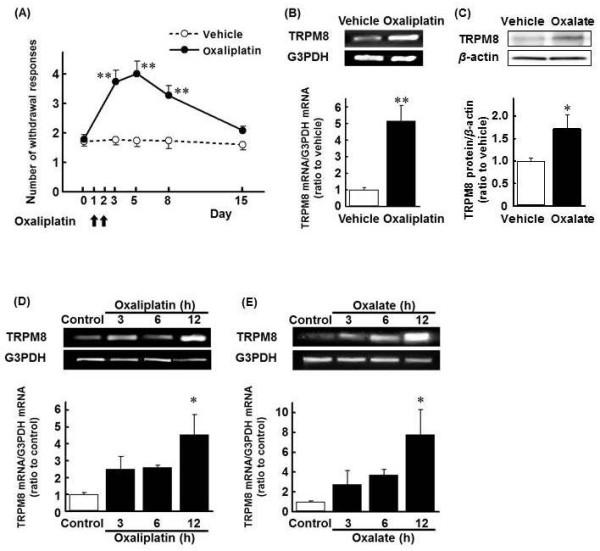
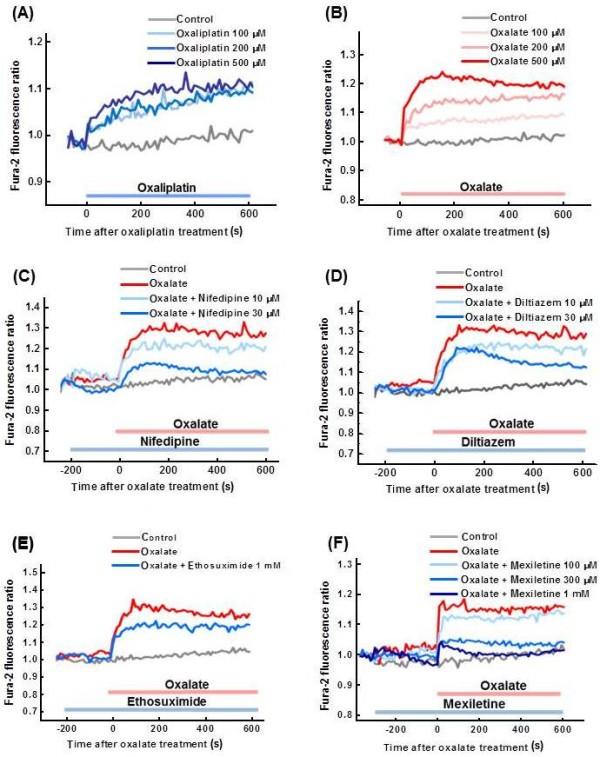
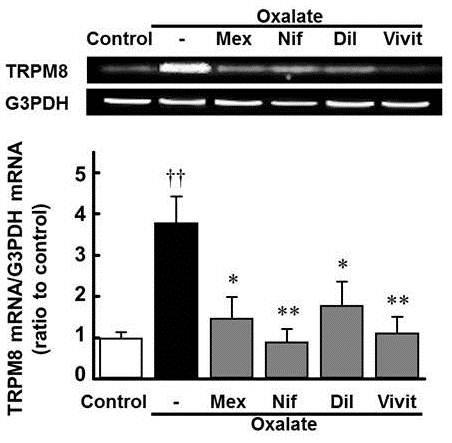
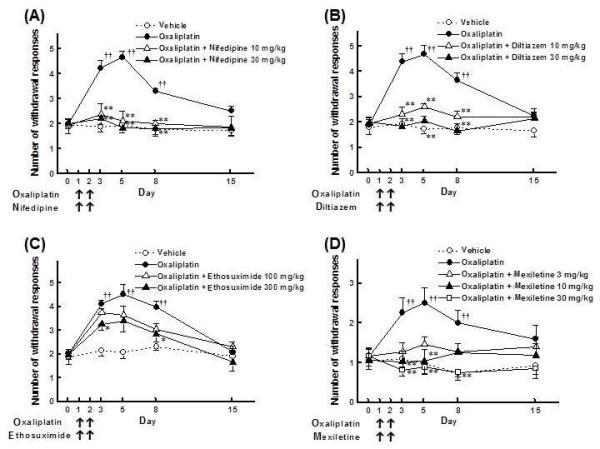
Oxaliplatin (4 mg/kg) induced cold hyperalgesia and increased in the transient receptor potential melastatin 8 (TRPM8) mRNA levels in the dorsal root ganglia (DRG). Furthermore, oxalate (1.3 mg/kg) significantly induced the increase in TRPM8 protein in the DRG. Treatment with oxaliplatin and oxalate (500 μM for each) also increased the TRPM8 mRNA levels and induced Ca²⁺ influx and nuclear factor of activated T-cell (NFAT) nuclear translocation in cultured DRG cells. These changes induced by oxalate were inhibited by nifedipine, diltiazem and mexiletine. Interestingly, co-administration with nifedipine, diltiazem or mexiletine prevented the oxaliplatin-induced cold hyperalgesia and increase in the TRPM8 mRNA levels in the DRG.
CONCLUSIONS
These data suggest that the L type Ca²⁺ channels/NFAT/TRPM8 pathway is a downstream mediator for oxaliplatin-induced cold hyperalgesia, and that Ca²⁺ channel blockers have prophylactic potential for acute neuropathy.
背景
奥沙利铂是一种用于治疗结直肠癌的重要药物。然而,它经常导致严重的急性和慢性周围神经病变。我们最近报道,奥沙利铂重复给药在大鼠早期引起冷痛觉过敏,晚期引起机械性痛觉过敏,奥沙利铂衍生的草酸盐参与冷痛觉过敏。在本研究中,我们研究了钙通道阻滞剂对奥沙利铂诱导的大鼠冷痛觉过敏的影响。
方法
通过丙酮试验评估冷痛觉过敏。奥沙利铂(4mg/kg)、草酸钠(1.3mg/kg)或载体于第 1 天和第 2 天腹腔注射。奥沙利铂或草酸盐于第 1 天和第 2 天同时给予钙通道(地尔硫卓、硝苯地平、乙琥胺)和钠通道(美西律)阻滞剂。
结果
奥沙利铂(4mg/kg)诱导冷痛觉过敏,并增加背根神经节(DRG)中瞬时受体电位 melastatin 8(TRPM8)mRNA 水平。此外,草酸盐(1.3mg/kg)显著增加了 DRG 中 TRPM8 蛋白的增加。奥沙利铂和草酸盐(各 500μM)处理也增加了培养的 DRG 细胞中 TRPM8mRNA 水平,并诱导钙内流和激活 T 细胞核因子(NFAT)核易位。草酸盐诱导的这些变化被硝苯地平、地尔硫卓和美西律抑制。有趣的是,与硝苯地平、地尔硫卓或美西律联合给药可预防奥沙利铂诱导的冷痛觉过敏和 DRG 中 TRPM8mRNA 水平的增加。
结论
这些数据表明,L 型钙通道/NFAT/TRPM8 途径是奥沙利铂诱导冷痛觉过敏的下游介质,钙通道阻滞剂对急性神经病具有预防潜力。

 Zotero 插件