
鉴定和系统发育分析宽纹缩胸蝎和环纹缩胸蝎新型钠离子通道蝎毒素。
Identification and phylogenetic analysis of Tityus pachyurus and Tityus obscurus novel putative Na+-channel scorpion toxins.
机构信息
Laboratório de Toxinologia, Departamento de Ciências Fisiológicas, Universidade de Brasília, Brasília, Distrito Federal, Brazil.
出版信息
PLoS One. 2012;7(2):e30478. doi: 10.1371/journal.pone.0030478. Epub 2012 Feb 15.
BACKGROUND
Colombia and Brazil are affected by severe cases of scorpionism. In Colombia the most dangerous accidents are caused by Tityus pachyurus that is widely distributed around this country. In the Brazilian Amazonian region scorpion stings are a common event caused by Tityus obscurus. The main objective of this work was to perform the molecular cloning of the putative Na(+)-channel scorpion toxins (NaScTxs) from T. pachyurus and T. obscurus venom glands and to analyze their phylogenetic relationship with other known NaScTxs from Tityus species.
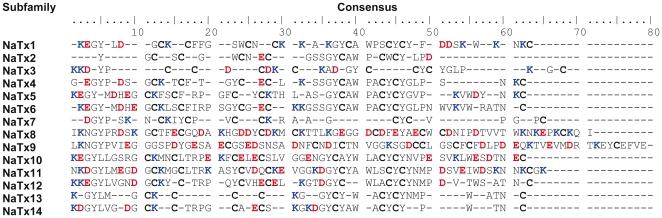
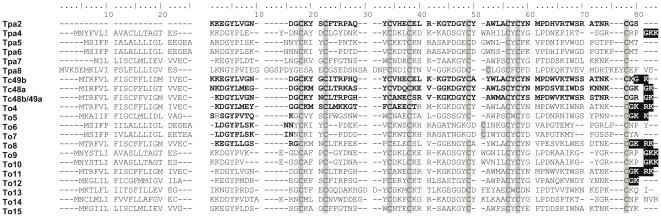
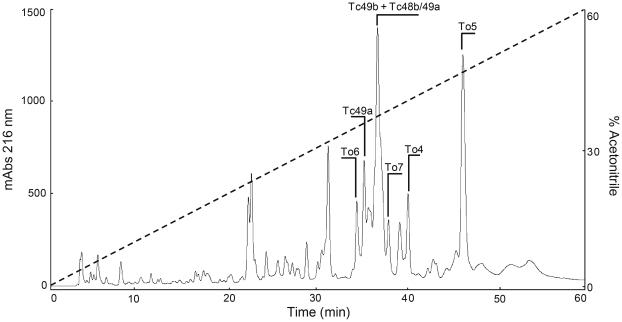
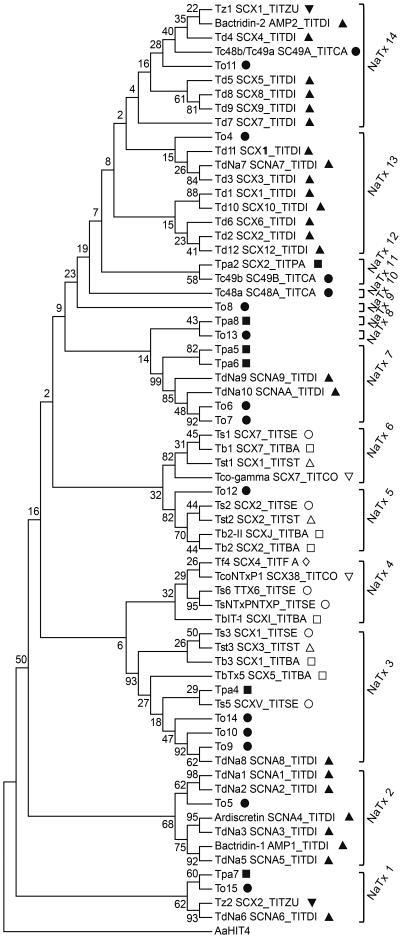
METHODOLOGY/PRINCIPAL FINDINGS: cDNA libraries from venom glands of these two species were constructed and five nucleotide sequences from T. pachyurus were identified as putative modulators of Na(+)-channels, and were named Tpa4, Tpa5, Tpa6, Tpa7 and Tpa8; the latter being the first anti-insect excitatory β-class NaScTx in Tityus scorpion venom to be described. Fifteen sequences from T. obscurus were identified as putative NaScTxs, among which three had been previously described, and the others were named To4 to To15. The peptides Tpa4, Tpa5, Tpa6, To6, To7, To9, To10 and To14 are closely related to the α-class NaScTxs, whereas Tpa7, Tpa8, To4, To8, To12 and To15 sequences are more related to the β-class NaScTxs. To5 is possibly an arthropod specific toxin. To11 and To13 share sequence similarities with both α and β NaScTxs. By means of phylogenetic analysis using the Maximum Parsimony method and the known NaScTxs from Tityus species, these toxins were clustered into 14 distinct groups.
CONCLUSIONS/SIGNIFICANCE: This communication describes new putative NaScTxs from T. pachyurus and T. obscurus and their phylogenetic analysis. The results indicate clear geographic separation between scorpions of Tityus genus inhabiting the Amazonian and Mountain Andes regions and those distributed over the Southern of the Amazonian rainforest. Based on the consensus sequences for the different clusters, a new nomenclature for the NaScTxs is proposed.
背景
哥伦比亚和巴西都受到严重的蝎子蜇伤的影响。在哥伦比亚,最危险的事故是由广泛分布于该国各地的 Tityus pachyurus 引起的。在巴西亚马逊地区,蝎子蜇伤是常见事件,由 Tityus obscurus 引起。这项工作的主要目的是从 T. pachyurus 和 T. obscurus 的毒腺中进行分子克隆潜在的 Na(+)-通道蝎子毒素(NaScTxs),并分析它们与其他已知的 Tityus 物种的 NaScTxs 的系统发育关系。
方法/主要发现:构建了来自这两个物种的毒腺 cDNA 文库,并从 T. pachyurus 中鉴定出五个核苷酸序列,这些序列被认为是 Na(+)-通道的调节剂,并被命名为 Tpa4、Tpa5、Tpa6、Tpa7 和 Tpa8;后者是 Tityus 蝎子毒液中第一个被描述的抗昆虫兴奋性β类 NaScTx。从 T. obscurus 中鉴定出 15 个序列,其中 3 个先前已被描述,其余序列被命名为 To4 到 To15。Tpa4、Tpa5、Tpa6、To6、To7、To9、To10 和 To14 肽与α类 NaScTxs 密切相关,而 Tpa7、Tpa8、To4、To8、To12 和 To15 序列与β类 NaScTxs 更相关。To5 可能是一种节肢动物特异性毒素。To11 和 To13 与α和β NaScTxs 都具有序列相似性。通过使用最大简约法的系统发育分析和来自 Tityus 物种的已知 NaScTxs,这些毒素被聚类为 14 个不同的组。
结论/意义:本通讯描述了来自 T. pachyurus 和 T. obscurus 的新的潜在 NaScTxs 及其系统发育分析。结果表明,栖息在亚马逊和安第斯山脉地区的 Tityus 属蝎子与分布在亚马逊雨林南部的蝎子之间存在明显的地理分离。基于不同簇的共识序列,提出了一种新的 NaScTx 命名法。

 Zotero 插件