
巴西内脏利什曼病诊断的预测模型。
Predictive models for the diagnostic of human visceral leishmaniasis in Brazil.
机构信息
Laboratório de Pesquisas Clínicas, Centro de Pesquisas René Rachou, Fundação Oswaldo Cruz (FIOCRUZ), Belo Horizonte, Minas Gerais, Brazil.
出版信息
PLoS Negl Trop Dis. 2012;6(2):e1542. doi: 10.1371/journal.pntd.0001542. Epub 2012 Feb 28.
BACKGROUND AND OBJECTIVES
In Brazil, as in many other affected countries, a large proportion of visceral leishmaniasis (VL) occurs in remote locations and treatment is often performed on basis of clinical suspicion. This study aimed at developing predictive models to help with the clinical management of VL in patients with suggestive clinical of disease.
METHODS
Cases of VL (n = 213) had the diagnosis confirmed by parasitological method, non-cases (n = 119) presented suggestive clinical presentation of VL but a negative parasitological diagnosis and a firm diagnosis of another disease. The original data set was divided into two samples for generation and validation of the prediction models. Prediction models based on clinical signs and symptoms, results of laboratory exams and results of five different serological tests, were developed by means of logistic regression and classification and regression trees (CART). From these models, clinical-laboratory and diagnostic prediction scores were generated. The area under the receiver operator characteristic curve, sensitivity, specificity, and positive predictive value were used to evaluate the models' performance.
RESULTS
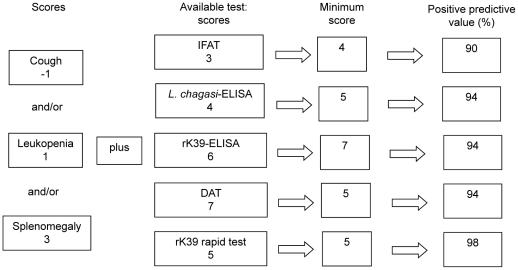
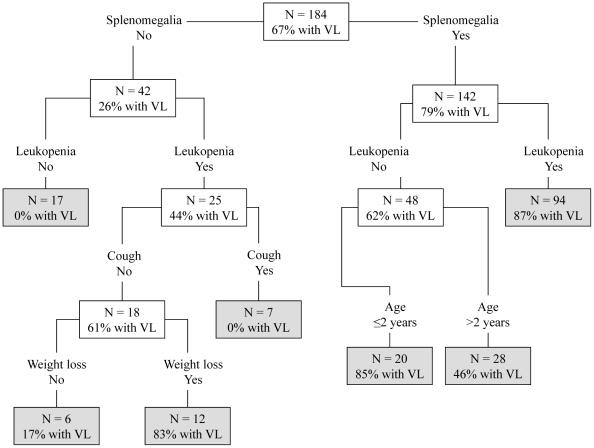
Based on the variables splenomegaly, presence of cough and leukopenia and on the results of five serological tests it was possible to generate six predictive models using logistic regression, showing sensitivity ranging from 90.1 to 99.0% and specificity ranging from 53.0 to 97.2%. Based on the variables splenomegaly, leukopenia, cough, age and weight loss and on the results of five serological tests six predictive models were generated using CART with sensitivity ranging from 90.1 to 97.2% and specificity ranging from 68.4 to 97.4%. The models composed of clinical-laboratory variables and the rk39 rapid test showed the best performance.
CONCLUSION
The predictive models showed to be a potential useful tool to assist healthcare systems and control programs in their strategical choices, contributing to more efficient and more rational allocation of healthcare resources.
背景与目的
在巴西,与许多其他受影响的国家一样,很大一部分内脏利什曼病(VL)发生在偏远地区,治疗通常基于临床怀疑。本研究旨在开发预测模型,以帮助对具有疾病提示性临床症状的 VL 患者进行临床管理。
方法
将 213 例 VL 病例(n=213)的诊断通过寄生虫学方法确认,119 例非病例(n=119)表现出 VL 的提示性临床症状,但寄生虫学诊断为阴性,并明确诊断为其他疾病。原始数据集分为两部分,用于生成和验证预测模型。通过逻辑回归和分类回归树(CART)开发了基于临床体征和症状、实验室检查结果以及五种不同血清学检测结果的预测模型。从这些模型中,生成了临床实验室和诊断预测评分。使用接收者操作特征曲线下面积、灵敏度、特异性和阳性预测值来评估模型的性能。
结果
基于脾肿大、咳嗽和白细胞减少的变量以及五项血清学检测结果,可以使用逻辑回归生成六个预测模型,其灵敏度范围为 90.1%至 99.0%,特异性范围为 53.0%至 97.2%。基于脾肿大、白细胞减少、咳嗽、年龄和体重减轻以及五项血清学检测结果,使用 CART 生成了六个预测模型,其灵敏度范围为 90.1%至 97.2%,特异性范围为 68.4%至 97.4%。由临床实验室变量和 rk39 快速检测组成的模型表现最佳。
结论
预测模型显示出作为一种有潜力的有用工具,可帮助医疗保健系统和控制计划做出战略选择,有助于更有效地分配医疗资源。
 Zotero 插件