
真核蛋白酶体对折叠蛋白质的直接非泛素依赖性识别和降解-固有降解信号的起源。
Direct ubiquitin independent recognition and degradation of a folded protein by the eukaryotic proteasomes-origin of intrinsic degradation signals.
机构信息
Advanced Centre for Treatment, Research and Education in Cancer, Kharghar, Navi Mumbai, India.
出版信息
PLoS One. 2012;7(4):e34864. doi: 10.1371/journal.pone.0034864. Epub 2012 Apr 10.
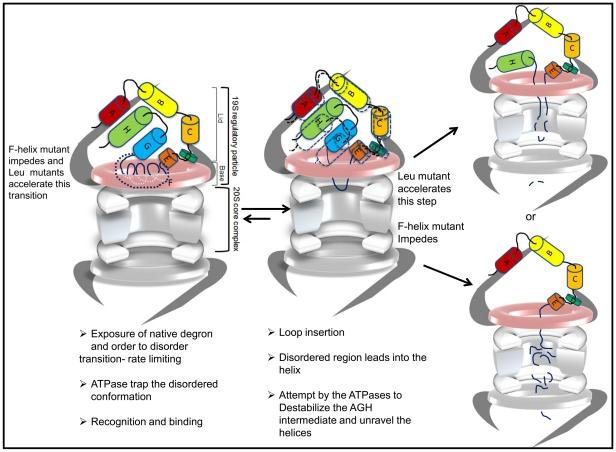
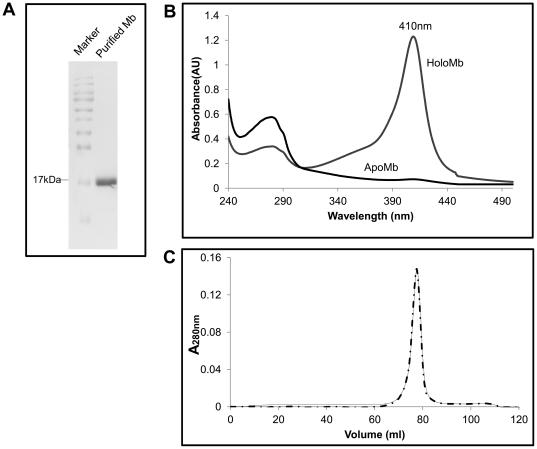
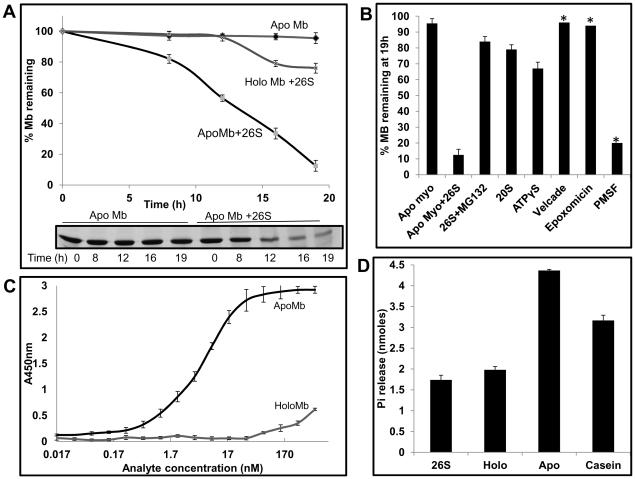
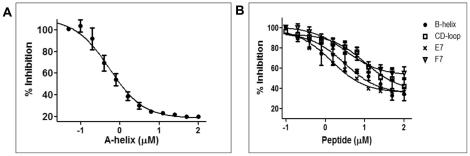
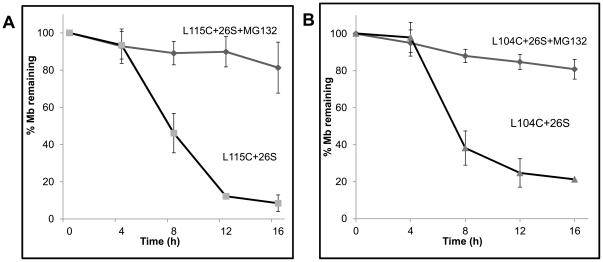
Eukaryotic 26S proteasomes are structurally organized to recognize, unfold and degrade globular proteins. However, all existing model substrates of the 26S proteasome in addition to ubiquitin or adaptor proteins require unstructured regions in the form of fusion tags for efficient degradation. We report for the first time that purified 26S proteasome can directly recognize and degrade apomyoglobin, a globular protein, in the absence of ubiquitin, extrinsic degradation tags or adaptor proteins. Despite a high affinity interaction, absence of a ligand and presence of only helices/loops that follow the degradation signal, apomyoglobin is degraded slowly by the proteasome. A short floppy F-helix exposed upon ligand removal and in conformational equilibrium with a disordered structure is mandatory for recognition and initiation of degradation. Holomyoglobin, in which the helix is buried, is neither recognized nor degraded. Exposure of the floppy F-helix seems to sensitize the proteasome and primes the substrate for degradation. Using peptide panning and competition experiments we speculate that initial encounters through the floppy helix and additional strong interactions with N-terminal helices anchors apomyoglobin to the proteasome. Stabilizing helical structure in the floppy F-helix slows down degradation. Destabilization of adjacent helices accelerates degradation. Unfolding seems to follow the mechanism of helix unraveling rather than global unfolding. Our findings while confirming the requirement for unstructured regions in degradation offers the following new insights: a) origin and identification of an intrinsic degradation signal in the substrate, b) identification of sequences in the native substrate that are likely to be responsible for direct interactions with the proteasome, and c) identification of critical rate limiting steps like exposure of the intrinsic degron and destabilization of an unfolding intermediate that are presumably catalyzed by the ATPases. Apomyoglobin emerges as a new model substrate to further explore the role of ATPases and protein structure in proteasomal degradation.
真核生物 26S 蛋白酶体在结构上被组织起来以识别、展开和降解球状蛋白。然而,除了泛素或衔接蛋白之外,所有现有的 26S 蛋白酶体的模型底物都需要无结构区域,以融合标签的形式存在,以实现有效的降解。我们首次报道,在没有泛素、外在降解标签或衔接蛋白的情况下,纯化的 26S 蛋白酶体可以直接识别和降解球蛋白,即球状蛋白。尽管存在高亲和力相互作用,没有配体,只有降解信号后的螺旋/环,但球蛋白被蛋白酶体缓慢降解。在配体去除后暴露的短而松软的 F 螺旋,并与无序结构处于平衡状态,对于识别和起始降解是必需的。球蛋白,其中螺旋被埋藏,既不能被识别也不能被降解。松软 F 螺旋的暴露似乎使蛋白酶体敏感,并使底物为降解做好准备。通过肽淘选和竞争实验,我们推测,通过松软螺旋的初始接触以及与 N 端螺旋的额外强相互作用,球蛋白锚定到蛋白酶体上。松软 F 螺旋中稳定的螺旋结构会减缓降解速度。相邻螺旋的不稳定会加速降解。解折叠似乎遵循螺旋展开的机制,而不是全局展开。我们的发现虽然证实了降解中无结构区域的要求,但提供了以下新的见解:a)在底物中识别和鉴定内在降解信号的起源,b)鉴定天然底物中可能负责与蛋白酶体直接相互作用的序列,以及 c)鉴定关键限速步骤,如内在降解基团的暴露和展开中间态的不稳定,这些步骤可能由 ATP 酶催化。球蛋白成为进一步探索 ATP 酶和蛋白质结构在蛋白酶体降解中的作用的新模型底物。


 Zotero 插件