
肥大细胞与伙伴们。
Mast cells and company.
机构信息
Institut Pasteur, Département d'Immunologie, Unité d'Allergologie Moléculaire et Cellulaire Paris, France.
出版信息
Front Immunol. 2012 Feb 20;3:16. doi: 10.3389/fimmu.2012.00016. eCollection 2012.
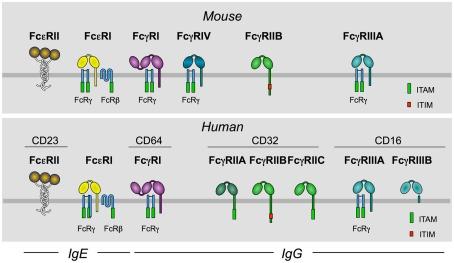
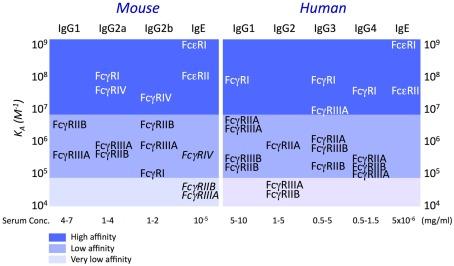
Classically, allergy depends on IgE antibodies and on high-affinity IgE receptors expressed by mast cells and basophils. This long accepted IgE/FcεRI/mast cell paradigm, on which the definition of immediate hypersensitivity was based in the Gell and Coomb's classification, appears too reductionist. Recently accumulated evidence indeed requires that not only IgE but also IgG antibodies, that not only FcεRI but also FcγR of the different types, that not only mast cells and basophils but also neutrophils, monocytes, macrophages, eosinophils, and other myeloid cells be considered as important players in allergy. This view markedly changes our understanding of allergic diseases and, possibly, their treatment.
经典上,过敏依赖于 IgE 抗体和由肥大细胞和嗜碱性粒细胞表达的高亲和力 IgE 受体。这种长期被接受的 IgE/FcεRI/肥大细胞范例,是基于 Gell 和 Coomb 的分类定义即刻超敏反应的基础,似乎过于简化。最近积累的证据确实表明,不仅 IgE,而且 IgG 抗体,不仅 FcεRI,而且不同类型的 FcγR,不仅肥大细胞和嗜碱性粒细胞,而且中性粒细胞、单核细胞、巨噬细胞、嗜酸性粒细胞和其他髓样细胞,都被认为是过敏反应的重要参与者。这种观点显著改变了我们对过敏性疾病的理解,并且可能改变它们的治疗方法。



 Zotero 插件