
白细胞介素 15 刺激的细胞因子诱导的杀伤细胞对人源化临床前小鼠模型中人类急性髓系白血病和横纹肌肉瘤的细胞毒性作用。
Cytotoxic Capacity of IL-15-Stimulated Cytokine-Induced Killer Cells Against Human Acute Myeloid Leukemia and Rhabdomyosarcoma in Humanized Preclinical Mouse Models.
机构信息
Department of Pediatric Hematology, Oncology and Hemostaseology, University Children's Hospital of Frankfurt/Main, Goethe-University Frankfurt/Main Frankfurt/Main, Germany.
出版信息
Front Oncol. 2012 Apr 9;2:32. doi: 10.3389/fonc.2012.00032. eCollection 2012.
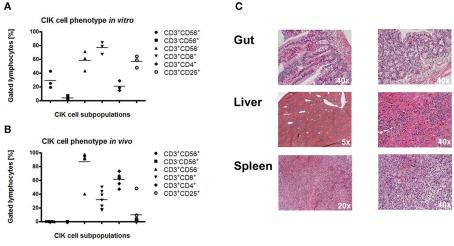
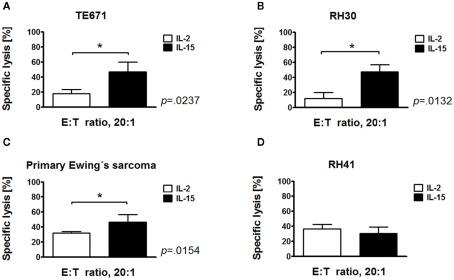
Allogeneic stem cell transplantation (allo-SCT) has become an important treatment modality for patients with high-risk acute myeloid leukemia (AML) and is also under investigation for soft tissue sarcomas. The therapeutic success is still limited by minimal residual disease (MRD) status ultimately leading to patients' relapse. Adoptive donor lymphocyte infusions based on MRD status using IL-15-expanded cytokine-induced killer (CIK) cells may prevent relapse without causing graft-versus-host-disease (GvHD). To generate preclinical data we developed mouse models to study anti-leukemic- and anti-tumor-potential of CIK cells in vivo. Immunodeficient mice (NOD/SCID/IL-2Rγc(-), NSG) were injected intravenously with human leukemic cell lines THP-1, SH-2 and with human rhabdomyosarcoma (RMS) cell lines RH41 and RH30 at minimal doses required for leukemia or tumor engraftment. Mice transplanted with THP-1 or RH41 cells were randomly assigned for analysis of CIK cell treatment. Organs of mice were analyzed by flow cytometry as well as quantitative polymerase chain reaction for engraftment of malignant cells and CIK cells. Potential of CIK cells to induce GvHD was determined by histological analysis. Tissues of the highest degree of THP-1 cell expansion included bone marrow followed by liver, lung, spleen, peripheral blood (PB), and brain. RH30 and RH41 engraftment mainly took place in liver and lung, but was also detectable in spleen and PB. In spite of delayed CIK cell expansion compared with malignant cells, CIK cells injected at equal amounts were sufficient for significant reduction of RH41 cells, whereas against fast-expanding THP-1 cells 250 times more CIK than THP-1 cells were needed to achieve comparable results. Our preclinical in vivo mouse models showed a reliable 100% engraftment of malignant cells which is essential for analysis of anti-cancer therapy. Furthermore our data demonstrated that IL-15-activated CIK cells have potent cytotoxic capacity against AML and RMS cells without causing GvHD.
异基因干细胞移植 (allo-SCT) 已成为高危急性髓系白血病 (AML) 患者的重要治疗方式,也正在软组织肉瘤中进行研究。治疗的成功仍然受到微小残留病 (MRD) 状态的限制,最终导致患者复发。基于 MRD 状态使用白细胞介素-15 扩增的细胞因子诱导的杀伤 (CIK) 细胞进行过继供体淋巴细胞输注可能会预防复发而不引起移植物抗宿主病 (GvHD)。为了生成临床前数据,我们开发了小鼠模型来研究 CIK 细胞在体内的抗白血病和抗肿瘤潜力。免疫缺陷小鼠 (NOD/SCID/IL-2Rγc(-),NSG) 以最小剂量静脉注射人白血病细胞系 THP-1、SH-2 和人横纹肌肉瘤 (RMS) 细胞系 RH41 和 RH30,以实现白血病或肿瘤植入。移植 THP-1 或 RH41 细胞的小鼠被随机分配进行 CIK 细胞治疗分析。通过流式细胞术以及定量聚合酶链反应分析恶性细胞和 CIK 细胞的植入情况。通过组织学分析确定 CIK 细胞诱导 GvHD 的潜力。THP-1 细胞扩增程度最高的组织包括骨髓,其次是肝脏、肺、脾脏、外周血 (PB) 和大脑。RH30 和 RH41 植入主要发生在肝脏和肺部,但在脾脏和 PB 中也可检测到。尽管与恶性细胞相比,CIK 细胞的扩增延迟,但注射等量的 CIK 细胞足以显著减少 RH41 细胞,而对于快速扩增的 THP-1 细胞,需要 250 倍于 THP-1 细胞的 CIK 细胞才能达到类似的结果。我们的临床前体内小鼠模型显示恶性细胞的可靠 100%植入,这对于分析抗癌治疗至关重要。此外,我们的数据表明,白细胞介素-15 激活的 CIK 细胞对 AML 和 RMS 细胞具有强大的细胞毒性,而不会引起 GvHD。


 Zotero 插件