
神经连接蛋白转录物和生物节律中抑制/兴奋突触支架蛋白的昼夜节律。
Diurnal rhythms in neurexins transcripts and inhibitory/excitatory synapse scaffold proteins in the biological clock.
机构信息
Department of Neurobiology, The George S. Wise Faculty of Life Sciences, Tel Aviv University, Tel Aviv, Israel.
出版信息
PLoS One. 2012;7(5):e37894. doi: 10.1371/journal.pone.0037894. Epub 2012 May 25.
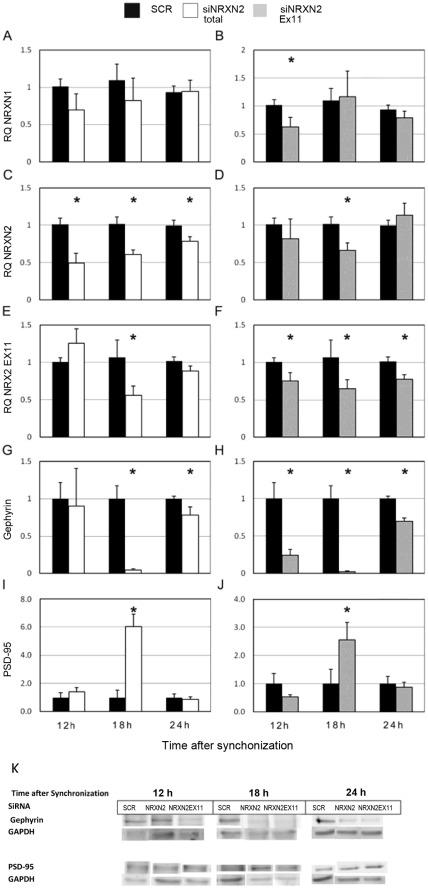
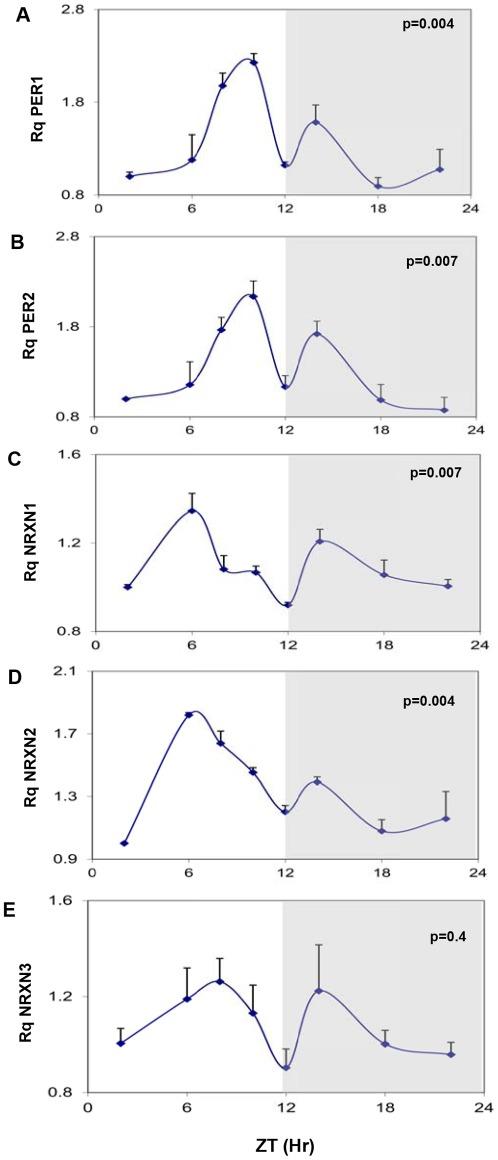
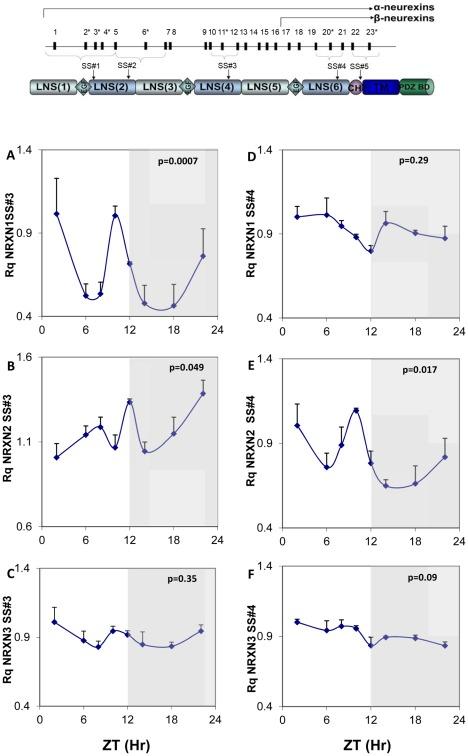
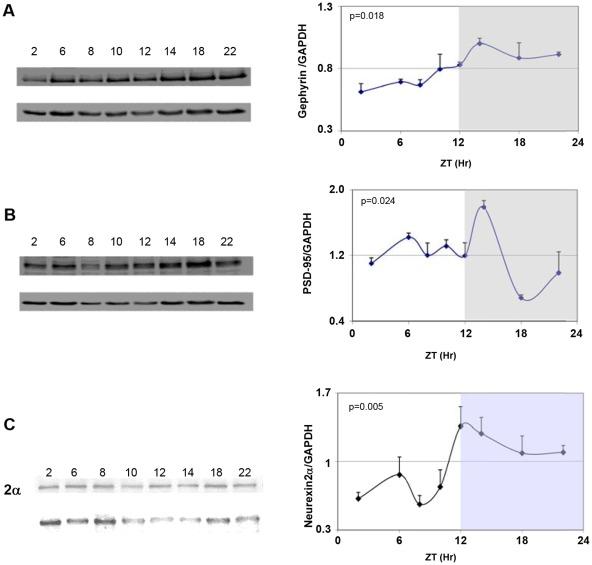
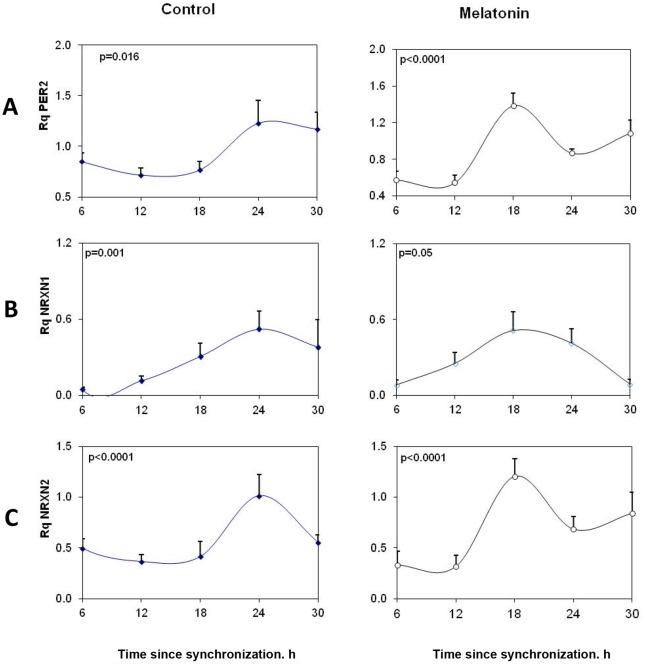
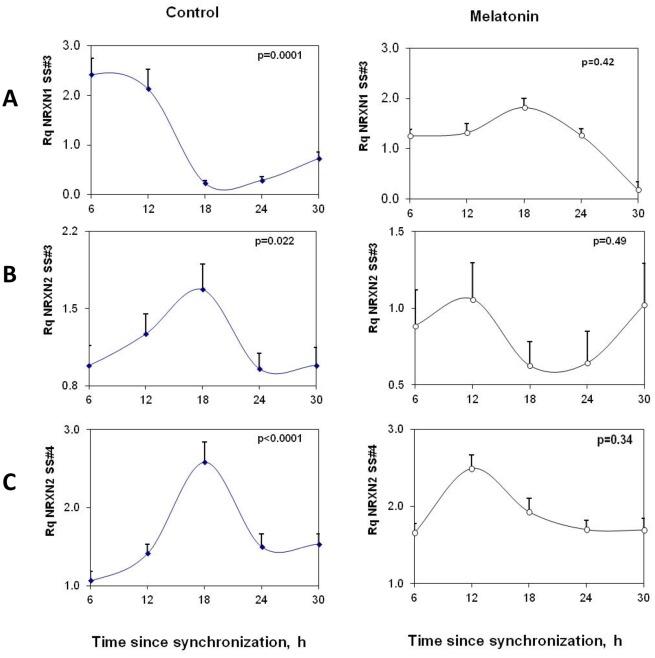
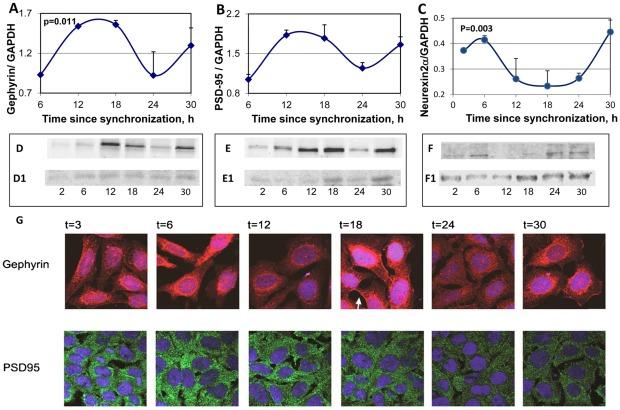
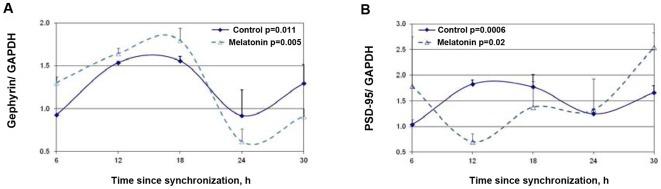
The neurexin genes (NRXN1/2/3) encode two families (α and β) of highly polymorphic presynaptic proteins that are involved in excitatory/inhibitory synaptic balance. Recent studies indicate that neuronal activation and memory formation affect NRXN1/2/3α expression and alternative splicing at splice sites 3 and 4 (SS#3/SS#4). Neurons in the biological clock residing in the suprachiasmatic nuclei of the hypothalamus (SCN) act as self-sustained oscillators, generating rhythms in gene expression and electrical activity, to entrain circadian bodily rhythms to the 24 hours day/night cycles. Cell autonomous oscillations in NRXN1/2/3α expression and SS#3/SS#4 exons splicing and their links to rhythms in excitatory/inhibitory synaptic balance in the circadian clock were explored. NRXN1/2/3α expression and SS#3/SS#4 splicing, levels of neurexin-2α and the synaptic scaffolding proteins PSD-95 and gephyrin (representing excitatory and inhibitory synapses, respectively) were studied in mRNA and protein extracts obtained from SCN of C3H/J mice at different times of the 24 hours day/night cycle. Further studies explored the circadian oscillations in these components and causality relationships in immortalized rat SCN2.2 cells. Diurnal rhythms in mNRXN1α and mNRXN2α transcription, SS#3/SS#4 exon-inclusion and PSD-95 gephyrin and neurexin-2α levels were found in the SCN in vivo. No such rhythms were found with mNRXN3α. SCN2.2 cells also exhibited autonomous circadian rhythms in rNRXN1/2 expression SS#3/SS#4 exon inclusion and PSD-95, gephyrin and neurexin-2α levels. rNRXN3α and rNRXN1/2β were not expressed. Causal relationships were demonstrated, by use of specific siRNAs, between rNRXN2α SS#3 exon included transcripts and gephyrin levels in the SCN2.2 cells. These results show for the first time dynamic, cell autonomous, diurnal rhythms in expression and splicing of NRXN1/2 and subsequent effects on the expression of neurexin-2α and postsynaptic scaffolding proteins in SCN across the 24-h cycle. NRXNs gene transcripts may have a role in coupling the circadian clock to diurnal rhythms in excitatory/inhibitory synaptic balance.
神经连接蛋白基因(NRXN1/2/3)编码两种高度多态的突触前蛋白家族(α 和 β),参与兴奋性/抑制性突触平衡。最近的研究表明,神经元激活和记忆形成会影响 NRXN1/2/3α 在剪接位点 3 和 4(SS#3/SS#4)的表达和选择性剪接。位于下丘脑视交叉上核(SCN)中的生物钟神经元作为自我维持的振荡器,产生基因表达和电活动的节律,使昼夜节律的身体节律与 24 小时的昼夜周期同步。探索了 NRXN1/2/3α 表达和 SS#3/SS#4 外显子剪接的细胞自主振荡及其与生物钟中兴奋性/抑制性突触平衡节律的关系。在不同时间点的 24 小时昼夜周期内,从 C3H/J 小鼠的 SCN 获得 mRNA 和蛋白质提取物,研究了 NRXN1/2/3α 的表达和 SS#3/SS#4 剪接、神经连接蛋白-2α 水平以及突触支架蛋白 PSD-95 和 Gephyrin(分别代表兴奋性和抑制性突触)。进一步的研究探索了这些成分的昼夜节律振荡及其在永生化大鼠 SCN2.2 细胞中的因果关系。在体内 SCN 中发现了 mNRXN1α 和 mNRXN2α 转录、SS#3/SS#4 外显子包含和 PSD-95 Gephyrin 和神经连接蛋白-2α 水平的昼夜节律。mNRXN3α 则没有这种节律。SCN2.2 细胞也表现出 rNRXN1/2 表达 SS#3/SS#4 外显子包含和 PSD-95、Gephyrin 和神经连接蛋白-2α 水平的自主昼夜节律。rNRXN3α 和 rNRXN1/2β 未表达。通过使用特定的 siRNA,在 SCN2.2 细胞中证明了 rNRXN2α SS#3 包含的转录物和 Gephyrin 水平之间的因果关系。这些结果首次表明,在 24 小时周期内,NRXN1/2 的表达和剪接以及随后对 SCN 中神经连接蛋白-2α 和突触后支架蛋白表达的影响在 SCN 中具有动态、细胞自主的昼夜节律。NRXNs 基因转录本可能在将生物钟与昼夜节律兴奋性/抑制性突触平衡耦合中发挥作用。
 Zotero 插件