
用于提高抗肿瘤光细胞毒性的受体靶向酞菁光敏剂。
Receptor-targeting phthalocyanine photosensitizer for improving antitumor photocytotoxicity.
机构信息
Danish-Chinese Centre for Proteases and Cancer, State Key Laboratory of Structural Chemistry, Fujian Institute of Research on the Structure of Matter, Chinese Academy of Sciences, Fuzhou, Fujian, China.
出版信息
PLoS One. 2012;7(5):e37051. doi: 10.1371/journal.pone.0037051. Epub 2012 May 31.
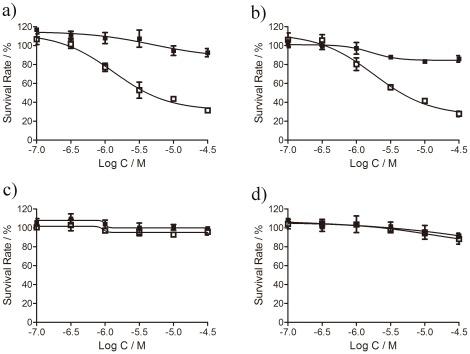
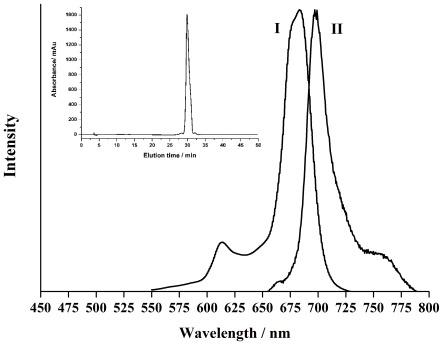
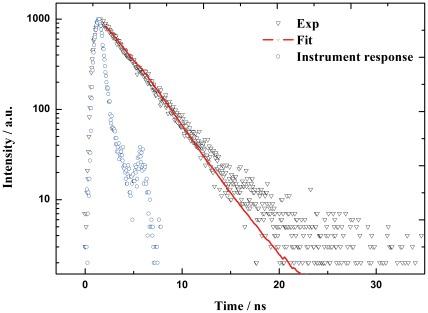
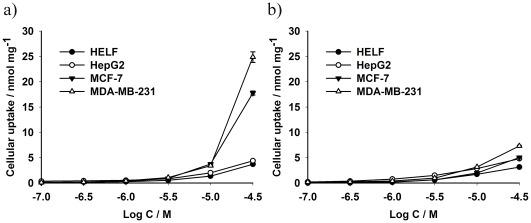
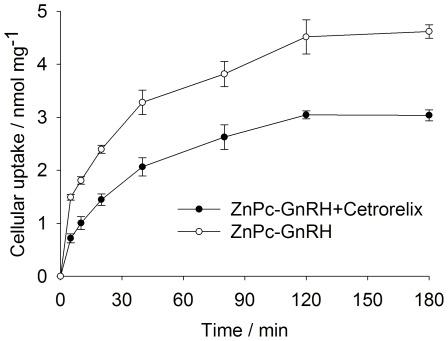
Photodynamic therapy (PDT) is a promising therapeutic modality which uses a photosensitizer to capture visible light resulting in phototoxicity in the irradiated region. PDT has been used in a number of pathological indications, including tumor. A key desirable feature of the photosensitizer is the high phototoxicity on tumor cells but not on normal cells. In this study, we conjugate a gonadotropin-releasing hormone (GnRH) to a photosensitizer, Zinc phthalocyanine (ZnPc), in order to enhance its specificity to breast cancer, which over-expresses GnRH receptor. ZnPc has unique advantages over other photosensitizers, but is difficult to derivatize and purify as a single isomer. We previously developed a straight-forward way to synthesize mono-substituted β-carboxy-phthalocyanine zinc (ZnPc-COOH). Photophysical and photochemical parameters of this ZnPc-GnRH conjugate including fluorescence quantum yield (Ф(f)), fluorescence decay time (τ(s)) and singlet oxygen quantum yield (Ф(Δ)) were evaluated and found comparable with that of ZnPc, indicating that addition of a GnRH peptide does not significantly alter the generation of singlet oxygen from ZnPc. Cellular uptakes and phototoxicities of this conjugate were tested and found significantly enhanced on human breast cancer cell lines overexpressing GnRH receptors (MDA-MB-231 and MCF-7 cells) compared to cells with low levels of GnRH receptors, such as human embryonic lung fibroblast (HELF) and human liver carcinoma (HepG2) cells. In addition, the cellular uptake of this conjugate toward MCF-7 cells were found clearly alleviated by a GnRH receptor blocker Cetrorelix, suggesting that the cellular uptake of this conjugate was GnRH receptor-mediated. Put together, these findings revealed that coupling ZnPc with GnRH analogue was an effective way to improve the selectivity of ZnPc towards tumors with over-expressed GnRH receptors.
光动力疗法(PDT)是一种有前途的治疗方式,它使用光敏剂来捕获可见光,从而在照射区域产生光毒性。PDT 已用于许多病理适应症,包括肿瘤。光敏剂的一个关键理想特性是对肿瘤细胞具有高光毒性,但对正常细胞没有光毒性。在这项研究中,我们将促性腺激素释放激素(GnRH)与光敏剂锌酞菁(ZnPc)偶联,以增强其对过度表达 GnRH 受体的乳腺癌的特异性。与其他光敏剂相比,ZnPc 具有独特的优势,但作为单一异构体很难进行衍生化和纯化。我们之前开发了一种简单的方法来合成单取代β-羧基酞菁锌(ZnPc-COOH)。该 ZnPc-GnRH 缀合物的光物理和光化学参数,包括荧光量子产率(Ф(f))、荧光衰减时间(τ(s))和单线态氧量子产率(Ф(Δ))进行了评估,发现与 ZnPc 相当,表明添加 GnRH 肽不会显著改变 ZnPc 产生单线态氧的能力。该缀合物的细胞摄取和光毒性在人乳腺癌细胞系(MDA-MB-231 和 MCF-7 细胞)中进行了测试,发现与 GnRH 受体水平较低的细胞(如人胚胎肺成纤维细胞(HELF)和人肝癌(HepG2)细胞)相比,明显增强。此外,该缀合物对 MCF-7 细胞的细胞摄取明显被 GnRH 受体阻断剂 Cetrorelix 缓解,表明该缀合物的细胞摄取是 GnRH 受体介导的。综上所述,这些发现表明,将 ZnPc 与 GnRH 类似物偶联是一种有效提高 ZnPc 对过度表达 GnRH 受体的肿瘤选择性的方法。
 Zotero 插件