
美罗培南持续应用与间歇应用于重症患者的临床及微生物学疗效:一项随机开放标签对照试验
Clinical and microbiological efficacy of continuous versus intermittent application of meropenem in critically ill patients: a randomized open-label controlled trial.
作者信息
Chytra Ivan, Stepan Martin, Benes Jan, Pelnar Petr, Zidkova Alexandra, Bergerova Tamara, Pradl Richard, Kasal Eduard
出版信息
Crit Care. 2012 Jun 28;16(3):R113. doi: 10.1186/cc11405.
INTRODUCTION
Meropenem bactericidal activity depends on the time when the free drug concentrations remain above the minimum inhibitory concentration of pathogens. The goal of this study was to compare clinical and bacteriological efficacy of continuous meropenem infusion versus bolus administration in critically ill patients with severe infection, and to evaluate the safety of both dosing regimens.
METHODS
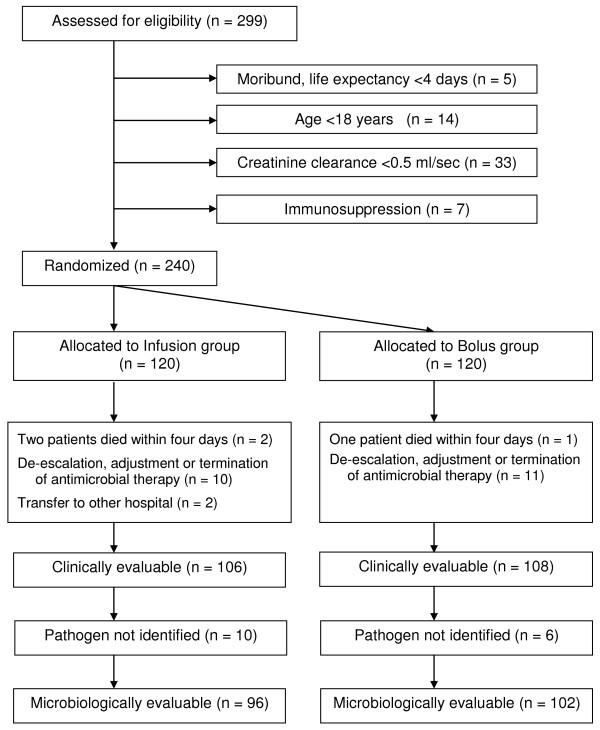
Patients admitted to the interdisciplinary Intensive Care Unit (ICU) who suffered from severe infections and received meropenem were randomized either in the Infusion group (n = 120) or in the Bolus group (n = 120). Patients in the Infusion group received a loading dose of 2 g of meropenem followed by a continuous infusion of 4 g of meropenem over 24 hours. Patients in the Bolus group were given 2 g of meropenem over 30 minutes every 8 hours. Clinical and microbiological outcome, safety, meropenem-related length of ICU and hospital stay, meropenem-related length of mechanical ventilation, duration of meropenem treatment, total dose of meropenem, and ICU and in-hospital mortality were assessed.
RESULTS
Clinical cure at the end of meropenem therapy was comparable between both groups (83.0% patients in the Infusion vs. 75.0% patients in the Bolus group; P = 0.180). Microbiological success rate was higher in the Infusion group as opposed to the Bolus group (90.6% vs. 78.4%; P = 0.020). Multivariate logistic regression identified continuous administration of meropenem as an independent predictor of microbiological success (OR = 2.977; 95% CI = 1.050 to 8.443; P = 0.040). Meropenem-related ICU stay was shorter in the Infusion group compared to the Bolus group (10 (7 to 14) days vs. 12 (7 to 19) days; P = 0.044) as well as shorter duration of meropenem therapy (7 (6 to 8) days vs. 8 (7 to 10) days; P = 0.035) and lower total dose of meropenem (24 (21 to 32) grams vs. 48 (42 to 60) grams; P < 0.0001). No severe adverse events related to meropenem administration in either group were observed.
CONCLUSIONS
Continuous infusion of meropenem is safe and, in comparison with higher intermittent dosage, provides equal clinical outcome, generates superior bacteriological efficacy and offers encouraging alternative of antimicrobial therapy in critically ill patients.
引言
美罗培南的杀菌活性取决于游离药物浓度保持高于病原体最低抑菌浓度的时间。本研究的目的是比较持续输注美罗培南与静脉推注给药在重症感染危重病患者中的临床和细菌学疗效,并评估两种给药方案的安全性。
方法
入住跨学科重症监护病房(ICU)且患有严重感染并接受美罗培南治疗的患者被随机分为输注组(n = 120)或推注组(n = 120)。输注组患者先接受2g美罗培南的负荷剂量,然后在24小时内持续输注4g美罗培南。推注组患者每8小时在30分钟内给予2g美罗培南。评估临床和微生物学结果、安全性、与美罗培南相关的ICU住院时间和住院时间、与美罗培南相关的机械通气时间、美罗培南治疗持续时间、美罗培南总剂量以及ICU和住院死亡率。
结果
美罗培南治疗结束时两组的临床治愈率相当(输注组为83.0%,推注组为75.0%;P = 0.180)。与推注组相比,输注组的微生物学成功率更高(90.6%对78.4%;P = 0.020)。多因素逻辑回归确定美罗培南持续给药是微生物学成功的独立预测因素(OR = 2.977;95%CI = 1.050至8.443;P = 0.040)。与推注组相比,输注组与美罗培南相关的ICU住院时间更短(10(7至14)天对12(7至19)天;P = 0.044),美罗培南治疗持续时间也更短(7(6至8)天对8(7至10)天;P = 0.035),美罗培南总剂量更低(24(21至32)克对48(42至60)克;P < 0.0001)。两组均未观察到与美罗培南给药相关的严重不良事件。
结论
持续输注美罗培南是安全的,与较高的间歇剂量相比,能提供相同的临床结果,产生更好的细菌学疗效,并为危重病患者提供了令人鼓舞的抗菌治疗替代方案。
 Zotero 插件