
一种 14 项的地中海饮食评估工具和高危人群中的肥胖指数:PREDIMED 试验。
A 14-item Mediterranean diet assessment tool and obesity indexes among high-risk subjects: the PREDIMED trial.
机构信息
Prevención con Dieta Mediterránea Network RD 06/0045, Instituto de Salud Carlos III, Spanish Government, Madrid, Spain.
出版信息
PLoS One. 2012;7(8):e43134. doi: 10.1371/journal.pone.0043134. Epub 2012 Aug 14.
OBJECTIVE
Independently of total caloric intake, a better quality of the diet (for example, conformity to the Mediterranean diet) is associated with lower obesity risk. It is unclear whether a brief dietary assessment tool, instead of full-length comprehensive methods, can also capture this association. In addition to reduced costs, a brief tool has the interesting advantage of allowing immediate feedback to participants in interventional studies. Another relevant question is which individual items of such a brief tool are responsible for this association. We examined these associations using a 14-item tool of adherence to the Mediterranean diet as exposure and body mass index, waist circumference and waist-to-height ratio (WHtR) as outcomes.
DESIGN
Cross-sectional assessment of all participants in the "PREvención con DIeta MEDiterránea" (PREDIMED) trial.
SUBJECTS
7,447 participants (55-80 years, 57% women) free of cardiovascular disease, but with either type 2 diabetes or ≥ 3 cardiovascular risk factors. Trained dietitians used both a validated 14-item questionnaire and a full-length validated 137-item food frequency questionnaire to assess dietary habits. Trained nurses measured weight, height and waist circumference.
RESULTS
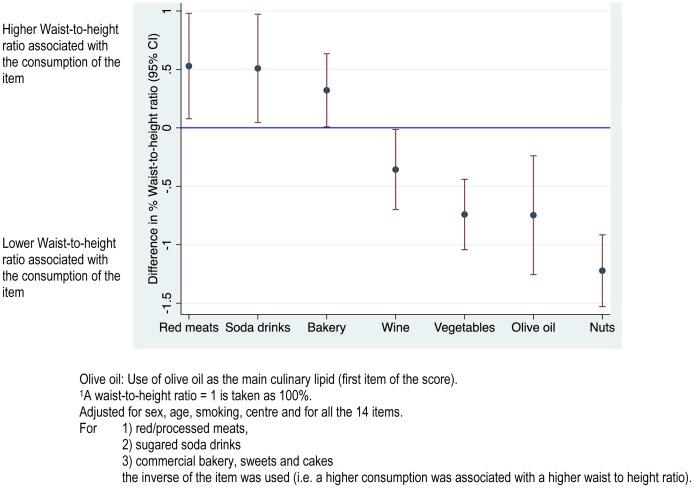
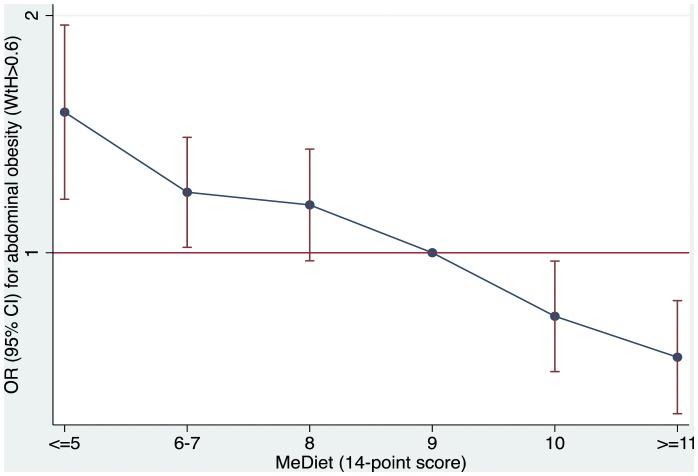
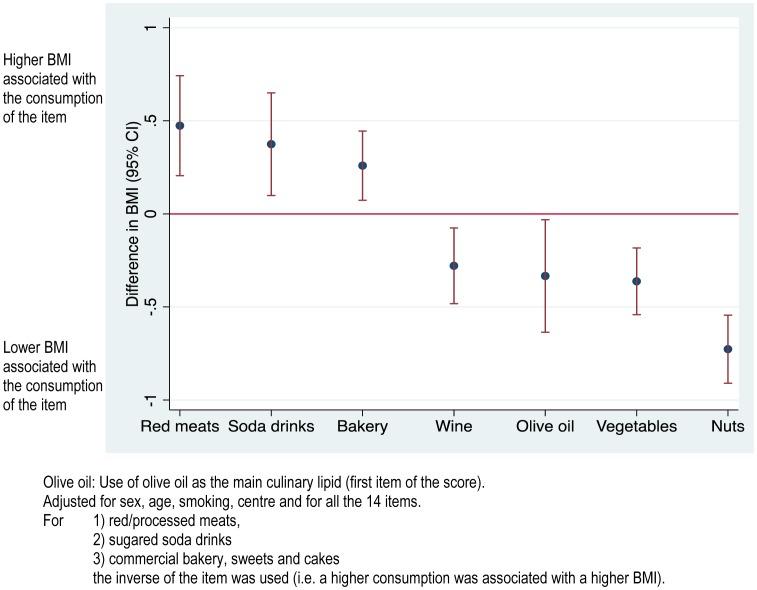
Strong inverse linear associations between the 14-item tool and all adiposity indexes were found. For a two-point increment in the 14-item score, the multivariable-adjusted differences in WHtR were -0.0066 (95% confidence interval, -0.0088 to -0.0049) for women and -0.0059 (-0.0079 to -0.0038) for men. The multivariable-adjusted odds ratio for a WHtR>0.6 in participants scoring ≥ 10 points versus ≤ 7 points was 0.68 (0.57 to 0.80) for women and 0.66 (0.54 to 0.80) for men. High consumption of nuts and low consumption of sweetened/carbonated beverages presented the strongest inverse associations with abdominal obesity.
CONCLUSIONS
A brief 14-item tool was able to capture a strong monotonic inverse association between adherence to a good quality dietary pattern (Mediterranean diet) and obesity indexes in a population of adults at high cardiovascular risk.
目的
独立于总热量摄入,饮食质量更好(例如,符合地中海饮食模式)与较低的肥胖风险相关。目前尚不清楚简短的饮食评估工具(而非完整的综合方法)是否也能捕捉到这种关联。除了降低成本外,简短的工具还有一个有趣的优势,即可以在干预研究中立即向参与者提供反馈。另一个相关问题是,这种简短工具的个别项目负责这种关联。我们使用 14 项地中海饮食依从性工具作为暴露因素,身体质量指数、腰围和腰高比(WHtR)作为结果来检查这些关联。
设计
“PREvención con DIeta MEDiterránea”(PREDIMED)试验中所有参与者的横断面评估。
对象
7447 名参与者(55-80 岁,57%为女性)无心血管疾病,但有 2 型糖尿病或≥3 个心血管危险因素。经过培训的营养师使用经过验证的 14 项问卷和经过验证的 137 项食物频率问卷来评估饮食习惯。经过培训的护士测量体重、身高和腰围。
结果
14 项工具与所有肥胖指数之间存在强烈的负线性关联。对于 14 项评分增加两分,女性 WHtR 的多变量调整差异为-0.0066(95%置信区间,-0.0088 至-0.0049),男性为-0.0059(-0.0079 至-0.0038)。WHtR>0.6 的参与者中,评分≥10 分与≤7 分相比的多变量调整比值比为 0.68(0.57 至 0.80),男性为 0.66(0.54 至 0.80)。坚果的高摄入量和含糖/碳酸饮料的低摄入量与腹部肥胖呈最强的负相关。
结论
在高心血管风险的成年人人群中,简短的 14 项工具能够捕捉到良好的饮食模式(地中海饮食)与肥胖指数之间的强烈单调负相关。
 Zotero 插件