
病毒突破核膜屏障的策略。
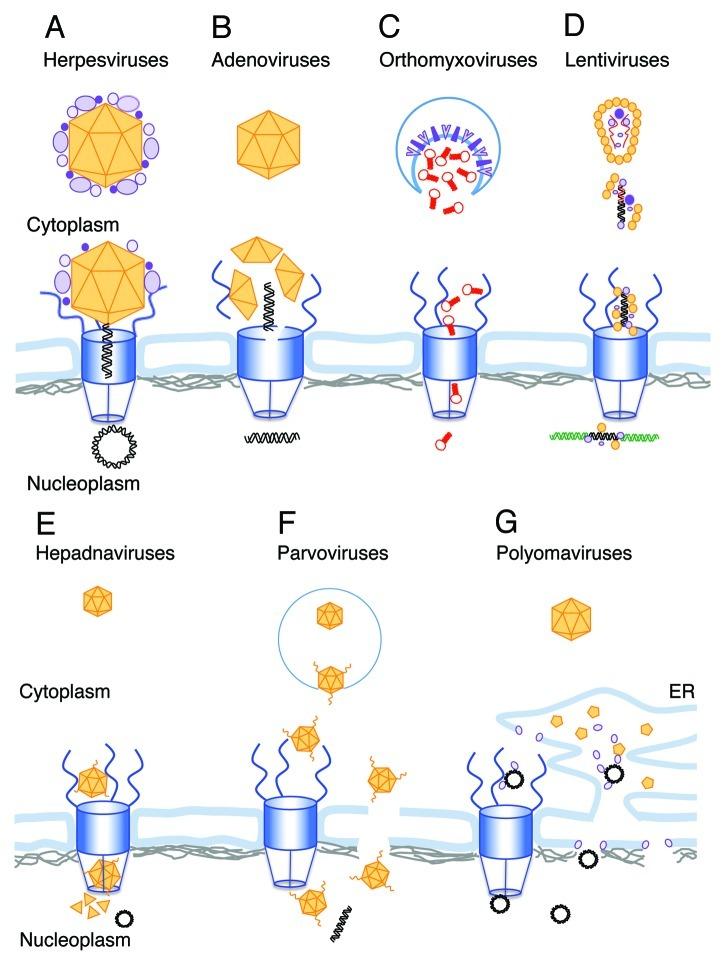
Virus strategies for passing the nuclear envelope barrier.
机构信息
Department of Clinical Microbiology and Immunology, Sackler School of Medicine, Tel Aviv University, Tel Aviv, Israel.
出版信息
Nucleus. 2012 Nov-Dec;3(6):526-39. doi: 10.4161/nucl.21979. Epub 2012 Aug 28.
Viruses that replicate in the nucleus need to pass the nuclear envelope barrier during infection. Research in recent years indicates that the nuclear envelope is a major hurdle for many viruses. This review describes strategies to overcome this obstacle developed by seven virus families: herpesviridae, adenoviridae, orthomyxoviridae, lentiviruses (which are part of retroviridae), Hepadnaviridae, parvoviridae and polyomaviridae. Most viruses use the canonical nuclear pore complex (NPC) in order to get their genome into the nucleus. Viral capsids that are larger than the nuclear pore disassemble before or during passing through the NPC, thus allowing genome nuclear entry. Surprisingly, increasing evidence suggest that parvoviruses and polyomaviruses may bypass the nuclear pore by trafficking directly through the nuclear membrane. Additional studies are required for better understanding these processes. Since nuclear entry emerges as the limiting step in infection for many viruses, it may serve as an ideal target for antiviral drug development.
在细胞核中复制的病毒在感染过程中需要穿过核膜屏障。近年来的研究表明,核膜是许多病毒的主要障碍。本文综述了七种病毒科(疱疹病毒科、腺病毒科、正粘病毒科、慢病毒(属于逆转录病毒科)、嗜肝 DNA 病毒科、细小病毒科和多瘤病毒科)为克服这一障碍而开发的策略。大多数病毒使用规范的核孔复合体(NPC)将其基因组导入细胞核。大于核孔的病毒衣壳在穿过 NPC 之前或期间解体,从而允许基因组进入细胞核。令人惊讶的是,越来越多的证据表明,细小病毒和多瘤病毒可能通过直接穿过核膜绕过核孔。需要进一步的研究来更好地理解这些过程。由于核进入成为许多病毒感染的限制步骤,它可能成为抗病毒药物开发的理想靶点。
 Zotero 插件