
Steppengrille(蟋蟀/拟蟋蟀):两种时间尺度上的选择性过滤和信号失配。
The Steppengrille (Gryllus spec./assimilis): selective filters and signal mismatch on two time scales.
机构信息
Department of Biology, Humboldt-Universität zu Berlin, Berlin, Germany.
出版信息
PLoS One. 2012;7(9):e43975. doi: 10.1371/journal.pone.0043975. Epub 2012 Sep 7.
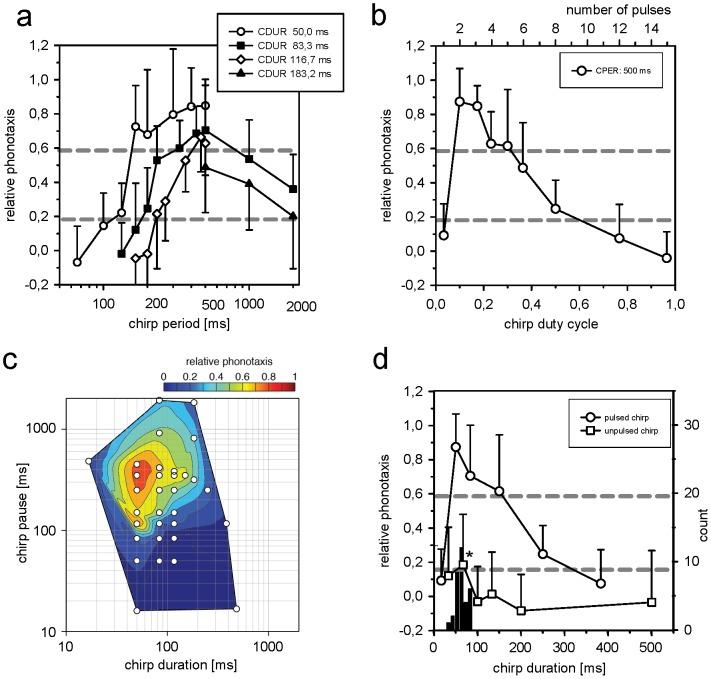
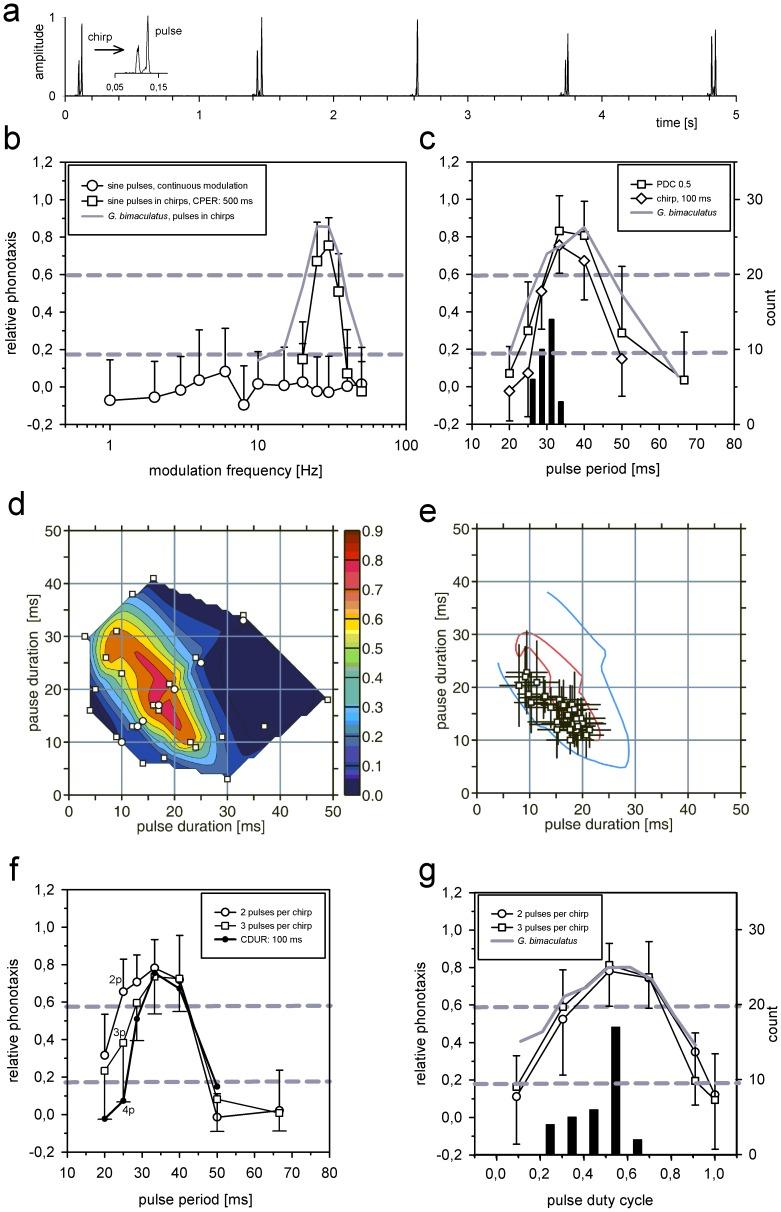
In Europe, several species of crickets are available commercially as pet food. Here we investigated the calling song and phonotactic selectivity for sound patterns on the short and long time scales for one such a cricket, Gryllus spec., available as "Gryllus assimilis", the Steppengrille, originally from Ecuador. The calling song consisted of short chirps (2-3 pulses, carrier frequency: 5.0 kHz) emitted with a pulse period of 30.2 ms and chirp rate of 0.43 per second. Females exhibited high selectivity on both time scales. The preference for pulse period peaked at 33 ms which was higher then the pulse period produced by males. Two consecutive pulses per chirp at the correct pulse period were already sufficient for positive phonotaxis. The preference for the chirp pattern was limited by selectivity for small chirp duty cycles and for chirp periods between 200 ms and 500 ms. The long chirp period of the songs of males was unattractive to females. On both time scales a mismatch between the song signal of the males and the preference of females was observed. The variability of song parameters as quantified by the coefficient of variation was below 50% for all temporal measures. Hence, there was not a strong indication for directional selection on song parameters by females which could account for the observed mismatch. The divergence of the chirp period and female preference may originate from a founder effect, when the Steppengrille was cultured. Alternatively the mismatch was a result of selection pressures exerted by commercial breeders on low singing activity, to satisfy customers with softly singing crickets. In the latter case the prominent divergence between male song and female preference was the result of domestication and may serve as an example of rapid evolution of song traits in acoustic communication systems.
在欧洲,有几种蟋蟀被商业化用作宠物食品。在这里,我们研究了一种蟋蟀(Gryllus spec.)的叫声和对短时间和长时间尺度上声音模式的音位选择,这种蟋蟀被称为“Gryllus assimilis”,即 Steppengrille,原产于厄瓜多尔。它的叫声由短的啁啾声(2-3 个脉冲,载波频率:5.0 kHz)组成,脉冲周期为 30.2 毫秒,啁啾率为每秒 0.43 次。雌性在两个时间尺度上都表现出很高的选择性。对脉冲周期的偏好峰值出现在 33 毫秒,高于雄性产生的脉冲周期。每个啁啾两个连续的脉冲,且脉冲周期正确,就足以产生正向音位选择。对啁啾模式的偏好受到小啁啾占空比和 200 毫秒至 500 毫秒之间的啁啾周期的限制。雄性歌曲中较长的啁啾周期对雌性没有吸引力。在两个时间尺度上,都观察到雄性歌曲信号与雌性偏好之间的不匹配。通过变异系数量化的歌曲参数的可变性在所有时间测量中都低于 50%。因此,雌性对歌曲参数的选择压力没有很强的方向性,这可以解释观察到的不匹配。啁啾周期和雌性偏好的分歧可能源于 Steppengrille 被培养时的奠基者效应。或者,这种不匹配是商业养殖者对低歌唱活动施加的选择压力的结果,以满足客户对柔和蟋蟀叫声的需求。在后一种情况下,雄性歌曲和雌性偏好之间显著的分歧是驯化的结果,可能成为声学通讯系统中歌曲特征快速进化的一个例子。
 Zotero 插件