
南非一个艾滋病毒高发农村地区成年人的高血压和肥胖症。
Hypertension and obesity in adults living in a high HIV prevalence rural area in South Africa.
机构信息
Africa Centre for Health and Population Studies, University of KwaZulu-Natal, Somkhele, KwaZulu-Natal, South Africa.
出版信息
PLoS One. 2012;7(10):e47761. doi: 10.1371/journal.pone.0047761. Epub 2012 Oct 17.
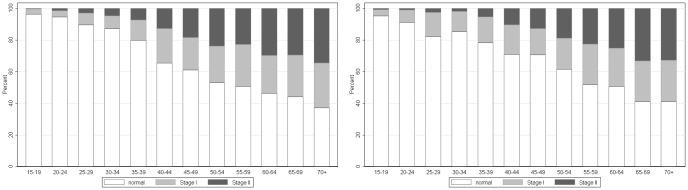
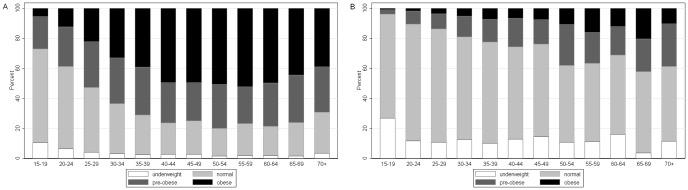
Hypertension and excess body weight are major risk factors of cardiovascular morbidity and mortality in developing countries. In countries with a high HIV prevalence, it is unknown how increased antiretroviral treatment and care (ART) coverage has affected the prevalence of overweight, obesity, and hypertension. We conducted a health survey in 2010 based on the WHO STEPwise approach in 14,198 adult resident participants of a demographic surveillance area in rural South Africa to investigate factors associated with hypertension and excess weight including HIV infection and ART status. Women had a significantly higher median body mass index (BMI) than men (26.4 vs. 21.2 kg/m(2), p<0.001). The prevalence of obesity (BMI ≥ 30 kg/m(2)) in women (31.3%, 95% confidence interval (CI) 30.2-32.4) was 6.5 times higher than in men (4.9%, 95% CI 4.1-5.7), whereas prevalence of hypertension (systolic or diastolic blood pressure ≥ 140 or 90 mm Hg, respectively) was 1.4 times higher in women than in men (28.5% vs 20.8%, p<0.001). In multivariable regression analysis, both hypertension and obesity were significantly associated with sex, age, HIV and ART status. The BMI of women and men on ART was on average 3.8 (95% CI 3.2-3.8) and 1.7 (95% CI 0.9-2.5) kg/m(2) lower than of HIV-negative women and men, respectively. The BMI of HIV-infected women and men not on ART was on average 1.2 (95% CI 0.8-1.6) and 0.4 (95% CI -0.1-0.9) kg/m(2) lower than of HIV-negative women and men, respectively. Obesity was a bigger risk factor for hypertension in men (adjusted odds ratio (aOR) 2.99, 95% CI 2.00-4.48) than in women (aOR 1.64, 95% CI 1.39-1.92) and overweight (25 ≤ BMI<30) was a significant risk factor for men only (aOR 1.53 95% CI 1.14-2.06). Our study suggests that, cardiovascular risk factors of hypertension and obesity differ substantially between women and men in rural South Africa.
高血压和超重是发展中国家心血管发病率和死亡率的主要危险因素。在艾滋病毒感染率较高的国家,尚不清楚增加抗逆转录病毒治疗和护理(ART)覆盖率如何影响超重、肥胖和高血压的流行。我们在南非农村一个人口监测地区的 14198 名成年常住居民中进行了一项基于世界卫生组织 STEPWISE 方法的健康调查,以调查与高血压和超重相关的因素,包括艾滋病毒感染和 ART 状况。女性的平均体重指数(BMI)明显高于男性(26.4 与 21.2kg/m2,p<0.001)。女性肥胖症(BMI≥30kg/m2)的患病率(31.3%,95%置信区间(CI)30.2-32.4)是男性的 6.5 倍(4.9%,95%CI 4.1-5.7),而女性高血压(收缩压或舒张压分别≥140 或 90mmHg)的患病率比男性高 1.4 倍(28.5%比 20.8%,p<0.001)。在多变量回归分析中,高血压和肥胖症均与性别、年龄、艾滋病毒和 ART 状况显著相关。接受抗逆转录病毒治疗的女性和男性的 BMI 平均比未感染艾滋病毒的女性和男性低 3.8(95%CI 3.2-3.8)和 1.7(95%CI 0.9-2.5)kg/m2。未接受抗逆转录病毒治疗的艾滋病毒感染者中,女性和男性的 BMI 平均比未感染艾滋病毒的女性和男性低 1.2(95%CI 0.8-1.6)和 0.4(95%CI -0.1-0.9)kg/m2。肥胖症是男性高血压的一个更大危险因素(调整后的优势比(aOR)2.99,95%CI 2.00-4.48),而不是女性(aOR 1.64,95%CI 1.39-1.92),超重(25≤BMI<30)仅对男性是一个显著的危险因素(aOR 1.53,95%CI 1.14-2.06)。我们的研究表明,在南非农村,女性和男性的心血管危险因素高血压和肥胖症存在显著差异。

 Zotero 插件