
黏连蛋白对于雌二醇激活 MYC 是必需的。
Cohesin is required for activation of MYC by estradiol.
机构信息
Department of Pathology, Dunedin School of Medicine, University of Otago, Dunedin, New Zealand.
出版信息
PLoS One. 2012;7(11):e49160. doi: 10.1371/journal.pone.0049160. Epub 2012 Nov 8.
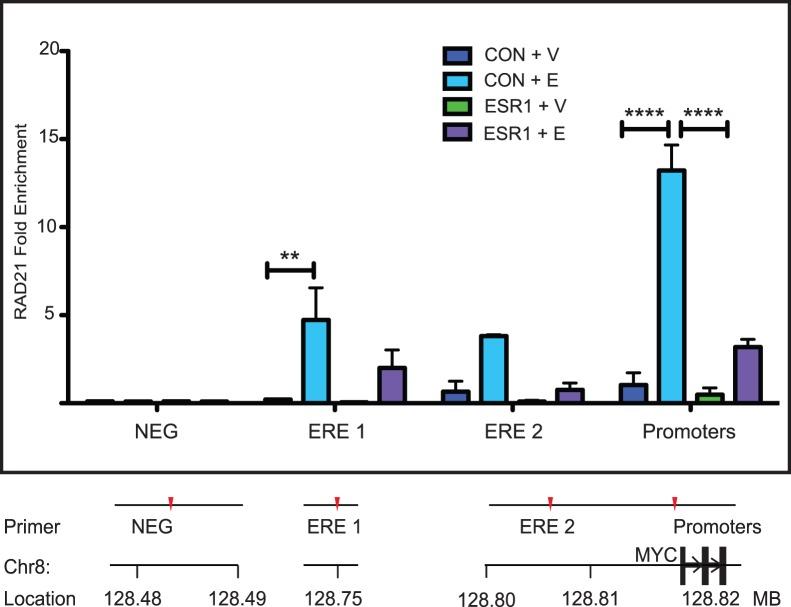
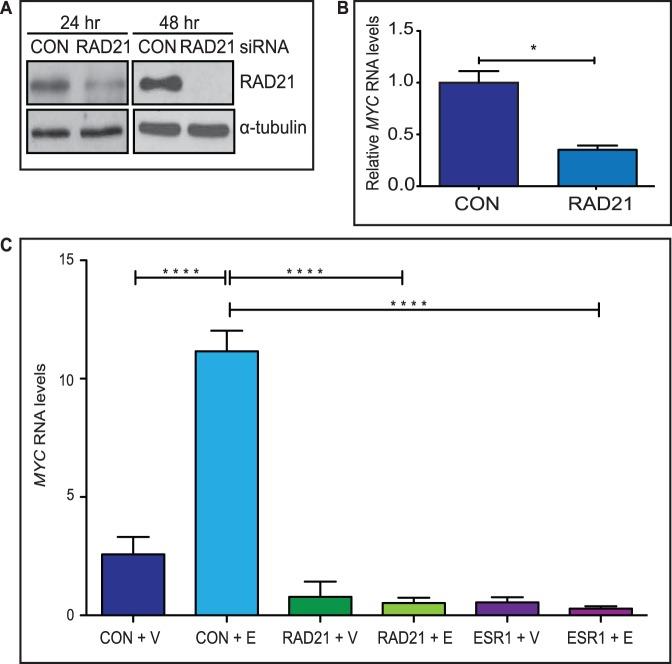
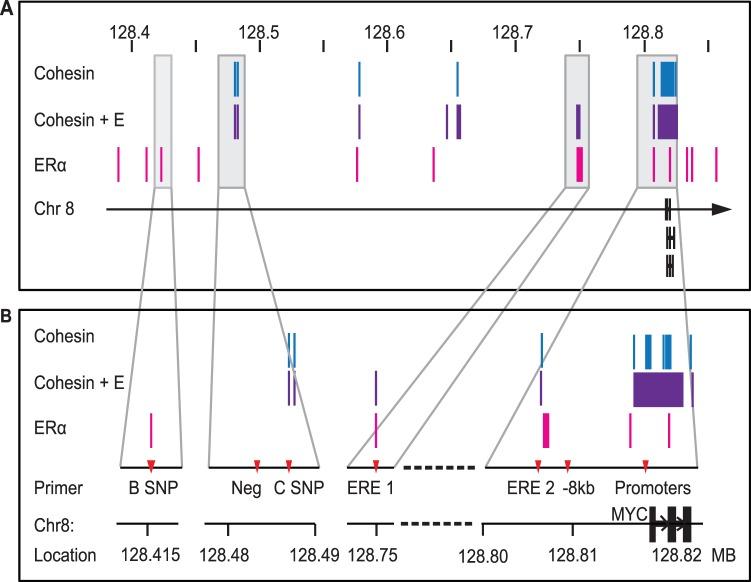
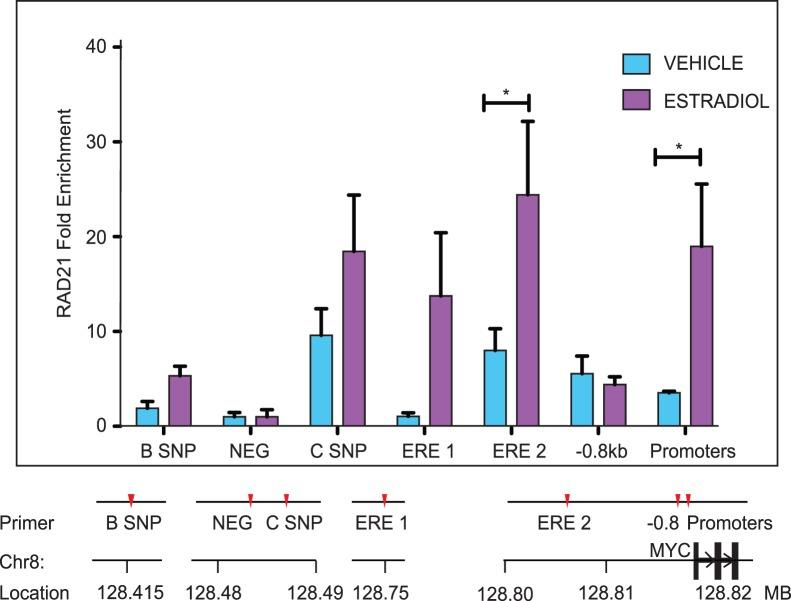
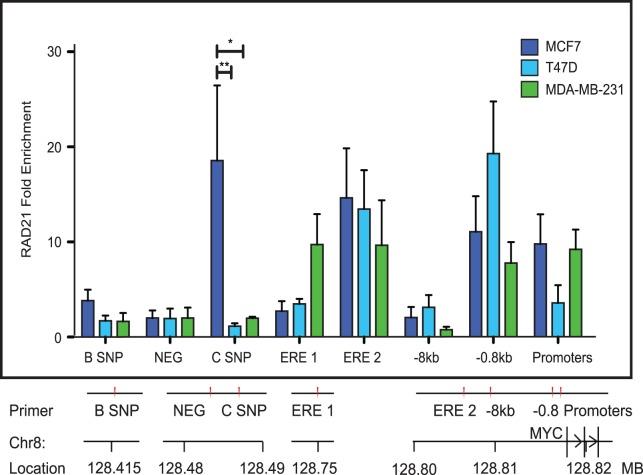
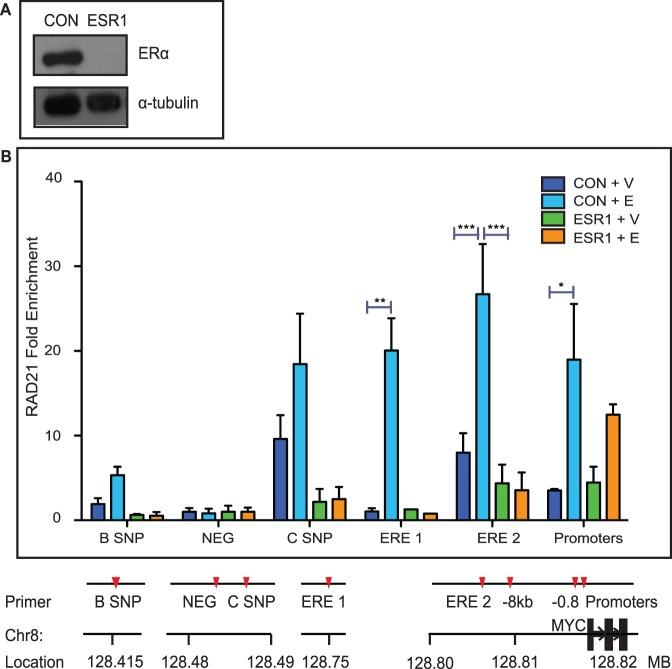
Cohesin is best known as a multi-subunit protein complex that holds together replicated sister chromatids from S phase until G2. Cohesin also has an important role in the regulation of gene expression. We previously demonstrated that the cohesin complex positively regulates expression of the oncogene MYC. Cell proliferation driven by MYC contributes to many cancers, including breast cancer. The MYC oncogene is estrogen-responsive and a transcriptional target of estrogen receptor alpha (ERα). Estrogen-induced cohesin binding sites coincide with ERα binding at the MYC locus, raising the possibility that cohesin and ERα combine actions to regulate MYC transcription. The objective of this study was to investigate a putative role for cohesin in estrogen induction of MYC expression. We found that siRNA-targeted depletion of a cohesin subunit, RAD21, decreased MYC expression in ER-positive (MCF7 and T47D) and ER-negative (MDA-MB-231) breast cancer cell lines. In addition, RAD21 depletion blocked estradiol-mediated activation of MYC in ER-positive cell lines, and decreased ERα binding to estrogen response elements (EREs) upstream of MYC, without affecting total ERα levels. Treatment of MCF7 cells with estradiol caused enrichment of RAD21 binding at upstream enhancers and at the P2 promoter of MYC. Enriched binding at all sites, except the P2 promoter, was dependent on ERα. Since RAD21 depletion did not affect transcription driven by an exogenous reporter construct containing a naked ERE, chromatin-based mechanisms are likely to be involved in cohesin-dependent MYC transcription. This study demonstrates that ERα activation of MYC can be modulated by cohesin. Together, these results demonstrate a novel role for cohesin in estrogen-mediated regulation of MYC and the first evidence that cohesin plays a role in ERα binding.
着丝粒蛋白复合体作为一种多亚基蛋白复合体而闻名,它将 S 期复制的姐妹染色单体保持在一起,直到 G2 期。着丝粒蛋白复合体在基因表达调控中也具有重要作用。我们之前证明了着丝粒复合体正向调节癌基因 MYC 的表达。由 MYC 驱动的细胞增殖有助于许多癌症,包括乳腺癌。MYC 癌基因是雌激素反应性的,是雌激素受体α (ERα) 的转录靶标。雌激素诱导的着丝粒结合位点与 ERα 在 MYC 基因座上的结合重合,这增加了着丝粒和 ERα 结合作用以调节 MYC 转录的可能性。本研究的目的是研究着丝粒在雌激素诱导 MYC 表达中的潜在作用。我们发现,靶向 RAD21 的 siRNA 使 ER 阳性(MCF7 和 T47D)和 ER 阴性(MDA-MB-231)乳腺癌细胞系中的 MYC 表达减少。此外,RAD21 耗竭阻断了 ER 阳性细胞系中雌二醇介导的 MYC 激活,并减少了 ERα 与 MYC 上游雌激素反应元件 (ERE) 的结合,而不影响总 ERα 水平。用雌二醇处理 MCF7 细胞导致 RAD21 在 MYC 的上游增强子和 P2 启动子处结合富集。除了 P2 启动子之外,所有位点的富集都依赖于 ERα。由于 RAD21 耗竭不影响含有裸露 ERE 的外源性报告基因构建体驱动的转录,因此染色质基机制可能涉及依赖于着丝粒的 MYC 转录。本研究表明,ERα 对 MYC 的激活可以通过着丝粒来调节。综上所述,这些结果表明着丝粒在雌激素介导的 MYC 调节中具有新的作用,并且首次证明着丝粒在 ERα 结合中发挥作用。



 Zotero 插件