
氯胺酮受体拮抗剂诺布啡烷(norBNI)后注射对大鼠恐惧和焦虑的影响。
Effects of a post-shock injection of the kappa opioid receptor antagonist norbinaltorphimine (norBNI) on fear and anxiety in rats.
机构信息
Department of Oral Biology, Faculty of Dentistry, University of Manitoba, Winnipeg, Manitoba, Canada.
出版信息
PLoS One. 2012;7(11):e49669. doi: 10.1371/journal.pone.0049669. Epub 2012 Nov 14.
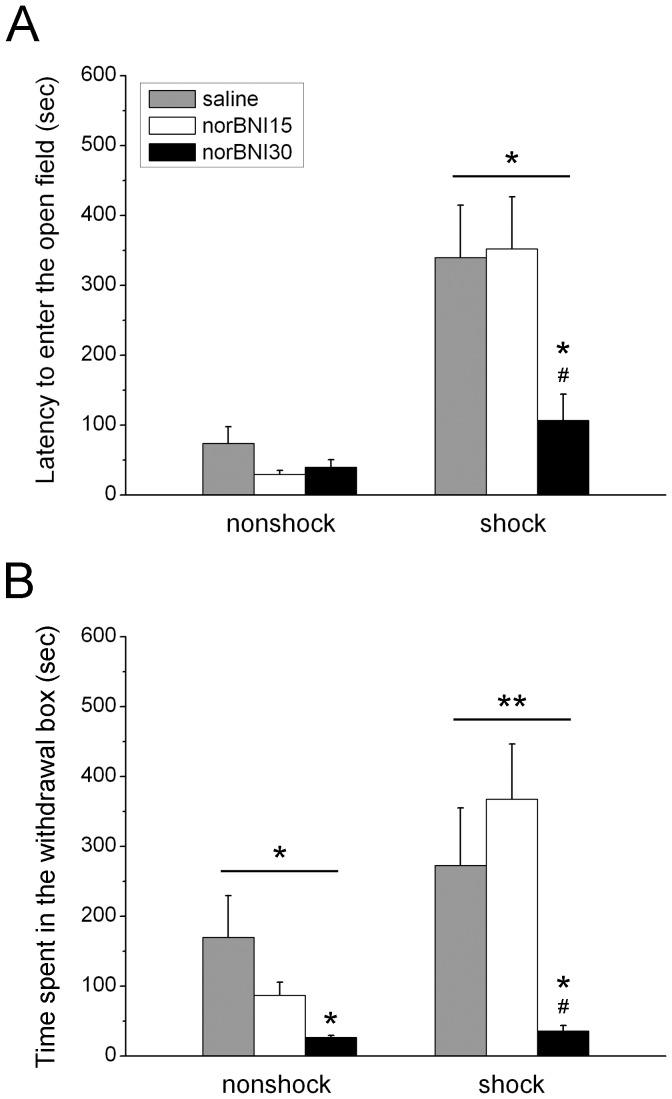
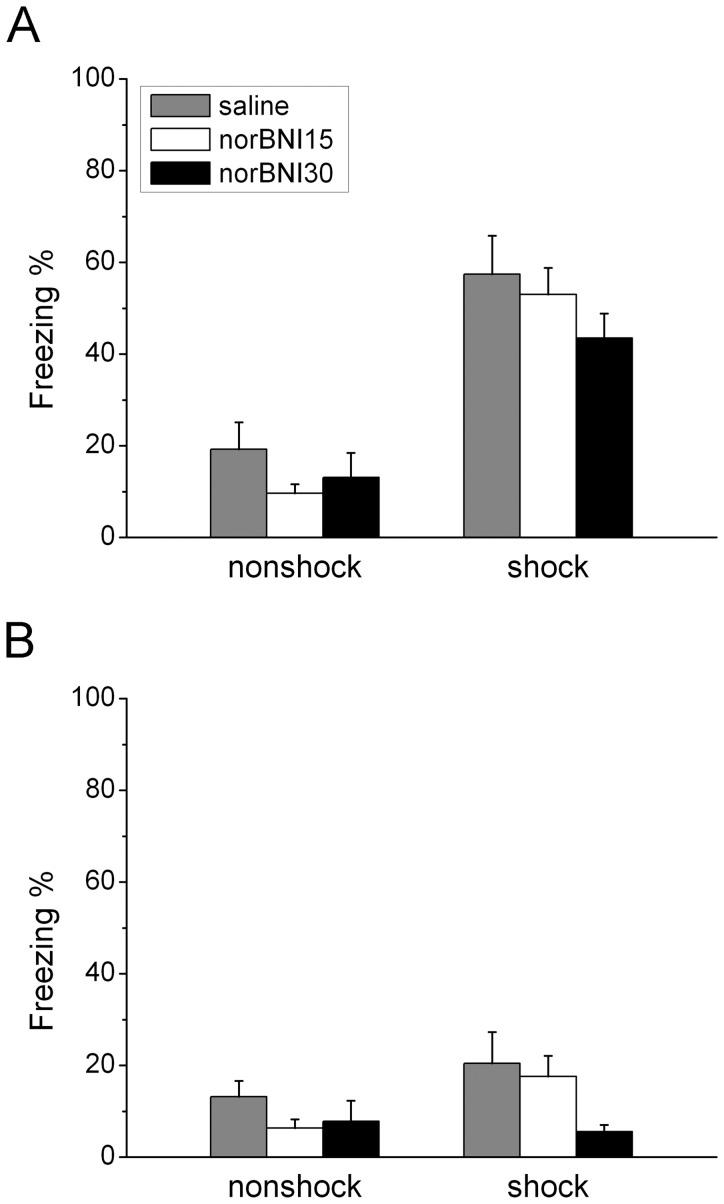
Exposure of rats to footshocks leads to an enduring behavioral state involving generalized fear responses and avoidance. Recent evidence suggests that the expression of negative emotional behaviors produced by a stressor is in part mediated by dynorphin and its main receptor, the kappa opioid receptor (KOR). The purpose of this study was to determine if a subcutaneous injection of the long-acting KOR antagonist norbinaltorphimine (norBNI; 15.0 and 30.0 mg/kg) given 2 days after an acute exposure of rats to footshooks (5×2 s episodes of 1.5 mA delivered over 5 min) attenuates the expression of lasting fear and anxiety. We report that exposure of rats to acute footshock produced long-lasting (>4 weeks) fear (freezing) and anxiety (avoidance of an open area in the defensive withdrawal test). The 30 mg dose of norBNI attenuated the fear expressed when shock rats were placed in the shock context at Day 9 but not Day 27 post-shock. The same dose of norBNI had no effect on the expression of generalized fear produced when shock rats were placed in a novel chamber at Days 8 and 24. In contrast, the 30 mg dose of norBNI produced consistent anxiolytic effects in shock and nonshock rats. First, the 30 mg dose was found to decrease the latency to enter the open field in the defensive withdrawal test done 30 days after the shock exposure. Second, the same high dose also had anxiolytic effects in both nonshock and shock rats as evidence by a decrease in the mean time spent in the withdrawal box. The present study shows that systemic injection of the KOR antagonist norBNI had mixed effect on fear. In contrast, norBNI had an anxiolytic effect which included the attenuation of the enhanced avoidance of a novel area produced by a prior shock experience.
大鼠暴露于电击会导致一种持久的行为状态,涉及广泛的恐惧反应和回避。最近的证据表明,应激源产生的负面情绪行为的表达部分是由强啡肽及其主要受体κ阿片受体(KOR)介导的。本研究的目的是确定在大鼠急性暴露于电击(5 分钟内 5×2 s 期 1.5 mA)后 2 天给予皮下注射长效 KOR 拮抗剂诺宾那肽(norBNI;15.0 和 30.0 mg/kg)是否会减弱持久的恐惧和焦虑的表达。我们报告说,大鼠暴露于急性电击会产生持久的(>4 周)恐惧(冻结)和焦虑(在防御性回避测试中回避开阔区域)。30 mg norBNI 剂量可减轻电击大鼠在第 9 天但不在第 27 天电击后置于电击环境中时表达的恐惧。相同剂量的 norBNI 对电击大鼠在第 8 天和第 24 天置于新室时产生的一般恐惧的表达没有影响。相比之下,30 mg norBNI 剂量在电击和非电击大鼠中均产生一致的抗焦虑作用。首先,在电击暴露后 30 天进行的防御性回避测试中,发现 30 mg 剂量可降低进入开阔区域的潜伏期。其次,相同的高剂量也对非电击和电击大鼠具有抗焦虑作用,这表现为进入回避箱的平均时间减少。本研究表明,系统注射 KOR 拮抗剂 norBNI 对恐惧有混合作用。相比之下,norBNI 具有抗焦虑作用,包括减弱先前电击经历引起的对新区域的回避增强。
 Zotero 插件