
硝酸盐还原口腔细菌在血压控制中的生理作用。
Physiological role for nitrate-reducing oral bacteria in blood pressure control.
机构信息
Centre for Clinical Pharmacology, William Harvey Research Institute, Barts and the London School of Medicine and Dentistry, Queen Mary University of London, London EC1M 6BQ, UK.
出版信息
Free Radic Biol Med. 2013 Feb;55:93-100. doi: 10.1016/j.freeradbiomed.2012.11.013. Epub 2012 Nov 23.
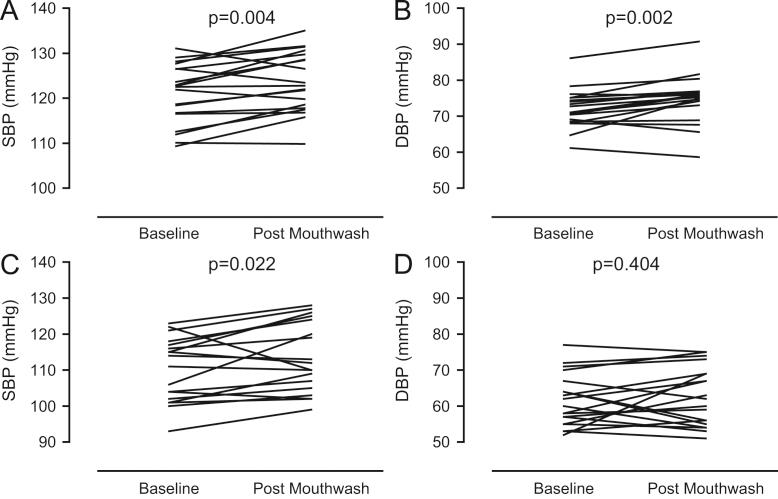
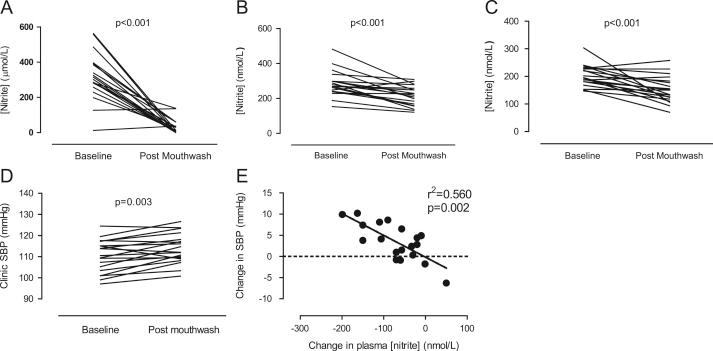
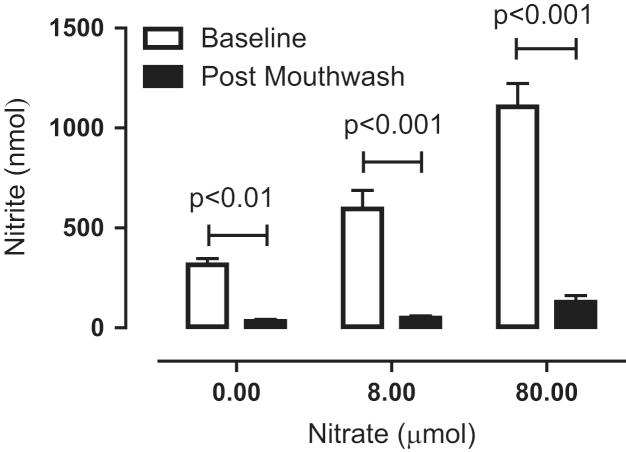
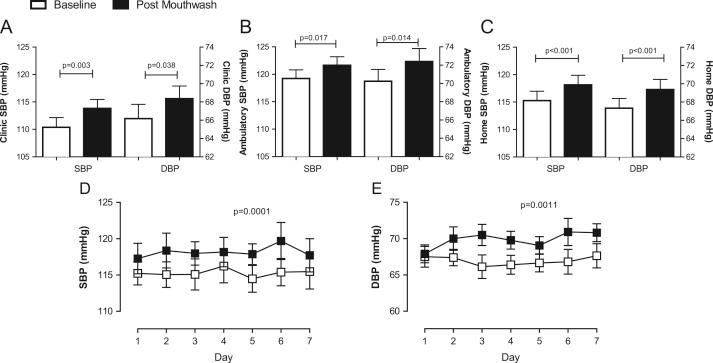
Circulating nitrate (NO(3)(-)), derived from dietary sources or endogenous nitric oxide production, is extracted from blood by the salivary glands, accumulates in saliva, and is then reduced to nitrite (NO(2)(-)) by the oral microflora. This process has historically been viewed as harmful, because nitrite can promote formation of potentially carcinogenic N-nitrosamines. More recent research, however, suggests that nitrite can also serve as a precursor for systemic generation of vasodilatory nitric oxide, and exogenous administration of nitrate reduces blood pressure in humans. However, whether oral nitrate-reducing bacteria participate in "setting" blood pressure is unknown. We investigated whether suppression of the oral microflora affects systemic nitrite levels and hence blood pressure in healthy individuals. We measured blood pressure (clinic, home, and 24-h ambulatory) in 19 healthy volunteers during an initial 7-day control period followed by a 7-day treatment period with a chlorhexidine-based antiseptic mouthwash. Oral nitrate-reducing capacity and nitrite levels were measured after each study period. Antiseptic mouthwash treatment reduced oral nitrite production by 90% (p < 0.001) and plasma nitrite levels by 25% (p = 0.001) compared to the control period. Systolic and diastolic blood pressure increased by 2-3 .5mmHg, increases correlated to a decrease in circulating nitrite concentrations (r(2) = 0.56, p = 0.002). The blood pressure effect appeared within 1 day of disruption of the oral microflora and was sustained during the 7-day mouthwash intervention. These results suggest that the recycling of endogenous nitrate by oral bacteria plays an important role in determination of plasma nitrite levels and thereby in the physiological control of blood pressure.
循环中的硝酸盐(NO3(-)),来源于饮食来源或内源性一氧化氮的产生,被唾液腺从血液中提取出来,在唾液中积累,然后被口腔微生物群还原为亚硝酸盐(NO2(-))。这一过程在历史上一直被认为是有害的,因为亚硝酸盐可以促进潜在致癌的 N-亚硝胺的形成。然而,最近的研究表明,亚硝酸盐也可以作为全身生成血管舒张性一氧化氮的前体,外源性给予硝酸盐可以降低人类的血压。然而,口腔硝酸盐还原菌是否参与“设定”血压尚不清楚。我们研究了抑制口腔微生物群是否会影响健康个体的全身亚硝酸盐水平和血压。我们在 19 名健康志愿者中测量了血压(诊所、家庭和 24 小时动态血压监测),在初始的 7 天对照期后,使用洗必泰基抗菌漱口水进行了为期 7 天的治疗期。在每个研究期间后测量口腔硝酸盐还原能力和亚硝酸盐水平。与对照期相比,抗菌漱口水治疗使口腔亚硝酸盐生成减少了 90%(p<0.001),血浆亚硝酸盐水平降低了 25%(p=0.001)。收缩压和舒张压分别增加了 2-3.5mmHg,增加与循环中亚硝酸盐浓度的降低相关(r(2) = 0.56,p = 0.002)。口腔微生物群被破坏后 1 天内血压就开始出现变化,并且在 7 天的漱口水干预期间持续存在。这些结果表明,口腔细菌对内源性硝酸盐的再循环在确定血浆亚硝酸盐水平以及生理血压控制中起着重要作用。

 Zotero 插件