
使 CRISPR/Cas 细菌免疫系统失活的噬菌体基因。
Bacteriophage genes that inactivate the CRISPR/Cas bacterial immune system.
机构信息
Department of Molecular Genetics, University of Toronto, Toronto, Ontario M5S 1A8, Canada.
出版信息
Nature. 2013 Jan 17;493(7432):429-32. doi: 10.1038/nature11723. Epub 2012 Dec 16.
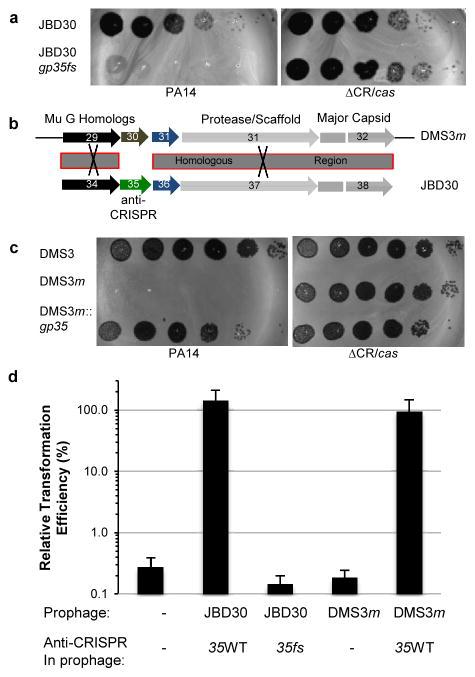
A widespread system used by bacteria for protection against potentially dangerous foreign DNA molecules consists of the clustered regularly interspaced short palindromic repeats (CRISPR) coupled with cas (CRISPR-associated) genes. Similar to RNA interference in eukaryotes, these CRISPR/Cas systems use small RNAs for sequence-specific detection and neutralization of invading genomes. Here we describe the first examples of genes that mediate the inhibition of a CRISPR/Cas system. Five distinct 'anti-CRISPR' genes were found in the genomes of bacteriophages infecting Pseudomonas aeruginosa. Mutation of the anti-CRISPR gene of a phage rendered it unable to infect bacteria with a functional CRISPR/Cas system, and the addition of the same gene to the genome of a CRISPR/Cas-targeted phage allowed it to evade the CRISPR/Cas system. Phage-encoded anti-CRISPR genes may represent a widespread mechanism for phages to overcome the highly prevalent CRISPR/Cas systems. The existence of anti-CRISPR genes presents new avenues for the elucidation of CRISPR/Cas functional mechanisms and provides new insight into the co-evolution of phages and bacteria.
一种广泛存在于细菌中的系统,用于抵御潜在危险的外源 DNA 分子,该系统由成簇的规律间隔的短回文重复序列(CRISPR)与 cas(CRISPR 相关)基因组成。与真核生物中的 RNA 干扰类似,这些 CRISPR/Cas 系统使用小 RNA 进行序列特异性检测,并中和入侵的基因组。在这里,我们描述了第一个介导 CRISPR/Cas 系统抑制的基因的例子。在感染铜绿假单胞菌的噬菌体基因组中发现了五个不同的“抗 CRISPR”基因。噬菌体抗 CRISPR 基因的突变使其无法感染具有功能 CRISPR/Cas 系统的细菌,而将相同的基因添加到 CRISPR/Cas 靶向噬菌体的基因组中,则使其能够逃避 CRISPR/Cas 系统。噬菌体编码的抗 CRISPR 基因可能代表了噬菌体克服高度流行的 CRISPR/Cas 系统的一种广泛机制。抗 CRISPR 基因的存在为阐明 CRISPR/Cas 功能机制提供了新的途径,并为噬菌体和细菌的共同进化提供了新的见解。

 Zotero 插件