
多种调控机制控制 B-1 B 细胞的激活。
Multiple regulatory mechanisms control B-1 B cell activation.
机构信息
Department of Microbiology, Immunology and Molecular Genetics, University of Kentucky College of Medicine Lexington, KY, USA.
出版信息
Front Immunol. 2012 Dec 17;3:372. doi: 10.3389/fimmu.2012.00372. eCollection 2012.
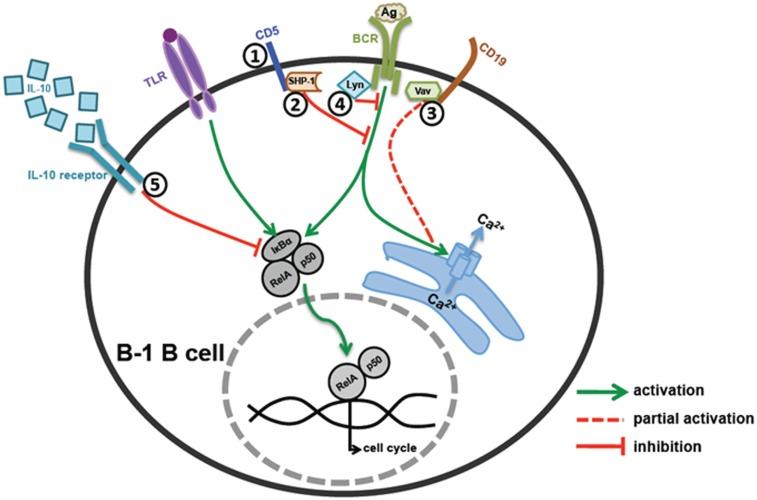
B-1 cells constitute a unique subset of B cells identified in several species including mice and humans. B-1 cells are further subdivided into B-1a and B-1b subsets as the former but not the later express CD5. The B-1a subset contributes to innate type of immune responses while the B-1b B cell subset contributes to adaptive responses. B-1 cell responses to B cell receptor (BCR) as well as Toll-like receptor (TLR) ligation are tightly regulated due to the cross-reactivity of antigen specific receptors on B-1 cells to self-antigens. B-1 cells are elevated in several autoimmune diseases. CD5 plays a major role in down regulation of BCR responses in the B-1a cell subset. Reduced amplification of BCR induced signals via CD19 and autoregulation of BCR and TLR responses by B-1 cell produced IL-10 appear to have a role in regulation of both B-1a and B-1b B cell responses. Siglec G receptors and Lyn kinase also regulate B-1 cell responses but their differential role in the two B-1 cell subsets is unknown.
B-1 细胞是在包括小鼠和人类在内的几种物种中鉴定出的一种独特的 B 细胞亚群。B-1 细胞进一步细分为 B-1a 和 B-1b 亚群,前者而非后者表达 CD5。B-1a 亚群有助于先天类型的免疫反应,而 B-1b B 细胞亚群有助于适应性反应。B-1 细胞对 B 细胞受体 (BCR) 以及 Toll 样受体 (TLR) 连接的反应受到严格调节,因为 B-1 细胞上抗原特异性受体对自身抗原的交叉反应性。几种自身免疫性疾病中 B-1 细胞升高。CD5 在 B-1a 细胞亚群中下调 BCR 反应中起主要作用。通过 CD19 减少 BCR 诱导信号的扩增以及 B-1 细胞产生的 IL-10 对 BCR 和 TLR 反应的自身调节似乎在调节 B-1a 和 B-1b B 细胞反应中起作用。Siglec G 受体和 Lyn 激酶也调节 B-1 细胞反应,但它们在这两个 B-1 细胞亚群中的差异作用尚不清楚。
 Zotero 插件