
局部晚期胰腺癌初次化疗后挽救性放化疗:单中心回顾性分析。
Salvage chemoradiotherapy after primary chemotherapy for locally advanced pancreatic cancer: a single-institution retrospective analysis.
机构信息
Division of Radiation Oncology, National Cancer Center Hospital, 5-1-1 Tsukiji, Tokyo 104-0045, Japan.
出版信息
BMC Cancer. 2012 Dec 20;12:609. doi: 10.1186/1471-2407-12-609.
BACKGROUND
There is no consensus on the indication for salvage chemoradiotherapy (CRT) after failure of primary chemotherapy for locally advanced pancreatic cancer (LAPC). Here we report on the retrospective analysis of patients who received salvage CRT after primary chemotherapy for LAPC. The primary objective of this study was to evaluate the efficacy and safety of salvage CRT after primary chemotherapy for LAPC.
METHODS
Thirty patients who underwent salvage CRT, after the failure of primary chemotherapy for LAPC, were retrospectively enrolled from 2004 to 2011 at the authors' institution. All the patients had histologically confirmed pancreatic adenocarcinoma.
RESULTS
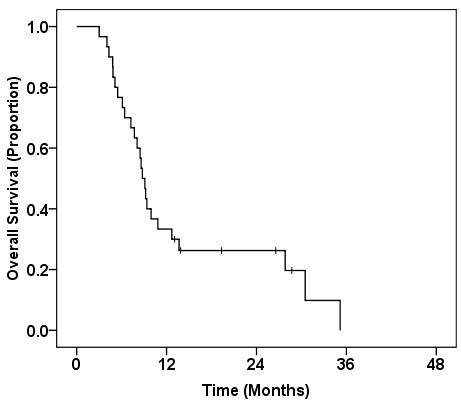
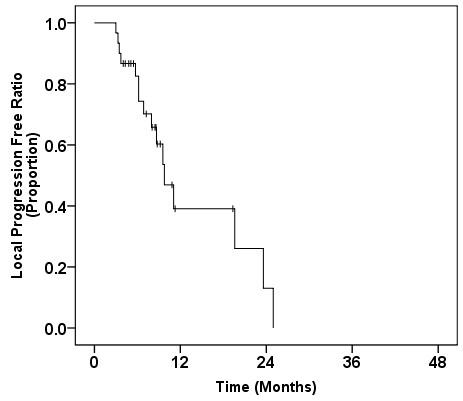
Primary chemotherapy was continued until progression or emergence of unacceptable toxicity. Eventually, 26 patients (87%) discontinued primary chemotherapy because of local tumor progression, whereas four patients (13%) discontinued chemotherapy because of interstitial pneumonitis caused by gemcitabine. After a median period of 7.9 months from starting chemotherapy, 30 patients underwent salvage CRT combined with either S-1 or 5-FU. Toxicities were generally mild and self-limiting. Median survival time (MST) from the start of salvage CRT was 8.8 months. The 6 month, 1-year and 2-year survival rates from the start of CRT were 77%, 33% and 26%, respectively. Multivariate analysis revealed that a lower pre-CRT serum CA 19-9 level (≤ 1000 U/ml; p = 0.009) and a single regimen of primary chemotherapy (p = 0.004) were independent prognostic factors for survival after salvage CRT. The MST for the entire patient population from the start of primary chemotherapy was 17.8 months, with 2- and 3-year overall survival rates of 39% and 22%, respectively.
CONCLUSIONS
CRT had moderate anti-tumor activity and an acceptable toxicity profile in patients with LAPC, even after failure of gemcitabine-based primary chemotherapy. If there are any signs of failure of primary chemotherapy without distant metastasis, salvage CRT could be a treatment of choice as a second-line therapy. Patients with relatively low serum CA19-9 levels after primary chemotherapy may achieve higher survival rates after salvage CRT. The strategy of using chemotherapy alone as a primary treatment for LAPC, followed-by CRT with salvage intent should be further investigated in prospective clinical trials.
TRIAL REGISTRATION
2011-136
背景
对于局部晚期胰腺癌(LAPC)患者在接受初始化疗失败后, salvage 放化疗(CRT)的适应证尚无共识。在此,我们报告了对接受 LAPC 初始化疗失败后行 salvage CRT 的患者进行的回顾性分析。本研究的主要目的是评估 LAPC 患者在接受初始化疗失败后行 salvage CRT 的疗效和安全性。
方法
2004 年至 2011 年,我们对在本机构接受 salvage CRT 的 30 例 LAPC 初始化疗失败的患者进行了回顾性分析。所有患者均经组织学证实为胰腺腺癌。
结果
初始化疗持续至疾病进展或出现不可耐受的毒性。最终,26 例(87%)患者因局部肿瘤进展而停止初始化疗,4 例(13%)患者因吉西他滨引起间质性肺炎而停止化疗。从开始化疗到行 salvage CRT 的中位时间为 7.9 个月,30 例患者接受了 S-1 或 5-FU 联合 salvage CRT。毒性一般较轻且为自限性。从开始 salvage CRT 到中位生存时间(MST)为 8.8 个月。从 CRT 开始的 6 个月、1 年和 2 年生存率分别为 77%、33%和 26%。多因素分析显示,较低的 CRT 前血清 CA19-9 水平(≤1000 U/ml;p=0.009)和初始化疗采用单药方案(p=0.004)是影响 salvage CRT 后生存的独立预后因素。从初始化疗开始的整个患者人群的 MST 为 17.8 个月,2 年和 3 年总生存率分别为 39%和 22%。
结论
即使在吉西他滨为基础的初始化疗失败后,CRT 对 LAPC 患者也具有中等的抗肿瘤活性和可接受的毒性谱。如果没有远处转移迹象的初始化疗失败迹象,那么作为二线治疗,CRT 可能是一种治疗选择。在初始化疗后血清 CA19-9 水平相对较低的患者,在接受 salvage CRT 后可能获得更高的生存率。将化疗作为 LAPC 的初始治疗方案,然后进行有挽救意图的 CRT 的策略,应在前瞻性临床试验中进一步研究。
临床试验注册
2011-136

 Zotero 插件