
骨髓细胞中 11β-羟类固醇脱氢酶 1 缺乏可减少动脉粥样硬化。
11β-hydroxysteroid dehydrogenase type 1 deficiency in bone marrow-derived cells reduces atherosclerosis.
机构信息
British Heart Foundation Centre for Cardiovascular Science, The Queen's Medical Research Institute, University of Edinburgh, Edinburgh, UK.
出版信息
FASEB J. 2013 Apr;27(4):1519-31. doi: 10.1096/fj.12-219105. Epub 2013 Jan 9.
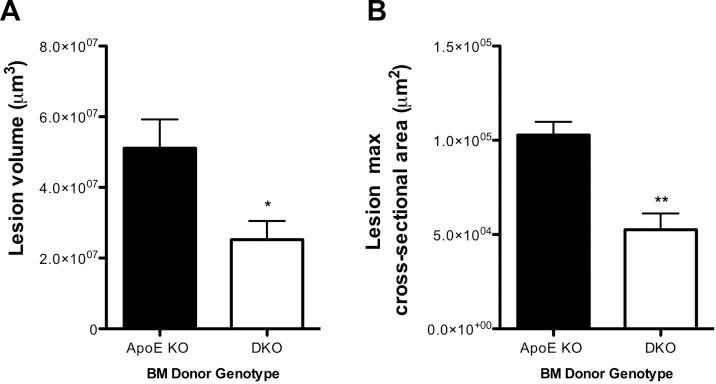
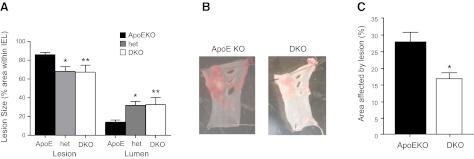
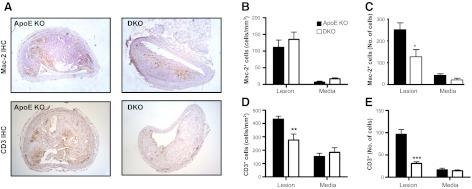
11β-Hydroxysteroid dehydrogenase type-1 (11β-HSD1) converts inert cortisone into active cortisol, amplifying intracellular glucocorticoid action. 11β-HSD1 deficiency improves cardiovascular risk factors in obesity but exacerbates acute inflammation. To determine the effects of 11β-HSD1 deficiency on atherosclerosis and its inflammation, atherosclerosis-prone apolipoprotein E-knockout (ApoE-KO) mice were treated with a selective 11β-HSD1 inhibitor or crossed with 11β-HSD1-KO mice to generate double knockouts (DKOs) and challenged with an atherogenic Western diet. 11β-HSD1 inhibition or deficiency attenuated atherosclerosis (74-76%) without deleterious effects on plaque structure. This occurred without affecting plasma lipids or glucose, suggesting independence from classical metabolic risk factors. KO plaques were not more inflamed and indeed had 36% less T-cell infiltration, associated with 38% reduced circulating monocyte chemoattractant protein-1 (MCP-1) and 36% lower lesional vascular cell adhesion molecule-1 (VCAM-1). Bone marrow (BM) cells are key to the atheroprotection, since transplantation of DKO BM to irradiated ApoE-KO mice reduced atherosclerosis by 51%. 11β-HSD1-null macrophages show 76% enhanced cholesterol ester export. Thus, 11β-HSD1 deficiency reduces atherosclerosis without exaggerated lesional inflammation independent of metabolic risk factors. Selective 11β-HSD1 inhibitors promise novel antiatherosclerosis effects over and above their benefits for metabolic risk factors via effects on BM cells, plausibly macrophages.
11β-羟类固醇脱氢酶 1 型(11β-HSD1)将无活性的可的松转化为有活性的皮质醇,从而放大细胞内糖皮质激素的作用。11β-HSD1 缺乏症可改善肥胖症中的心血管危险因素,但会加剧急性炎症。为了确定 11β-HSD1 缺乏症对动脉粥样硬化及其炎症的影响,使用选择性 11β-HSD1 抑制剂对动脉粥样硬化易感载脂蛋白 E 敲除(ApoE-KO)小鼠进行处理,或使其与 11β-HSD1-KO 小鼠杂交以产生双重敲除(DKO),并用致动脉粥样硬化的西方饮食对其进行挑战。11β-HSD1 抑制或缺乏可减轻动脉粥样硬化(74-76%),而对斑块结构没有不良影响。这一现象的发生与血脂或血糖无关,表明其独立于经典代谢危险因素。KO 斑块的炎症反应并不更严重,事实上 T 细胞浸润减少了 36%,与循环单核细胞趋化蛋白 1(MCP-1)减少 38%和病变血管细胞黏附分子 1(VCAM-1)减少 36%相关。骨髓(BM)细胞是动脉粥样硬化保护的关键,因为将 DKO BM 移植到辐射 ApoE-KO 小鼠中可使动脉粥样硬化减少 51%。11β-HSD1 缺失的巨噬细胞显示出 76%增强的胆固醇酯外排作用。因此,11β-HSD1 缺乏症可减轻动脉粥样硬化,而不会使病变炎症加剧,且独立于代谢危险因素。选择性 11β-HSD1 抑制剂有望通过对 BM 细胞(可能是巨噬细胞)的作用,在改善代谢危险因素方面发挥出优于其的抗动脉粥样硬化作用。



 Zotero 插件