
高渗透压玻璃化法:一种简单、温度宽容的小鼠胚胎冷冻保存新方法。
High osmolality vitrification: a new method for the simple and temperature-permissive cryopreservation of mouse embryos.
机构信息
RIKEN BioResource Center, Tsukuba, Ibaraki, Japan.
出版信息
PLoS One. 2013;8(1):e49316. doi: 10.1371/journal.pone.0049316. Epub 2013 Jan 16.
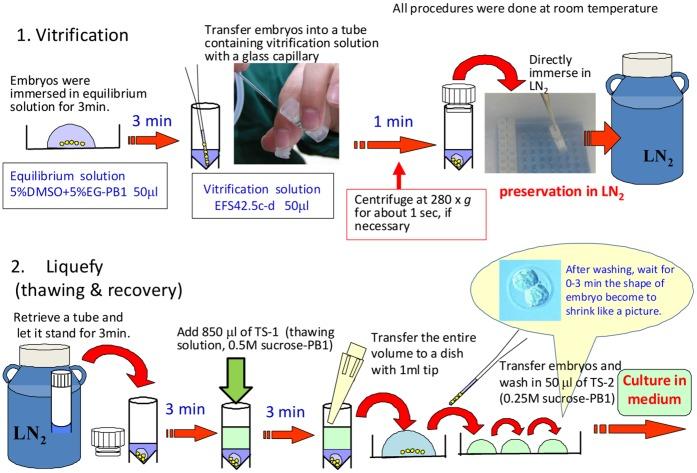
Procedures for cryopreserving embryos vary considerably, each having its specific advantages and disadvantages in terms of technical feasibility, embryo survival yield, temperature permissibility and species- or strain-dependent applicability. Here we report a high osmolality vitrification (HOV) method that is advantageous in these respects. Cryopreservation by vitrification is generally very simple, but, unlike slow freezing, embryos should be kept at a supercooling temperature (below -130°C) to avoid cryodamage. We overcame this problem by using an HOV solution containing 42.5% (v/v) ethylene glycol, 17.3% (w/v) Ficoll and 1.0 M sucrose. This solution is more viscous than other cryopreservation solutions, but easy handling of embryos was assured by employing a less viscous equilibration solution before vitrification. Most (>80%) embryos cryopreserved in this solution survived at -80°C for at least 30 days. Normal mice were recovered even after intercontinental transportation in a conventional dry-ice package for 2-3 days, indicating that special containers such as dry shippers with liquid nitrogen vapor are unnecessary. The HOV solution could also be employed for long-term storage in liquid nitrogen, as with other conventional cryoprotectants. Finally, we confirmed that this new vitrification method could be applied successfully to embryos of all six strains of mice we have tested so far. Thus, our HOV method provides an efficient and reliable strategy for the routine cryopreservation of mouse embryos in animal facilities and biomedical laboratories, and for easy and cheap transportation.
胚胎冷冻保存的程序差异很大,每种方法在技术可行性、胚胎存活率、温度允许性以及物种或品系依赖性适用性方面都有其特定的优缺点。在这里,我们报告了一种高渗透压玻璃化(HOV)方法,在这些方面具有优势。玻璃化冷冻保存通常非常简单,但与慢速冷冻不同,胚胎应保持在过冷温度(低于-130°C)以下,以避免冷冻损伤。我们通过使用含有 42.5%(v/v)乙二醇、17.3%(w/v)Ficoll 和 1.0 M 蔗糖的 HOV 溶液克服了这个问题。与其他冷冻保护剂相比,该溶液的粘性更大,但通过在玻璃化之前使用粘性较小的平衡溶液,确保了胚胎的容易处理。在这种溶液中冷冻保存的大多数(>80%)胚胎在-80°C 下至少存活 30 天。即使在传统的干冰包装中经过 2-3 天的洲际运输,也能回收正常的小鼠,这表明不需要特殊的容器,如带有液氮蒸气的干运器。HOV 溶液也可像其他传统的冷冻保护剂一样,在液氮中长期储存。最后,我们证实这种新的玻璃化方法可以成功应用于迄今为止我们测试的六种小鼠品系的胚胎。因此,我们的 HOV 方法为动物设施和生物医学实验室中常规冷冻保存小鼠胚胎以及方便和廉价的运输提供了一种高效可靠的策略。
 Zotero 插件