
临床分离株的生物膜形成及其在慢性感染中的意义。
Biofilm formation by clinical isolates and the implications in chronic infections.
机构信息
Department of Extremity Trauma and Regenerative Medicine, United States Army Institute of Surgical Research, Ft, Sam Houston, San Antonio, TX, USA.
出版信息
BMC Infect Dis. 2013 Jan 29;13:47. doi: 10.1186/1471-2334-13-47.
BACKGROUND
Biofilm formation is a major virulence factor contributing to the chronicity of infections. To date few studies have evaluated biofilm formation in infecting isolates of patients including both Gram-positive and Gram-negative multidrug-resistant (MDR) species in the context of numerous types of infectious syndromes. Herein, we investigated the biofilm forming capacity in a large collection of single patient infecting isolates and compared the relationship between biofilm formation to various strain characteristics.
METHODS
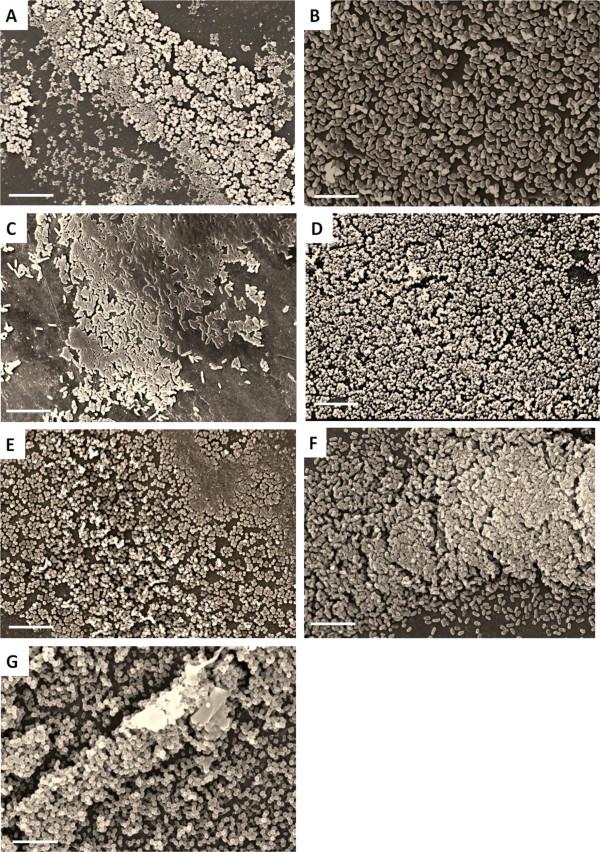
The biofilm-forming capacity of 205 randomly sampled clinical isolates from patients, collected from various anatomical sites, admitted for treatment at Brooke Army Medical Center (BAMC) from 2004-2011, including methicillin-resistant/methicillin susceptible Staphylococcus aureus (MRSA/MSSA) (n=23), Acinetobacter baumannii (n=53), Pseudomonas aeruginosa (n=36), Klebsiella pneumoniae (n=54), and Escherichia coli (n=39), were evaluated for biofilm formation using the high-throughput microtiter plate assay and scanning electron microscopy (SEM). Relationships between biofilm formation to clonal type, site of isolate collection, and MDR phenotype were evaluated. Furthermore, in patients with relapsing infections, serial strains were assessed for their ability to form biofilms in vitro.
RESULTS
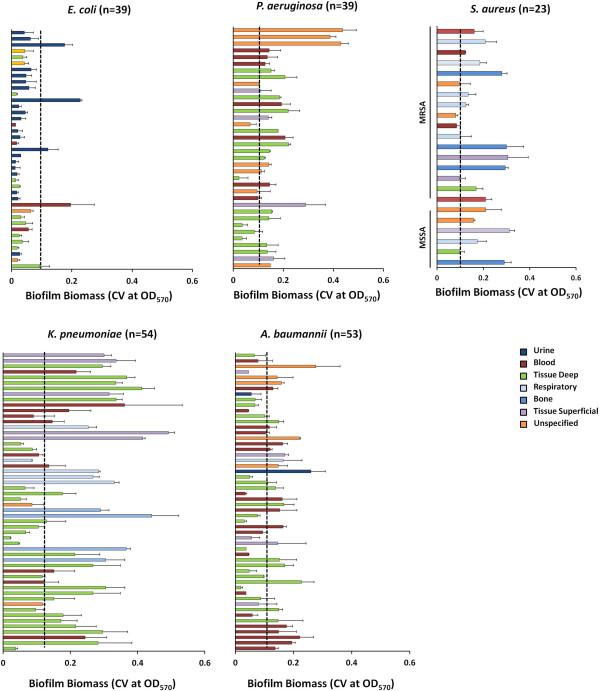
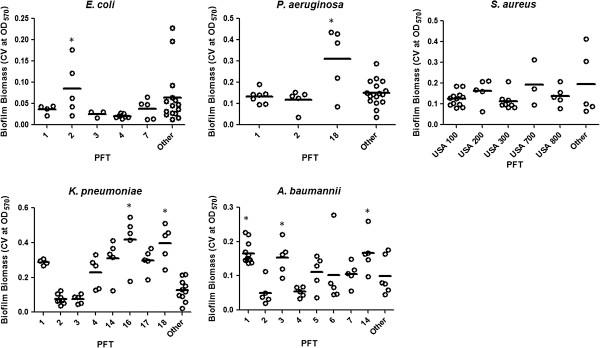
Of the 205 clinical isolates tested, 126 strains (61.4%) were observed to form biofilms in vitro at levels greater than or equal to the Staphylococcus epidermidis, positive biofilm producing strain, with P. aeruginosa and S. aureus having the greatest number of biofilm producing strains. Biofilm formation was significantly associated with specific clonal types, the site of isolate collection, and strains positive for biofilm formation were more frequently observed to be MDR. In patients with relapsing infections, the majority of serial isolates recovered from these individuals were observed to be strong biofilm producers in vitro.
CONCLUSIONS
This study is the first to evaluate biofilm formation in a large collection of infecting clinical isolates representing diverse types of infections. Our results demonstrate: (1) biofilm formation is a heterogeneous property amongst clinical strains which is associated with certain clonal types, (2) biofilm forming strains are more frequently isolated from non-fluid tissues, in particular bone and soft tissues, (3) MDR pathogens are more often biofilm formers, and (4) strains from patients with persistent infections are positive for biofilm formation.
背景
生物膜形成是导致感染慢性化的主要毒力因子。迄今为止,很少有研究评估过包括革兰氏阳性和革兰氏阴性多药耐药(MDR)物种在内的感染患者分离株中的生物膜形成,这些研究涉及多种感染综合征。在此,我们研究了从 2004 年至 2011 年在布鲁克陆军医疗中心(BAMC)接受治疗的不同解剖部位的单个患者感染分离株中生物膜形成能力,并比较了生物膜形成与各种菌株特征之间的关系。
方法
使用高通量微量滴定板测定法和扫描电子显微镜(SEM)评估了从 2004 年至 2011 年在布鲁克陆军医疗中心(BAMC)接受治疗的来自不同解剖部位的患者的 205 个随机采样临床分离株(耐甲氧西林/甲氧西林敏感金黄色葡萄球菌(MRSA/MSSA)[n=23]、鲍曼不动杆菌[n=53]、铜绿假单胞菌[n=36]、肺炎克雷伯菌[n=54]和大肠埃希菌[n=39])的生物膜形成能力。评估了生物膜形成与克隆型、分离株采集部位和 MDR 表型之间的关系。此外,对患有复发性感染的患者进行了连续菌株的体外生物膜形成能力评估。
结果
在所测试的 205 株临床分离株中,有 126 株(61.4%)在体外形成生物膜的水平大于或等于表皮葡萄球菌阳性生物膜产生株,铜绿假单胞菌和金黄色葡萄球菌产生的生物膜产生株最多。生物膜形成与特定的克隆型显著相关,分离株采集部位和生物膜形成阳性的菌株更常表现为 MDR。在患有复发性感染的患者中,从这些患者中回收的大多数连续分离株在体外被观察为强生物膜产生者。
结论
这项研究是首次评估代表多种感染类型的大量感染临床分离株中的生物膜形成。我们的研究结果表明:(1)生物膜形成是临床菌株中的一种异质性特性,与某些克隆型有关;(2)生物膜形成株更常从非流体组织中分离,特别是骨骼和软组织;(3)MDR 病原体更常形成生物膜;(4)持续性感染患者的菌株阳性形成生物膜。

 Zotero 插件