
按性别分析估算肾小球滤过率和白蛋白尿与死亡率及肾衰竭的关系:荟萃分析。
Associations of estimated glomerular filtration rate and albuminuria with mortality and renal failure by sex: a meta-analysis.
机构信息
Faculty of Epidemiology and Population Health, London School of Hygiene and Tropical Medicine, London, UK.
出版信息
BMJ. 2013 Jan 29;346:f324. doi: 10.1136/bmj.f324.
OBJECTIVE
To assess for the presence of a sex interaction in the associations of estimated glomerular filtration rate and albuminuria with all-cause mortality, cardiovascular mortality, and end stage renal disease.
DESIGN
Random effects meta-analysis using pooled individual participant data.
SETTING
46 cohorts from Europe, North and South America, Asia, and Australasia.
PARTICIPANTS
2,051,158 participants (54% women) from general population cohorts (n=1,861,052), high risk cohorts (n=151,494), and chronic kidney disease cohorts (n=38,612). Eligible cohorts (except chronic kidney disease cohorts) had at least 1000 participants, outcomes of either mortality or end stage renal disease of ≥ 50 events, and baseline measurements of estimated glomerular filtration rate according to the Chronic Kidney Disease Epidemiology Collaboration equation (mL/min/1.73 m(2)) and urinary albumin-creatinine ratio (mg/g).
RESULTS
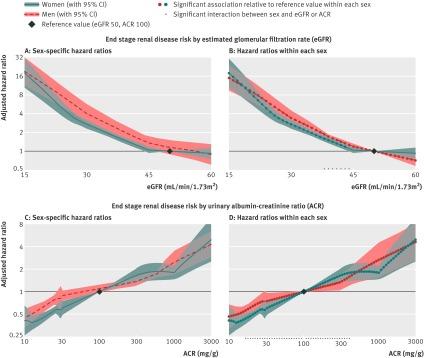
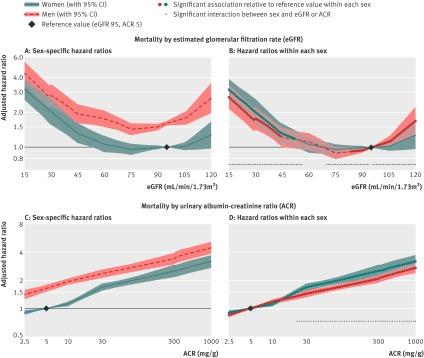
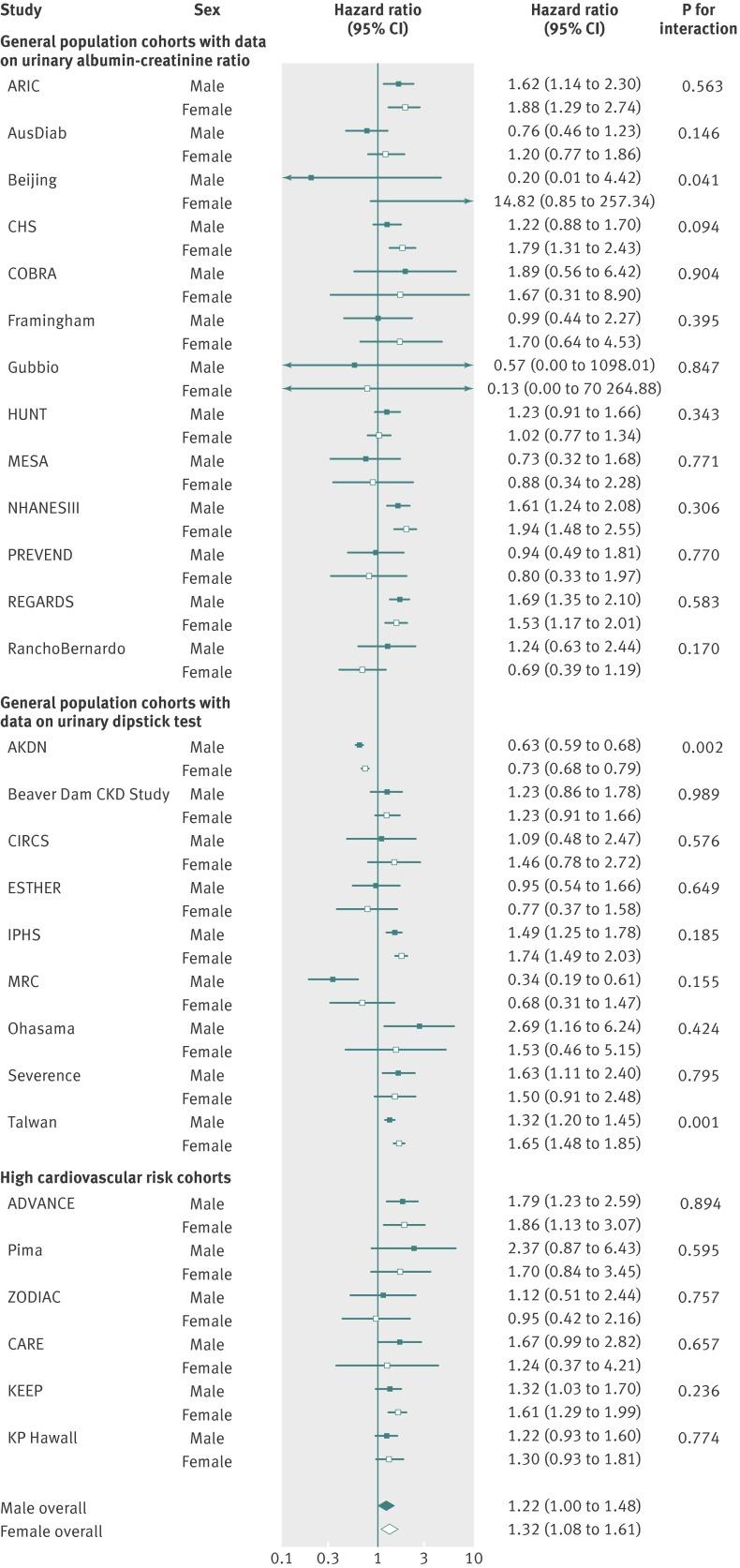
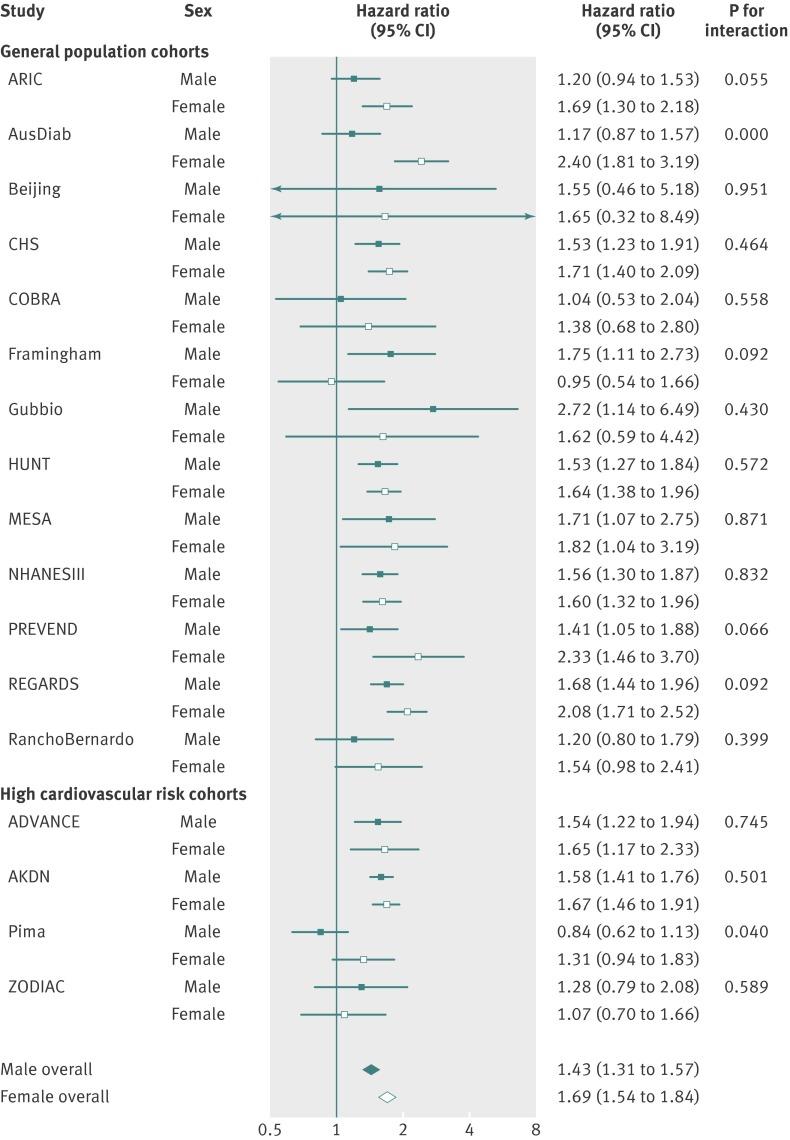
Risks of all-cause mortality and cardiovascular mortality were higher in men at all levels of estimated glomerular filtration rate and albumin-creatinine ratio. While higher risk was associated with lower estimated glomerular filtration rate and higher albumin-creatinine ratio in both sexes, the slope of the risk relationship for all-cause mortality and for cardiovascular mortality were steeper in women than in men. Compared with an estimated glomerular filtration rate of 95, the adjusted hazard ratio for all-cause mortality at estimated glomerular filtration rate 45 was 1.32 (95% CI 1.08 to 1.61) in women and 1.22 (1.00 to 1.48) in men (P(interaction)<0.01). Compared with a urinary albumin-creatinine ratio of 5, the adjusted hazard ratio for all-cause mortality at urinary albumin-creatinine ratio 30 was 1.69 (1.54 to 1.84) in women and 1.43 (1.31 to 1.57) in men (P(interaction)<0.01). Conversely, there was no evidence of a sex difference in associations of estimated glomerular filtration rate and urinary albumin-creatinine ratio with end stage renal disease risk.
CONCLUSIONS
Both sexes face increased risk of all-cause mortality, cardiovascular mortality, and end stage renal disease with lower estimated glomerular filtration rates and higher albuminuria. These findings were robust across a large global consortium.
目的
评估估算肾小球滤过率和白蛋白尿与全因死亡率、心血管死亡率和终末期肾病之间关联的性别交互作用。
设计
使用汇总个体参与者数据的随机效应荟萃分析。
设置
来自欧洲、北美和南美、亚洲和澳大拉西亚的 46 个队列。
参与者
来自一般人群队列(n=1,861,052)、高危队列(n=151,494)和慢性肾脏病队列(n=38,612)的 2,051,158 名参与者(54%为女性)。有资格的队列(除慢性肾脏病队列外)至少有 1000 名参与者,死亡率或终末期肾病的结局有≥50 个事件,并且根据慢性肾脏病流行病学合作研究组(mL/min/1.73 m(2))和尿白蛋白-肌酐比值(mg/g)基线测量估算肾小球滤过率。
结果
在所有估算肾小球滤过率和白蛋白-肌酐比值水平下,男性的全因死亡率和心血管死亡率风险均高于女性。虽然在两性中,较低的估算肾小球滤过率和较高的白蛋白-肌酐比值与更高的风险相关,但全因死亡率和心血管死亡率风险的风险关系斜率在女性中比男性更陡峭。与估算肾小球滤过率 95 相比,在女性中,估算肾小球滤过率 45 时全因死亡率的调整后危险比为 1.32(95%CI 1.08 至 1.61),而在男性中为 1.22(1.00 至 1.48)(P(交互)<0.01)。与尿白蛋白-肌酐比值 5 相比,在女性中,尿白蛋白-肌酐比值 30 时全因死亡率的调整后危险比为 1.69(1.54 至 1.84),而在男性中为 1.43(1.31 至 1.57)(P(交互)<0.01)。相反,在估算肾小球滤过率和尿白蛋白-肌酐比值与终末期肾病风险的关联中,没有证据表明存在性别差异。
结论
无论性别如何,估算肾小球滤过率降低和白蛋白尿增加都会导致全因死亡率、心血管死亡率和终末期肾病风险增加。这些发现是在一个大型全球联盟中得到的。
 Zotero 插件