
脊髓损伤后,肉豆蔻酸乙醇酰胺的抗炎和神经保护作用涉及 PPAR-δ 和 PPAR-γ,有分子证据支持。
Molecular evidence for the involvement of PPAR-δ and PPAR-γ in anti-inflammatory and neuroprotective activities of palmitoylethanolamide after spinal cord trauma.
机构信息
Department of Biological and Environmental Sciences, University of Messina, Viale Ferdinando Stagno D'Alcontres, Messina 31-98166, Italy.
出版信息
J Neuroinflammation. 2013 Feb 1;10:20. doi: 10.1186/1742-2094-10-20.
BACKGROUND
Palmitoylethanolamide (PEA) is an endogenous fatty acid amide displaying anti-inflammatory and analgesic actions. Moreover, several data have suggested that PEA reduced inflammation and tissue injury associated with spinal cord trauma and showed a regulatory role for peroxisome proliferator-activated receptor (PPAR)-α signaling in the neuroprotective effect of PEA. However, several other mechanisms could explain the anti-inflammatory and anti-hyperalgesic effects of PEA, including the activation of PPAR-δ and PPAR-γ. The aim of the present study was to carefully investigate the exact contribution of PPAR-δ and PPAR-γ in addition to PPAR-α, in the protective effect of PEA on secondary inflammatory damage associated with an experimental model of spinal cord injury (SCI).
METHODS
SCI was induced in mice through a spinal cord compression by the application of vascular clips (force of 24 g) to the dura via a four-level T5 to T8 laminectomy, and PEA (10 mg/kg, intraperitoneally, 1 and 6 hours after SCI) was injected into wildtype mice and into mice lacking PPAR-α (PPAR-αKO). To deepen the ability of specific PPAR-δ and PPAR-γ antagonists to reverse the effect of PEA, mice were administered GSK0660 or GW9662, 30 minutes before PEA injection.
RESULTS
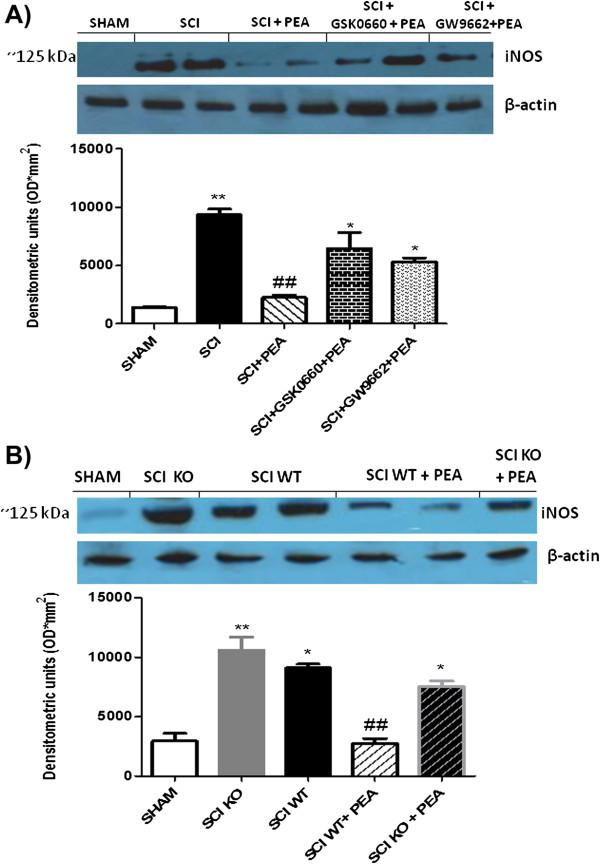
Genetic ablation of PPAR-α in mice exacerbated spinal cord damage, while PEA-induced neuroprotection seemed be abolished in PPARαKO mice. Twenty-four hours after spinal cord damage, immunohistological and biochemical studies were performed on spinal cord tissue. Our results indicate that PPAR-δ and PPAR-γ also mediated the protection induced by PEA. In particular, PEA was less effective in PPAR-αKO, GSK0660-treated or GW9662-pretreated mice, as evaluated by the degree of spinal cord inflammation and tissue injury, neutrophil infiltration, proinflammmatory cytokine, inducible nitric oxide synthase expression and motor function. PEA is also able to restore PPAR-δ and PPAR-γ expression in spinal cord tissue.
CONCLUSION
This study indicates that PPAR-δ and PPAR-γ can also contribute to the anti-inflammatory activity of PEA in SCI.
背景
棕榈酰乙醇酰胺(PEA)是一种内源性脂肪酸酰胺,具有抗炎和镇痛作用。此外,有几项数据表明,PEA 减轻了与脊髓创伤相关的炎症和组织损伤,并显示过氧化物酶体增殖物激活受体(PPAR)-α信号在 PEA 的神经保护作用中的调节作用。然而,其他几种机制可以解释 PEA 的抗炎和抗痛觉过敏作用,包括激活 PPAR-δ 和 PPAR-γ。本研究的目的是仔细研究除了 PPAR-α 之外,PPAR-δ 和 PPAR-γ 在 PEA 对与脊髓损伤(SCI)实验模型相关的继发性炎症损伤的保护作用中的确切贡献。
方法
通过在 T5 到 T8 椎板切除术的硬脑膜上应用血管夹(24 克的力)对小鼠进行脊髓压迫,诱导 SCI,并用 PEA(10 mg/kg,腹腔内,SCI 后 1 和 6 小时)注射到野生型小鼠和缺乏 PPAR-α 的小鼠(PPAR-αKO)中。为了深入了解特定的 PPAR-δ 和 PPAR-γ 拮抗剂逆转 PEA 作用的能力,在注射 PEA 前 30 分钟,小鼠给予 GSK0660 或 GW9662。
结果
在小鼠中遗传敲除 PPAR-α 加剧了脊髓损伤,而 PEA 诱导的神经保护作用似乎在 PPARαKO 小鼠中被消除。在脊髓损伤后 24 小时,对脊髓组织进行免疫组织化学和生化研究。我们的结果表明,PPAR-δ 和 PPAR-γ 也介导了 PEA 诱导的保护作用。特别是,PEA 在 PPAR-αKO、GSK0660 处理或 GW9662 预处理的小鼠中的作用效果较差,如通过脊髓炎症和组织损伤、中性粒细胞浸润、促炎细胞因子、诱导型一氧化氮合酶表达和运动功能来评估。PEA 还能够恢复脊髓组织中 PPAR-δ 和 PPAR-γ 的表达。
结论
本研究表明,PPAR-δ 和 PPAR-γ 也可以有助于 PEA 在 SCI 中的抗炎活性。



 Zotero 插件