
检测不纯和异质癌症样本中的体细胞点突变。
Sensitive detection of somatic point mutations in impure and heterogeneous cancer samples.
机构信息
The Broad Institute of Harvard and MIT, Cambridge, Massachusetts, USA.
出版信息
Nat Biotechnol. 2013 Mar;31(3):213-9. doi: 10.1038/nbt.2514. Epub 2013 Feb 10.
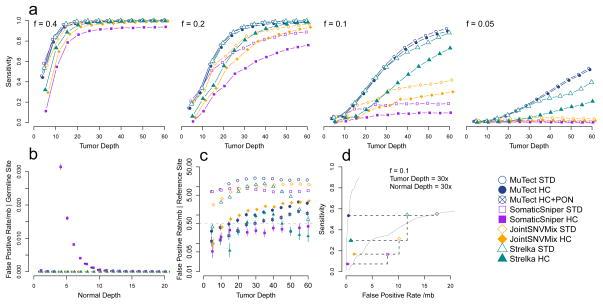
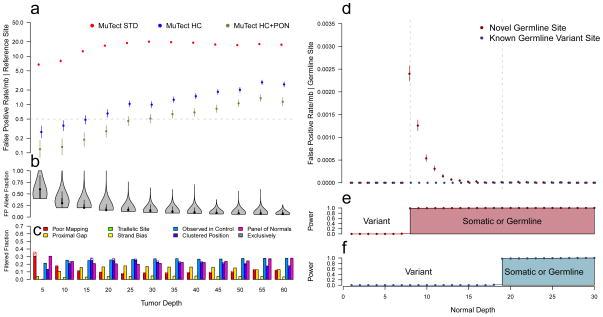
Detection of somatic point substitutions is a key step in characterizing the cancer genome. However, existing methods typically miss low-allelic-fraction mutations that occur in only a subset of the sequenced cells owing to either tumor heterogeneity or contamination by normal cells. Here we present MuTect, a method that applies a Bayesian classifier to detect somatic mutations with very low allele fractions, requiring only a few supporting reads, followed by carefully tuned filters that ensure high specificity. We also describe benchmarking approaches that use real, rather than simulated, sequencing data to evaluate the sensitivity and specificity as a function of sequencing depth, base quality and allelic fraction. Compared with other methods, MuTect has higher sensitivity with similar specificity, especially for mutations with allelic fractions as low as 0.1 and below, making MuTect particularly useful for studying cancer subclones and their evolution in standard exome and genome sequencing data.
体细胞点突变的检测是描述癌症基因组的关键步骤。然而,由于肿瘤异质性或正常细胞污染,现有方法通常会错过仅在部分测序细胞中出现的低等位基因分数突变。在这里,我们提出了 MuTect 方法,该方法应用贝叶斯分类器来检测具有非常低等位基因分数的体细胞突变,仅需要几个支持的读数,然后是经过精心调整的滤波器,以确保高特异性。我们还描述了基准测试方法,这些方法使用真实的而不是模拟的测序数据来评估灵敏度和特异性作为测序深度、碱基质量和等位基因分数的函数。与其他方法相比,MuTect 具有更高的灵敏度和相似的特异性,尤其是对于等位基因分数低至 0.1 及以下的突变,这使得 MuTect 特别适用于研究癌症亚克隆及其在标准外显子和基因组测序数据中的进化。


 Zotero 插件